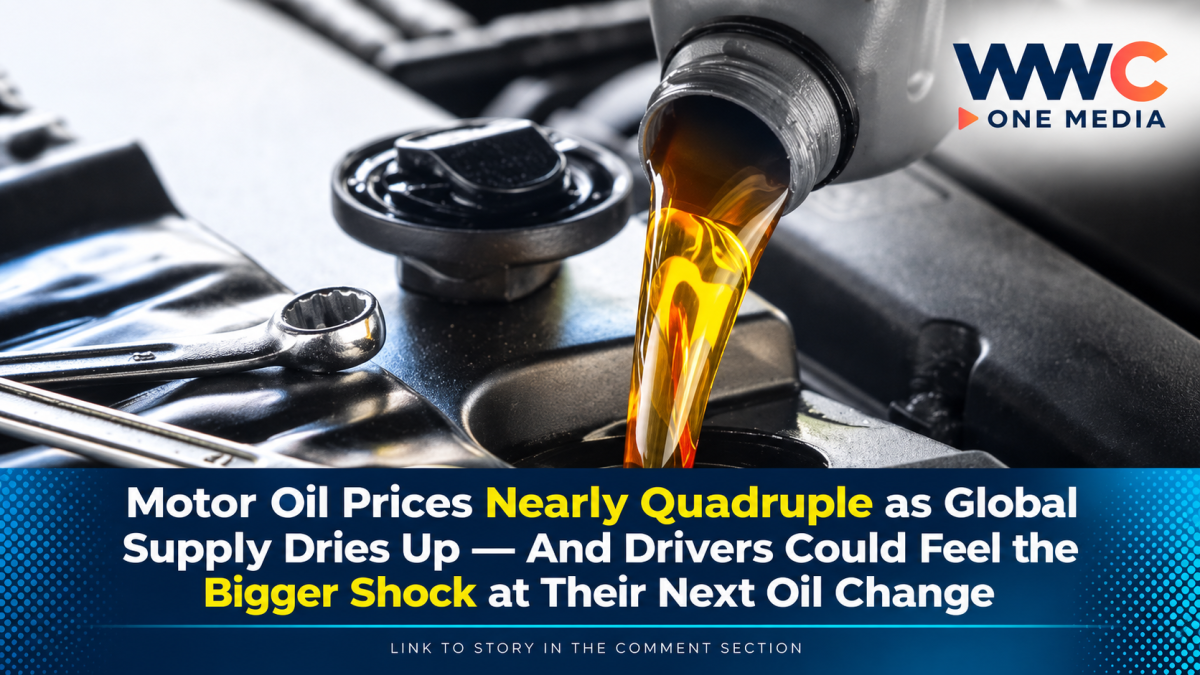
A new supply squeeze is hitting an unexpected part of the automotive market: motor oil.
While gasoline and diesel prices have attracted most of the attention from the energy crisis, a shortage of specialized base oils used to manufacture modern synthetic lubricants is now pushing motor-oil prices sharply higher, forcing some retailers to limit purchases and leaving repair shops scrambling for supplies.
The latest warning comes as the price of Group III base oil — a critical ingredient in many full-synthetic motor oils — has almost quadrupled since February to about $12.45 per gallon, according to Argus Media data cited by the Financial Times.
The squeeze is already visible at US retailers.
Costco has raised the price of a 10-quart package of Kirkland Signature full-synthetic motor oil to $57.99, compared with roughly $30 last year, and has imposed purchase limits. AP separately confirmed the price increase and rationing, while USA Today reported the same $57.99 price for the two-pack of five-quart bottles.
But the Costco price tag is only the visible part of a much larger supply-chain problem.
The Real Bottleneck Is Not Crude Oil
The unusual feature of this crisis is that the shortage is not simply about a lack of crude oil.
Motor oil begins with base oil, which is then combined with additives and other components to create lubricants capable of protecting modern engines.
For newer vehicles, manufacturers increasingly specify highly engineered synthetic lubricants, including low-viscosity grades designed to improve engine efficiency and fuel economy.
That makes certain specialized base oils particularly important.
Group III base oil is among the most important categories for these formulations, and the United States relies heavily on overseas supplies.
Industry analysts previously warned that roughly 44% of US Group III supply comes from the Middle East, while South Korea accounts for another significant source — creating a vulnerability when both Gulf production and Asian feedstock flows are disrupted.
That dependence has suddenly become a major problem.
The Middle East Conflict Triggered the Supply Shock
The current squeeze traces back to disruptions caused by the conflict involving Iran and its regional energy infrastructure.
A major blow came in March, when an Iranian strike damaged Shell’s Pearl gas-to-liquids facility in Qatar, a major source of Group III base oils.
The situation was compounded by disruption in the Strait of Hormuz, a crucial shipping corridor for Middle Eastern crude.
That matters because the world’s base-oil supply chain is interconnected.
Even when a particular base-oil plant is not directly damaged, difficulty moving crude and refined products through the Gulf can disrupt the feedstock available to producers elsewhere.
South Korean producers are particularly important to the global lubricant market, but their refineries also depend heavily on Middle Eastern crude.
As a result, the supply chain has effectively been hit from multiple directions.
Costco Is Becoming the Warning Sign Consumers Can See
Costco’s decision to restrict motor-oil purchases has turned the otherwise obscure base-oil problem into a mainstream consumer issue.
The retailer’s Kirkland Signature full-synthetic motor oil has risen to $57.99 for a 10-quart package, while purchase restrictions have been imposed on some products. AP reported that Costco has also limited purchases of Mobil 1 motor oil.
USA Today reported that the Kirkland product had sold for around $35.99 in December 2025, meaning consumers are now paying substantially more than they did less than a year ago.
The price increase is particularly noticeable because Costco has built its reputation around low-cost private-label products.
But the retailer is not the only place experiencing pressure.
The Financial Times reported that Walmart’s website was showing low stocks for several motor-oil brands, while Jiffy Lube warned of intermittent shortages.
That suggests the problem is moving beyond an isolated retail pricing decision.
Repair Shops Are Starting to Feel the Pressure
Independent garages are especially vulnerable because they generally do not have the purchasing power or long-term contracts enjoyed by major lubricant companies and national service chains.
The Financial Times reported that some independent shops are struggling to obtain bulk supplies of full-synthetic oil, with availability described as unpredictable.
The problem becomes even more complicated when a mechanic needs a specific manufacturer-approved formulation.
For example, some newer vehicles require oils meeting precise specifications such as GM’s Dexos standard.
A shop cannot simply replace the recommended lubricant with whatever oil happens to be available.
The replacement has to meet the required performance specifications.
That is one reason why a shortage of one particular base-oil category can create problems even when other types of lubricants remain readily available.
Why Manufacturers Cannot Simply Switch Overnight
At first glance, the solution seems straightforward: use another base oil.
In reality, changing a modern synthetic lubricant formulation can be complicated.
Automakers specify precise performance characteristics for engine oils, while lubricant manufacturers must conduct testing and obtain the appropriate approvals.
The American Petroleum Institute has responded by invoking emergency provisional licensing to give lubricant manufacturers more flexibility in using alternative base-oil supplies.
But industry experts say switching formulations is not instantaneous.
A lubricant that works under one formulation may require extensive testing before it can be marketed as meeting a particular vehicle manufacturer’s specification.
That creates a bottleneck even when alternative feedstocks technically exist.
Big Oil Companies Have More Protection
Not every oil-change chain is experiencing the same level of disruption.
Valvoline, for example, said its nearly 2,500 locations had not experienced the same shortages reported by some independent operators.
The company sources much of its motor oil from Saudi Aramco and has instead absorbed higher lubricant costs through higher service prices.
Valvoline has raised the price of an oil change by approximately $5 to $7, according to the Financial Times.
That illustrates another important feature of the crisis.
Large companies with established supplier relationships can have greater protection against immediate shortages.
Smaller distributors, independent garages and blenders purchasing on the spot market have fewer options.
The Shortage Could Last Months
The industry’s biggest concern is that this will not disappear immediately even if geopolitical tensions ease.
Valvoline CEO Lori Flees told a Goldman Sachs retail conference that it could take four to six months after the Strait of Hormuz is fully reopened for Group III base-oil flows to return to their previous pattern.
That means the disruption could continue well after the immediate energy crisis begins to fade.
The supply chain needs time to normalize.
Refineries have to restore production, tankers have to resume regular routes, inventories have to be rebuilt and lubricant manufacturers need to replenish their stocks.
In other words, reopening a shipping route does not immediately refill every motor-oil shelf.
Europe Is Already Looking for Alternatives
The shortage is also changing how lubricant manufacturers think about supply.
ICIS reported that European lubricant producers are increasingly turning toward re-refined base oils, made from used lubricants, as supplies of virgin Group III base oils remain constrained.
Under normal market conditions, companies may take years to change formulations or increase the proportion of recycled base oils they use.
The current supply shock is accelerating that process.
For the industry, that could eventually create a more diversified supply chain.
But in the short term, it highlights just how difficult it is to replace high-quality base oils at scale.
Why This Matters to Ordinary Drivers
For most drivers, the first sign of the crisis may not be an empty shelf.
It could simply be a higher bill.
An oil change that previously cost a certain amount could become more expensive as shops pass higher lubricant costs to customers.
Some drivers may also encounter fewer choices, temporary shortages of specific viscosities or longer waits for certain manufacturer-approved oils.
Axios reported earlier in 2026 that industry executives were already warning of higher prices and sporadic shortages of synthetic motor oils, particularly for lighter grades such as 0W-8, 0W-16 and certain 0W-20 formulations used in newer vehicles.
That does not mean every car will suddenly be affected.
Older vehicles may use conventional or different synthetic formulations that are less exposed to the particular Group III bottleneck.
But newer engines can be more dependent on specialized lubricants.
This Is Not Another Gasoline Shortage
There is an important distinction between the motor-oil crisis and the gasoline shortages experienced during previous energy shocks.
The United States is not running out of all petroleum products.
Instead, the vulnerability lies in a specific, highly specialized segment of the lubricant supply chain.
Global lubricant base-oil exports are tiny compared with the overall crude-oil market, with the Financial Times estimating typical exports at roughly 350,000 barrels per day compared with more than 100 million barrels per day of global oil consumption.
That small market size makes disruptions disproportionately powerful.
When supply is tight, there are fewer alternative sources capable of immediately replacing lost production.
The Bigger Risk Extends Beyond Cars
Base oils are not used exclusively in passenger vehicles.
They are also essential for industrial lubricants and machinery.
That means a prolonged shortage could affect manufacturing, agriculture, transportation equipment and other industries that depend on lubricants to keep machinery operating.
The impact could therefore extend beyond the price of an oil change.
The longer the disruption continues, the more important alternative supplies and recycled lubricants could become.
The Next Shock Could Be Hidden Under the Hood
The global energy crisis has already changed what consumers pay for gasoline, diesel and electricity.
Now another cost is emerging in a place few drivers were watching.
Motor oil.
The combination of damaged Middle Eastern production, shipping disruptions, dependence on specialized Group III base oils and strict automotive specifications has created a supply chain that cannot be repaired overnight.
For drivers, that could mean higher oil-change bills and fewer choices.
For repair shops, it could mean another difficult operating environment.
And for lubricant manufacturers, it is forcing a rapid search for alternative feedstocks and formulations.
The real warning may therefore not be the $57.99 price tag at Costco.
It is what happens if the world’s lubricant supply chain remains constrained for months.
Because every gasoline-powered engine still needs one thing that rarely gets noticed until it becomes expensive:
oil.motor oil shortage, engine oil shortage, lubricant supply chain, base oil prices, automotive oil crisis 2026