
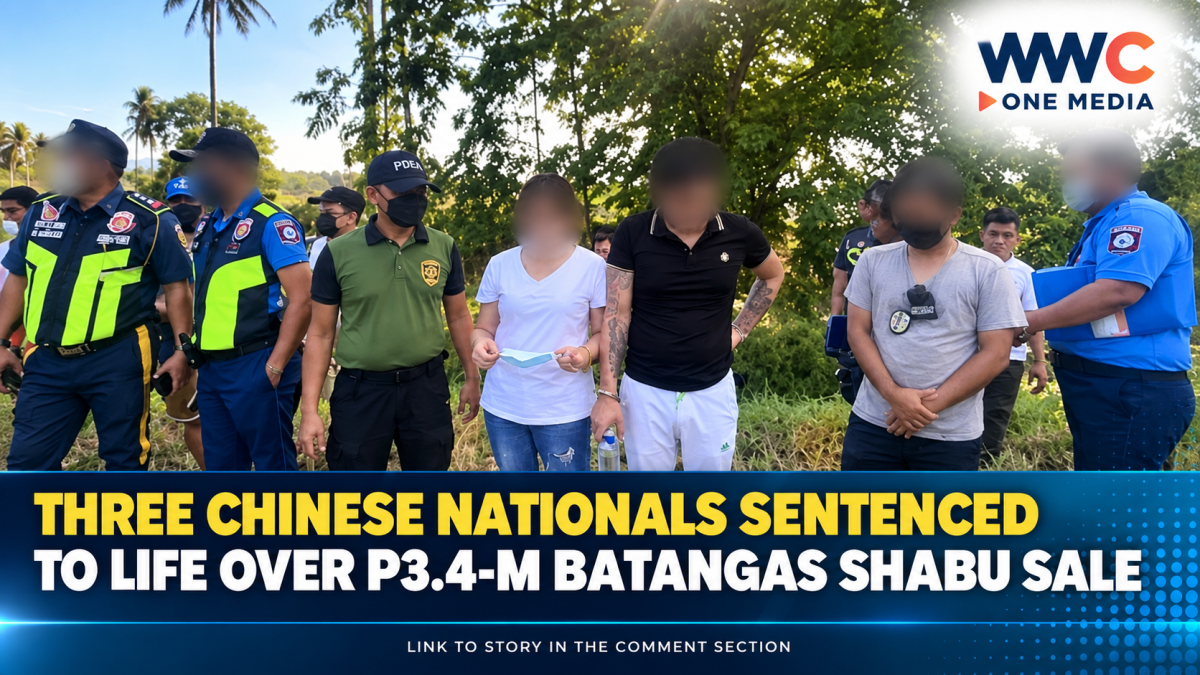
BATANGAS, Philippines — A drug case that began with a buy-bust operation and a nearly two-hour pursuit in 2024 has ended with three Chinese nationals receiving life imprisonment after a Batangas court found them guilty of selling more than half a kilogram of shabu.
The Tanauan City Regional Trial Court Branch 83 found A Ming, Yan Xing Xue and Ko Xiao Ya guilty beyond reasonable doubt of violating Republic Act 9165, or the Comprehensive Dangerous Drugs Act of 2002.
The court ordered each defendant to serve life imprisonment and pay a ₱500,000 fine.
The decision, dated Aug. 17, 2026, was contained in a 35-page ruling that was made public by the Philippine Drug Enforcement Agency (PDEA) on Sept. 5.
The case involved 502.6 grams of methamphetamine hydrochloride, commonly known as shabu, valued at ₱3,417,680.
The operation that started it all
The convictions stemmed from a PDEA Regional Office IV-A buy-bust operation on May 2, 2024, in a subdivision in Barangay Santiago, Malvar, Batangas.
Authorities said the three defendants sold the drugs to a police poseur-buyer during the operation.
But the encounter quickly escalated.
According to reports, the suspects realized they were dealing with an anti-narcotics operative and allegedly drew firearms before fleeing in their vehicle.
Police pursued them from the area.
The chase eventually ended along the southbound lane of the Southern Tagalog Arterial Road (STAR) Tollway in Barangay San Andres, Malvar, where authorities apprehended the three after an exchange of fire.
What began as an undercover drug transaction had turned into a high-speed pursuit — and ultimately became a case that remained in the courts for more than two years.
Court delivers life sentences
The court’s Aug. 17 decision found the three guilty of the drug-sale offense.
Each was sentenced to life imprisonment and ordered to pay ₱500,000.
The quantity involved — more than 500 grams — placed the case among the more serious offenses covered by the country’s comprehensive dangerous-drugs law.
The defendants were identified in reports as:
- A Ming, also known as “Koi” or “Xia Ting Ming”
- Yan Xing Xue, also known as “Xue Yan Xing”
- Ko Xiao Ya, also known as “Yu Ali”
One defendant faces an additional rehabilitation order
The case did not end with the trafficking conviction for Ko Xiao Ya.
She was also found guilty in a separate case involving drug use and was ordered to undergo six months of rehabilitation at a government facility, according to PDEA-related reports.
That means Ko faces consequences beyond the life sentence imposed in the drug-sale case.
PDEA: Arrest is only the beginning
PDEA Director General Isagani R. Nerez said the conviction demonstrates that a drug enforcement operation does not end when suspects are arrested.
The agency emphasized that the case continued through investigation, prosecution and judicial proceedings before reaching the conviction.
Nerez said the outcome should reassure the public that cases arising from lawful operations can ultimately result in accountability in court.
The agency also credited the courts and the Department of Justice for the successful prosecution of the case.
The bigger picture: drug enforcement remains active
The Batangas conviction comes as Philippine authorities continue intensive anti-drug operations across the country.
In Negros Oriental, for example, police reported that nearly ₱23 million worth of suspected shabu had been seized during the first half of 2026, with 290 anti-drug operations resulting in 301 arrests. Authorities reported confiscating more than 3.2 kilograms of suspected shabu during that period.
The figures illustrate that the Batangas case is part of a much wider national campaign against illegal drugs.
But unlike a seizure or arrest announcement, the latest development in this case is a court conviction.
That distinction matters.
An arrest represents an allegation and the beginning of legal proceedings. A conviction means a court has determined the accused were guilty beyond reasonable doubt.
From a buy-bust to a final court ruling
The timeline of the case is striking:
May 2, 2024: PDEA conducts the buy-bust operation in Malvar.
May 2, 2024: The suspects allegedly flee after the transaction, triggering a pursuit that ends at STAR Tollway.
Aug. 17, 2026: Tanauan City RTC Branch 83 issues its 35-page decision.
Sept. 5, 2026: PDEA makes the conviction public.
Sept. 6, 2026: The case receives wider national attention following reports of the ruling.
More than two years separated the arrest from the court decision.
That delay also illustrates the reality of criminal prosecution: an operation can last minutes, but the legal process can take years.
Why the case is drawing attention
The case combines several elements that make it significant beyond the amount of drugs involved: foreign nationals, a substantial quantity of shabu, a buy-bust operation, an alleged armed escape, a highway pursuit and, ultimately, a life sentence.
But the most important development is the judicial outcome.
Authorities did not simply announce another drug arrest.
This time, the case reached the courtroom and resulted in convictions.
And according to PDEA, that is precisely the message it wants the public to take away.
The case now moves into its next phase
The life sentences mark a major milestone in the case, but they also underscore a broader challenge for Philippine law enforcement: ensuring that drug cases are built on lawful operations, properly handled evidence and prosecutions that can withstand judicial scrutiny.
The Batangas case began with a covert transaction.
It escalated into a dramatic pursuit.
More than two years later, it ended with three life sentences.
For investigators, the message is clear: the arrest may make the headlines — but it is the evidence, prosecution and court ruling that ultimately determine how the story ends.



Leave a Reply