
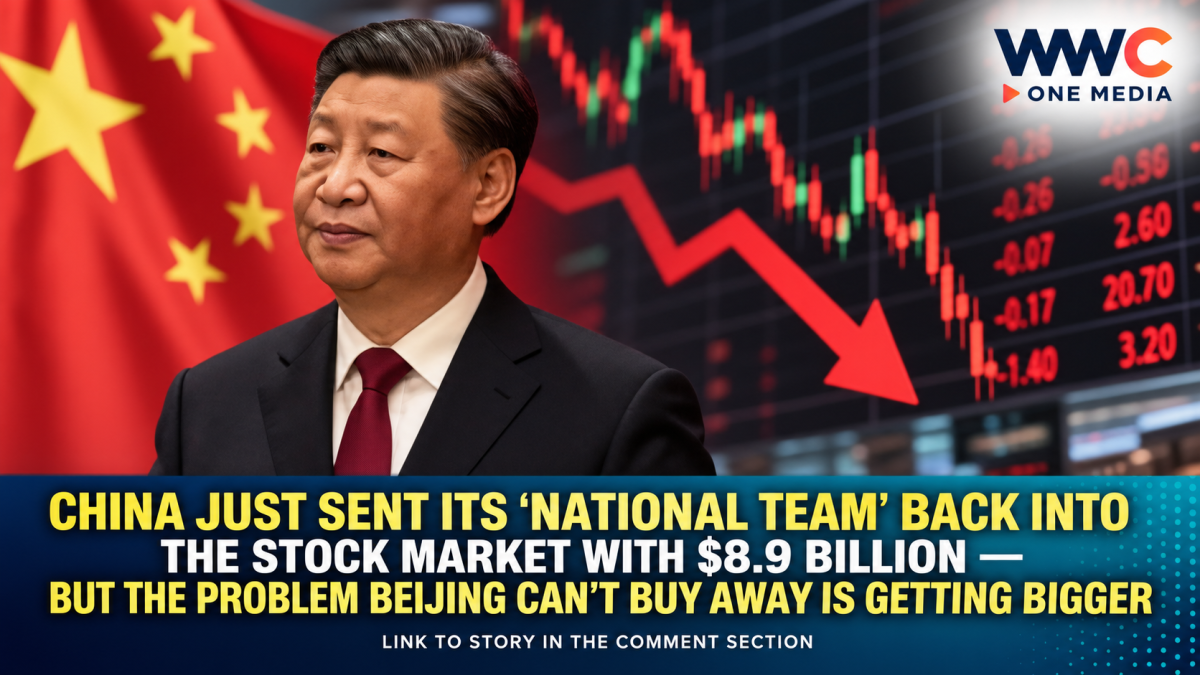
BEIJING — China has once again reached for one of its most powerful tools for calming a falling stock market: state money.
After a brutal technology-led selloff erased roughly 10 trillion yuan, or about $1.48 trillion, from mainland Chinese market value in two weeks, two major state-owned investment groups disclosed that they had deployed around 60 billion yuan — approximately $8.9 billion — into Chinese shares.
The intervention helped stabilize markets temporarily.
But it also exposed a much harder question for Beijing: Can government-backed buying rescue investor confidence when the problem is no longer simply panic, but increasingly expensive technology valuations colliding with a slowing economy?
China’s ‘National Team’ Is Back
The phrase “national team” is market shorthand for the collection of state-controlled investment institutions that Beijing has previously mobilized during major stock-market disruptions.
This time, China Reform Holdings said it had spent about 50 billion yuan buying shares, while China Chengtong Holdings Group reported purchases approaching 10 billion yuan.
China Reform said it intended to continue increasing equity holdings and supporting technological innovation and high-quality development among state-owned companies. China Chengtong similarly pledged additional action aimed at market stability.
The intervention was accompanied by a regulatory response.
China Securities Regulatory Commission Chairman Wu Qing met investors on July 20 as the watchdog sought proposals for stabilizing the market. Regulators also planned discussions with securities firms, fund managers and listed companies.
Caixin reported that the two state-controlled capital operators had together deployed roughly 60 billion yuan into domestic equities and exchange-traded funds, while large ETFs historically associated with state intervention were also experiencing substantial inflows.
That combination — government-linked buying, regulatory meetings and corporate buybacks — sent an unmistakable signal.
Beijing did not want the selloff to spiral.
What Triggered the Rout?
The market’s trouble was particularly severe in technology.
Shanghai’s technology-heavy STAR Market plunged roughly 25% from its July 1 peak, according to Reuters. Chinese shares overall lost more than 5% during one particularly difficult week.
Several forces hit simultaneously.
A worldwide semiconductor selloff had already shaken enthusiasm for the artificial-intelligence trade. Investors were reconsidering whether the enormous amount of money being poured into chips, data centers and AI infrastructure could generate profits quickly enough to justify increasingly aggressive valuations.
China then contributed another unexpected shock.
On July 17, Beijing-based Moonshot AI unveiled Kimi K3, a 2.8-trillion-parameter open-weight AI model. Moonshot said the system could compete with leading American frontier models in some tasks, while independent evaluations also showed strong performance.
The release carried echoes of the earlier “DeepSeek moment.”
If increasingly capable Chinese AI systems can be developed or operated more cheaply, investors must reconsider assumptions about how much expensive computing infrastructure will ultimately be needed — and how much profit semiconductor and AI infrastructure companies can extract from that spending.
Global technology stocks were already under pressure. Reuters reported that the Philadelphia Semiconductor Index had fallen 20% from its June peak by July 17, while Asian technology markets suffered sharp declines.
Moonshot itself experienced the opposite problem: demand became so intense that it temporarily paused new Kimi subscriptions because requests were pushing its computing clusters toward capacity limits.
That contrast captures the strange state of the AI market.
Demand for AI can be extremely strong while investors simultaneously question whether AI-related stocks have become too expensive.
China’s Tech Boom Has Changed the Entire Market
This matters more than it would have a few years ago because technology now occupies a much larger share of China’s equity market.
By early July, technology companies represented roughly 27% of the CSI 300 Index, twice their weighting a year earlier, according to the South China Morning Post.
AI infrastructure companies including Zhongji Innolight and Eoptolink Technology had climbed near the top of the benchmark, displacing traditional market leaders such as liquor giant Kweichow Moutai.
The change reflects Beijing’s broader industrial strategy.
Semiconductors, AI, batteries, electric vehicles and advanced manufacturing have become central to China’s attempt to move beyond property-driven growth and compete directly with the United States in strategically important technologies.
But that success has created another vulnerability.
If technology dominates the market, a tech correction increasingly becomes a China-market correction.
And Valuations Were Already Stretched
That is where Beijing’s rescue becomes complicated.
Reuters Breakingviews calculated that companies on Shanghai’s main board were trading at an average of about 13 times 2025 earnings around the time of the intervention.
Companies on the more technology-focused STAR Market, by contrast, were trading around 86 times earnings — even after a sharp decline — and fewer than half had paid dividends in the previous year.
Some individual semiconductor valuations were considerably more extreme.
Asia Times subsequently reported estimates suggesting China’s largest listed semiconductor companies collectively carried valuations far above the profits analysts expected them to generate, with some shares previously trading at price-to-earnings multiples above 200.
This creates a dilemma for China’s state investors.
Buying inexpensive blue-chip companies during a panic can eventually produce strong returns.
Buying high-growth technology companies at exceptionally high valuations is different.
Government-backed funds may prevent forced selling from becoming a systemic crisis, but they cannot guarantee that corporate profits will eventually justify the prices investors paid.
The Rescue Worked — But Only Up to a Point
The first intervention helped stop the immediate slide.
The Financial Times reported that the CSI 300 subsequently rose around 1.5%, while Hong Kong’s Hang Seng Index gained roughly 2.4% as state support helped restore confidence.
But the relief did not eliminate the weakness underneath the market.
Within days, several Chinese semiconductor stocks were falling heavily again. Asia Times reported that Hua Hong Semiconductor dropped more than 12% in one session, while other chip-related companies suffered steep losses.
And subsequent July data showed just how dramatically sentiment had deteriorated.
The CSI 300 eventually lost about 13% during July, while the Shanghai Composite fell roughly 5%, according to South China Morning Post reporting based on market data. New A-share account openings fell 7% from June, while newly opened margin-trading accounts dropped more than 22%.
That suggests Beijing’s national team could provide a floor under panic.
It could not instantly restore investors’ appetite for risk.
Behind the Stock Market Is a Much Bigger Economic Problem
The technology correction also landed at an awkward time for China’s economy.
Economic growth slowed to 4.3% year over year in the second quarter of 2026, down from 5% in the first quarter. China’s property downturn remained a drag on household wealth and consumption, while new-home prices were still falling from a year earlier.
Domestic demand has remained one of Beijing’s most persistent weaknesses.
Exports and advanced manufacturing continue to provide important growth, but households remain cautious after years of falling property values and economic uncertainty.
The employment picture adds another layer.
Official data released after the July market intervention showed unemployment among urban Chinese aged 16 to 24, excluding students, jumped from 14.9% in June to 17.9% in July, the highest level in 11 months.
That is why the equity-market rescue is about more than protecting stock prices.
Chinese policymakers are simultaneously trying to support technology investment, stabilize property markets, revive consumption, create enough jobs for millions of graduates and prevent financial-market volatility from undermining confidence.
Those objectives do not always point in the same direction.
Beijing’s New Dilemma: Stop the Crash Without Creating the Next Bubble
China has intervened in its stock market before.
The immediate logic is straightforward: when investors begin selling indiscriminately, a state buyer with effectively enormous resources can break the cycle of fear.
But intervention changes investor behavior.
If traders believe Beijing will repeatedly rescue politically favored technology companies whenever prices fall sharply, they may become more willing to speculate aggressively in those same shares.
Reuters Breakingviews warned that heavy government buying could unintentionally encourage investors to chase favored AI and semiconductor stocks, potentially pushing valuations further away from fundamentals.
That is the contradiction at the heart of China’s latest rescue.
Beijing wants vibrant capital markets capable of financing its technological ambitions.
It also wants stability.
And increasingly, it wants state investment vehicles to generate sensible financial returns rather than endlessly absorb market losses.
Achieving all three simultaneously becomes much harder when stocks are trading at extraordinary valuations.
The Real Test Comes After the Rescue
China’s technology story remains formidable.
Moonshot’s Kimi K3 demonstrated that Chinese AI developers continue closing the capability gap with some Western competitors. Semiconductor investment remains a national priority, and technology has become the dominant force within China’s major equity benchmarks.
There are also signs that long-term state capital has continued moving toward technology.
By August, China’s National Social Security Fund had increased its exposure to onshore equities, with semiconductors, electronics and components accounting for nearly 59% of the portfolio holdings identified in available market data.
But that does not remove the central question raised by July’s intervention.
China can deploy billions to stop investors from fleeing. It cannot buy its way out of every structural weakness indefinitely.
Property stress, subdued household demand, employment pressure and lofty technology valuations will ultimately matter more to China’s markets than a single week of government purchases.
The national team has once again shown that Beijing can change the direction of the market.
What it has not yet proved is whether it can change the fundamentals underneath it.
WWC ONE MEDIA M.J.E




Leave a Reply