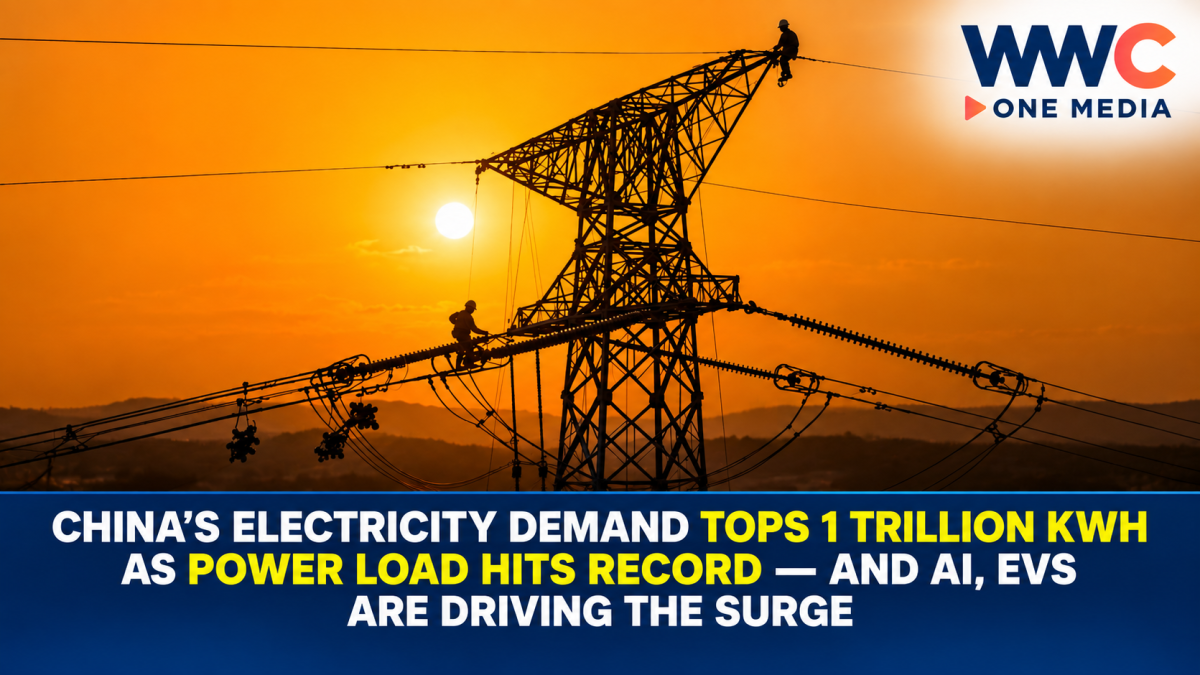
China’s electricity demand has crossed another extraordinary threshold.
The country consumed 1.0332 trillion kilowatt-hours of electricity in August, exceeding 1 trillion kWh for the second consecutive month, according to data released by China’s National Energy Administration.
But the headline number isn’t the only surprise.
China’s maximum power load reached a record 1.56 billion kilowatts, around 49.69 million kW higher than the previous year’s maximum. The national power load exceeded last year’s peak for seven days during August.
The figures offer a revealing snapshot of how rapidly electricity demand is changing across the world’s second-largest economy — with traditional manufacturing still consuming enormous amounts of power while newer industries such as electric vehicles, battery swapping and data centers are expanding at much faster rates.
A trillion-kWh month becomes the new normal
China’s August electricity consumption increased 1.7% from a year earlier.
The increase may look modest compared with some of the country’s fastest-growing industries, but the absolute scale is enormous.
China had already recorded monthly electricity consumption above 1 trillion kWh in July, when demand reached approximately 1.04 trillion kWh.
For the first eight months of 2026, total social electricity consumption reached 7.173 trillion kWh, an increase of 4.3% from the same period last year.
That makes electricity demand an important indicator of activity across China’s industrial and services economy.
And underneath the overall number, a major transformation is taking place.
High-tech manufacturing is consuming power at a much faster pace
Electricity use in China’s high-tech and equipment manufacturing industries jumped 7.2% in August, reaching 122.2 billion kWh.
Several individual industries posted even faster growth.
Electricity consumption by computer and communications-equipment manufacturing increased 7.5%, while automobile manufacturing rose 7.6%.
General equipment manufacturing climbed 7.6%, specialized equipment manufacturing rose 8.2%, and electrical machinery consumption jumped 12.3%.
The numbers illustrate a broader shift in China’s electricity-intensive economy.
Factories producing advanced equipment, electronics, electric vehicles and other technology-related products are becoming increasingly important sources of electricity demand.
EV charging is exploding
One of the most striking numbers came from China’s electric-vehicle ecosystem.
Electricity consumption by EV charging and battery-swapping services surged 51.2% in August, reaching 17.2 billion kWh.
For the first eight months of the year, electricity consumption in the charging and battery-swapping sector increased 55.1% year over year.
That reflects the rapidly expanding electrification of China’s transport system.
The country’s enormous EV fleet requires a corresponding expansion of charging infrastructure, grid capacity and electricity generation.
And that creates a feedback loop:
More electric vehicles → more charging demand → more electricity infrastructure → greater pressure on the grid.
Data centers are becoming another major electricity consumer
Another sector is growing almost as quickly.
China’s internet data-service electricity consumption increased 37.9% in August, reaching 10.2 billion kWh.
During the first eight months, electricity consumption from internet data services climbed 42.5%.
That growth is increasingly relevant as China expands artificial intelligence, cloud computing and digital infrastructure.
Large-scale data centers require electricity not only to operate servers but also to cool them and maintain uninterrupted service.
China Daily has separately highlighted the growing electricity requirements of large AI models and digital infrastructure, noting that the expansion of AI is increasing demand for power-intensive computing.
The implication is significant:
China’s next wave of electricity demand may increasingly come from machines processing information rather than simply factories producing physical goods.
Industry remains the biggest electricity consumer
Despite the rapid growth of newer sectors, traditional industry still dominates China’s electricity consumption.
The secondary sector used 612.4 billion kWh in August, up 2.4% from a year earlier.
Industrial electricity consumption alone reached 606.5 billion kWh, an increase of 2.7%.
That means manufacturing and industry remain the backbone of China’s electricity system.
But the composition of that industrial demand is changing.
High-tech and equipment manufacturing is expanding more rapidly than many traditional segments, reinforcing Beijing’s push toward advanced manufacturing, electrification and technology-intensive production.
Services are growing even faster
China’s services sector also continued to increase electricity consumption.
Third-industry electricity use reached 215.5 billion kWh in August, up 5.1% year over year.
That growth was significantly faster than total national electricity demand.
Within the services sector, charging infrastructure and internet data services were among the fastest-growing categories.
For the first eight months, third-industry electricity consumption increased 7.1%, compared with 4.4% for the secondary sector.
That provides another indication that China’s electricity economy is gradually shifting toward services and digital infrastructure alongside its enormous manufacturing base.
Household electricity use actually fell
One of the most surprising details is that Chinese households used less electricity in August than a year earlier.
Residential electricity consumption fell 4% year over year to 188.3 billion kWh.
That decline does not necessarily mean households suddenly became more energy efficient.
China’s National Energy Administration attributed much of the reduction to more typhoons and heavier rainfall in August, which resulted in lower temperatures in some regions and reduced air-conditioning demand.
That weather effect helped offset stronger electricity consumption from industrial and commercial users.
The grid is facing a very different kind of demand
China’s record power load also highlights the challenge of managing electricity supply across an enormous country.
In early August, a heatwave had already pushed electricity loads across several northern, northeastern and eastern regional grids to record levels, prompting State Grid to optimize operations and prepare cross-regional power transmission.
The record 1.56 billion-kW national peak in August demonstrates just how large the system has become.
China therefore needs not only more generation but also more transmission capacity, storage, flexible generation and smarter grid management to move electricity to where it is needed at the right time.
More demand doesn’t automatically mean more coal
The latest electricity figures also arrive alongside an important change in China’s power-generation mix.
Data reported from China’s National Bureau of Statistics showed that fossil-fuel power generation fell 4.3% in August, while hydropower, nuclear, wind and solar generation increased.
Coal and gas generation fell about 4% in August, according to analysis cited by the Centre for Research on Energy and Clean Air.
At the same time, solar generation increased 10.3% and wind generation rose 7.9%, while hydropower generation climbed 2.8%. Nuclear generation rose 9.4%.
That creates a crucial distinction.
China’s electricity demand is rising, but not every additional kilowatt-hour is necessarily being supplied by fossil fuels.
The country’s enormous expansion of renewable and nuclear capacity is increasingly helping meet incremental demand.
But coal remains important
The transition should not be misunderstood as the disappearance of coal from China’s power system.
Reuters reported earlier this year that China’s coal-fired electricity generation was expected to rebound in 2026 after its first annual decline in a decade, with analysts citing weather, hydropower conditions and other factors.
Coal remains a major source of electricity-system flexibility and reliability, particularly when renewable generation fluctuates.
That means China’s energy transition is occurring alongside continued reliance on conventional power sources.
Electricity is becoming a strategic economic indicator
The latest data reveal something bigger than a record monthly electricity bill.
China’s electricity system is increasingly reflecting the country’s transition toward:
- Electric vehicles
- Battery infrastructure
- Data centers
- Artificial intelligence
- Advanced manufacturing
- Electrified industrial processes
- Renewable energy
At the same time, traditional factories and heavy industry continue to consume enormous amounts of power.
This creates a difficult balancing act for China’s energy planners.
The country needs to accommodate rapidly growing electricity-intensive industries while ensuring that the grid remains reliable during periods of extreme weather and demand spikes.
The number to watch is no longer just total consumption
The 1.0332 trillion kWh August figure is impressive.
But arguably more revealing are the growth rates underneath it.
EV charging: +51.2%
Internet data services: +37.9%
High-tech and equipment manufacturing: +7.2%
Third-sector electricity consumption: +5.1%
Total electricity consumption: +1.7%.
Those figures show where China’s electricity economy is heading.
The country’s future power demand is increasingly being shaped by technologies that barely existed at today’s scale a generation ago.
And that could have consequences far beyond China’s power sector.
Because as electric vehicles, AI systems, data centers and advanced manufacturing expand, electricity itself is becoming one of the most important inputs in the global technology race.
China has now demonstrated that it can consume more than 1 trillion kWh in a single month.
The next question is how much electricity the country will need when its AI, EV and advanced-manufacturing ambitions reach their next stage.
And that could put China’s power grid — rather than its factories — at the center of the next phase of the country’s economic transformation.