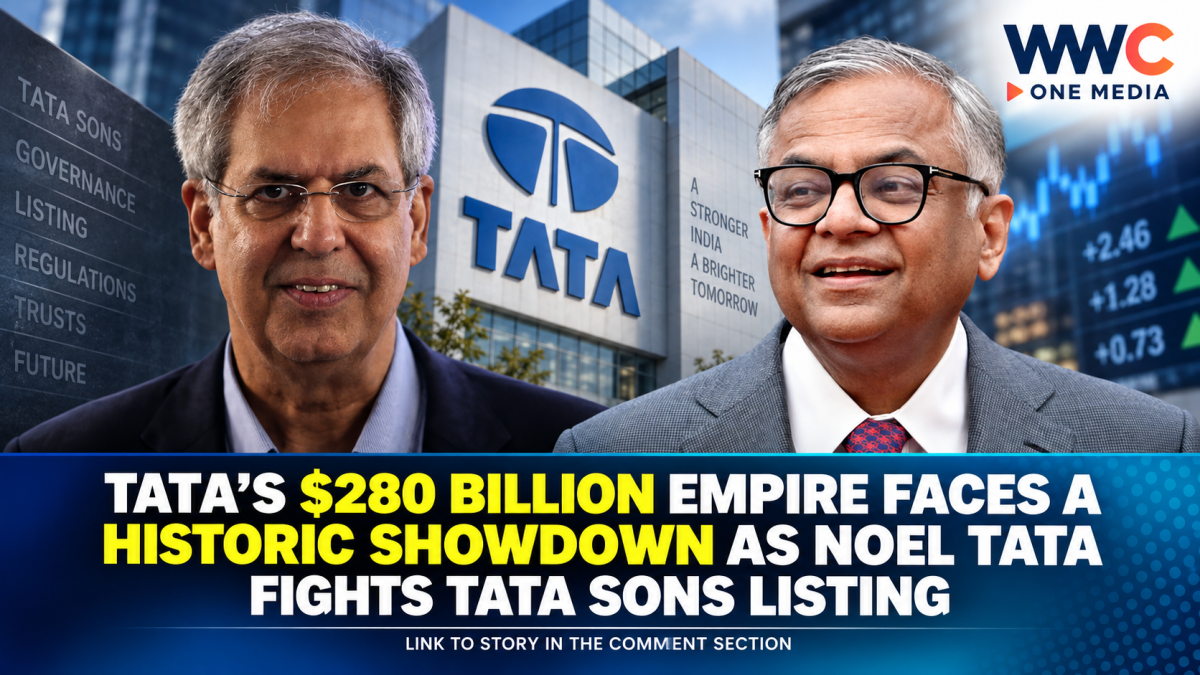
A major power struggle is unfolding inside one of India’s most influential business groups.
Tata Sons, the holding company at the center of the Tata conglomerate, has begun moving toward a potential stock-market listing — but Tata Trusts chairman Noel Tata is opposing the plan.
The dispute escalated after the Tata Sons board backed a five-year extension for chairman N. Chandrasekaran and agreed to begin preparations to comply with regulatory requirements for a public listing.
Noel Tata opposed both moves, setting up a potentially consequential clash between the Tata Trusts, which control roughly two-thirds of Tata Sons, and the company’s board.
The stakes are enormous.
Tata Sons sits at the heart of a sprawling group whose businesses include Tata Consultancy Services, Tata Motors, Air India, Tata Electronics and numerous other companies. The broader Tata Group has a combined market value of roughly $277 billion, according to Reuters.
And if Tata Sons ultimately goes public, the listing could become one of India’s largest-ever IPOs.
The fight is about more than an IPO
At first glance, the dispute appears to be a question of whether Tata Sons should list its shares.
But the conflict goes much deeper.
The Tata Trusts hold approximately 66% of Tata Sons, giving the philanthropic organizations a dominant ownership position in the holding company. Noel Tata, who chairs the Trusts, has argued that keeping Tata Sons privately held is important to preserving the group’s distinctive ownership and charitable structure.
Tata Trusts said it had not agreed to a public listing and called for all available alternatives to be examined.
Noel Tata has argued that a listing could fundamentally alter what has become known as the “Tata model,” in which charitable trusts hold the controlling stake in the group’s parent company.
That puts the current dispute at the intersection of corporate governance, regulation, ownership and philanthropy.
Why Tata Sons is under pressure to go public
The immediate catalyst is India’s central bank.
The Reserve Bank of India (RBI) has classified Tata Sons as an upper-layer non-banking financial company, or NBFC-UL, under its regulatory framework.
Tata Sons had sought to remain outside the requirement to register as an investment company, but the RBI rejected its application and directed the company to take steps toward compliance.
The regulatory issue has been building for years.
Tata Sons was designated an upper-layer NBFC in 2022. Under the applicable framework, such companies face enhanced regulatory requirements, including a public-listing requirement under the relevant rules.
The latest RBI decision has therefore pushed the question from a theoretical possibility toward a concrete corporate deadline.
The board takes a major step
On September 17, Tata Sons’ board reappointed N. Chandrasekaran as executive chairman for another five years.
The decision was significant because Chandrasekaran had previously said he would not seek another term after his current mandate expires in February 2027.
The board then moved toward compliance with the RBI’s regulatory requirements, including preparations for a potential listing.
Noel Tata opposed Chandrasekaran’s reappointment.
Tata Trusts subsequently described the resolution as “illegal,” arguing that the company’s Articles of Association require the support of both Trust-nominated directors for certain decisions.
Reuters reported that Noel voted against the reappointment while the other Tata Trusts nominee, Venu Srinivasan, supported it.
That disagreement is now potentially heading into a legal and governance battle.
Why the potential IPO could be enormous
A public listing of Tata Sons would expose the parent company itself to public-market valuation for the first time.
Analysts cited by the Financial Times estimate that Tata Sons could potentially be worth more than $120 billion if listed.
That would put the transaction among India’s biggest stock-market listings.
It could also create a major liquidity event for shareholders.
One important shareholder is the Shapoorji Pallonji Group, which owns roughly 18.37% of Tata Sons. A listing would provide a mechanism for that stake to be valued and potentially monetized in public markets.
That is one reason the listing debate has attracted intense attention from investors.
An alternative proposal has emerged
The fight has already produced an alternative to an outright IPO.
According to Mint, the Shapoorji Pallonji Group has offered to sell up to 3% of its Tata Sons stake for ₹25,000 crore, with payment proposed over an extended period.
The proposal was presented as a possible alternative to taking Tata Sons public.
That proposal is significant because it addresses one of the practical arguments behind a listing: providing liquidity to minority shareholders.
Whether such an arrangement can satisfy the RBI’s regulatory requirements is a separate question.
Tata Sons has already started preparing
The debate is no longer purely theoretical.
The Economic Times reported that Tata Sons has begun preliminary work related to a potential listing, with February 2027 emerging as an approximate internal working target, according to people familiar with the matter.
The report also said the preparations began before the latest public dispute between Noel Tata and other board members.
That does not mean an IPO is guaranteed by that date.
The eventual timetable could depend on regulatory decisions, shareholder approvals, legal challenges and the resolution of the governance dispute.
The deeper issue: who controls Tata’s future?
The current confrontation puts two different visions of Tata Sons against each other.
On one side is the board’s move toward regulatory compliance and potentially greater transparency through public ownership.
On the other is the Tata Trusts’ position that the existing ownership structure is central to the group’s identity and charitable mission.
Noel Tata has publicly argued that the Tata structure should be preserved, while Tata Sons has indicated that it will work toward complying with the RBI’s requirements.
The disagreement has also exposed questions about how decisions are supposed to be made when the interests of Tata Sons’ board and its largest shareholder diverge.
Those questions could ultimately be as important as the IPO itself.
The market is already reacting
Tata Group companies have experienced significant share-price movements as investors assess the implications of the dispute.
Reuters reported that Tata Chemicals fell as much as 9.7% intraday on September 18, while Tata Motors and Tata Consultancy Services also declined before recovering some ground.
The reaction illustrates how a dispute involving a privately held parent company can spill into the publicly traded companies underneath it.
Investors are attempting to determine what a future Tata Sons listing could mean for capital allocation, governance, ownership and strategic decisions across the wider group.
What happens next?
Several hurdles remain before Tata Sons can become a publicly traded company.
The company must navigate the RBI’s regulatory requirements, corporate approvals and potentially contentious shareholder and governance issues.
The Tata Trusts’ position also means that the ownership structure cannot simply be ignored.
The dispute could therefore move through several stages:
Regulatory compliance.
Board and shareholder approvals.
Potential legal challenges.
Resolution of Tata Trusts’ objections.
Preparation for a potential IPO.
And potentially, one of the largest corporate listings India has ever seen.
For now, the central question is no longer simply whether Tata Sons could go public.
It is whether India’s 158-year-old Tata structure can reach the public markets without fundamentally changing the balance of power that has governed the conglomerate for generations.
That is the battle now unfolding between Noel Tata, Tata Trusts and the Tata Sons board — and its outcome could reshape the ownership and governance of one of India’s most important business empires.