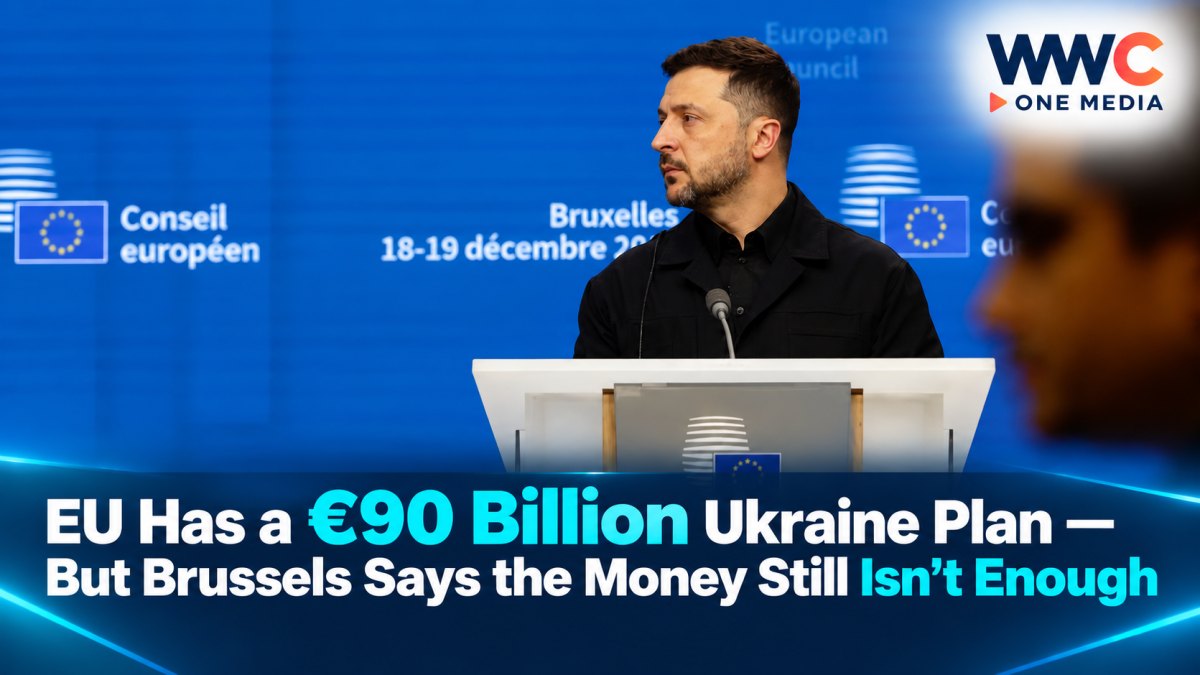
BRUSSELS — The European Union is stepping up pressure on international partners to help finance Ukraine as the cost of the war continues to rise, warning that its own multibillion-euro support package will not cover all of Kyiv’s projected needs through 2027.
The appeal comes ahead of the high-level week of the United Nations General Assembly, where European officials are expected to press allies on additional financial and defense assistance for Ukraine.
The urgency has increased as Ukraine prepares for another expensive year of war and faces a growing gap between government revenues and military spending.
The EU has already committed a €90 billion ($103 billion) Ukraine Support Loan for 2026 and 2027. But European Commission Economy Commissioner Valdis Dombrovskis said the original financing plan assumed international partners would provide the remaining share of Ukraine’s needs.
The EU’s €90 Billion Is Only Part of the Equation
The Ukraine Support Loan is one of the largest financial commitments the EU has made to Kyiv since Russia’s full-scale invasion.
Under the framework, approximately €30 billion is earmarked for budgetary assistance, while €60 billion is designated for defense procurement and strengthening Ukraine’s defense-industrial capacity during 2026 and 2027.
The EU’s own calculations put Ukraine’s total financing needs for the two-year period at roughly €135 billion.
That leaves approximately €45 billion that Brussels expects international partners to help provide.
Dombrovskis made the point after an informal meeting of EU finance ministers in Dublin attended by representatives from Britain, Canada and Switzerland.
The issue is therefore not whether Europe has committed substantial funding.
It has.
The question is whether enough additional partners will provide the money needed to close the remaining gap.
Ukraine’s 2027 Problem Is Becoming More Urgent
The funding pressure is especially visible in Ukraine’s proposed 2027 budget.
Ukraine’s government has proposed 4.89 trillion hryvnias, or about $110 billion, in defense spending for 2027, a 12% increase from the previous year.
Defense spending would account for roughly two-thirds of total planned government expenditure.
Ukraine’s Finance Minister Sergii Marchenko said the country will need more than $52 billion in international financial assistance in 2027.
At the time of his Sept. 16 presentation, partners had committed approximately $20 billion, leaving a substantial amount still to be secured.
Marchenko also said Ukraine faces an additional $27 billion unfunded defense requirement in 2026, reflecting increased military costs and the need to expand weapons production and support military personnel.
Those figures help explain why Brussels is urging other governments to increase their contributions.
The EU Has Already Started Sending More Money
The push for additional international support comes as the EU itself continues disbursing money under its Ukraine Support Loan.
On Sept. 18, the European Commission disbursed another €3.3 billion for Ukrainian defense procurement, specifically covering drones and missiles.
The Commission said this was the fourth payment under the loan’s defense window.
With the latest payment, the EU said it will have disbursed nearly €15 billion to Ukraine during 2026, combining defense and broader support.
Reuters separately confirmed that Ukraine received the €3.3 billion tranche and said Kyiv would use the funds for priority defense requirements, particularly missiles and drones.
The new payment illustrates the two-track nature of the EU’s support.
Brussels is financing Ukraine’s government while simultaneously helping Kyiv purchase military equipment.
Canada Is Now in Talks to Join the EU Loan
One of the most significant developments is Canada’s possible participation in the €90 billion program.
The European Commission confirmed Sept. 18 that Canada has expressed interest in joining the Ukraine Support Loan and that technical discussions are continuing.
Canada would need to meet the conditions established for non-EU countries participating in the program, including being a significant military, defense and financial supporter of Ukraine and maintaining an appropriate security and defense partnership with the EU. Discussions over Canada’s contribution to borrowing costs are also continuing.
The European Commission stressed that Canada’s potential participation would not increase the €90 billion ceiling.
Instead, it would allow Canadian defense companies to participate in procurement under the same general framework available to eligible European suppliers.
That could give Ukraine access to a broader pool of defense manufacturers.
Britain Has Already Joined the Framework
Canada would not be the first non-EU country to participate.
The United Kingdom’s participation was approved in July after the EU and Britain signed the necessary agreement.
Under the arrangement, Ukraine can use financing from the support loan to procure eligible defense products from British manufacturers. Britain also agreed to make a proportionate contribution toward borrowing costs associated with contracts awarded to UK companies.
The European Commission has now pointed to the British arrangement as a model for Canada’s possible participation.
But Brussels is making a distinction between joining the loan and providing additional bilateral aid.
Participation in the €90 billion mechanism does not by itself eliminate the broader financing gap.
Norway Has Provided Another Example
Norway has also emerged as an important contributor.
European officials recently highlighted Norway’s planned support for Ukraine in 2027, with Dombrovskis describing a package of roughly $9 billion in defense and budgetary assistance as an example of the kind of additional contribution European partners want to see.
Norway also announced a separate €90 million contribution to the EU’s Ukraine Facility on Sept. 17, supporting financial stability and reforms in Ukraine.
The Norwegian contribution illustrates that European partners are being asked to provide support through multiple channels rather than relying exclusively on the EU’s central loan.
Why the Funding Gap Is Growing
Ukraine’s financial requirements have changed significantly as the war has continued.
Military spending has risen.
Infrastructure has suffered additional damage.
Government revenues are under pressure.
And the country must simultaneously maintain essential public services while financing its defense effort.
Reuters reported that Ukraine’s Finance Ministry estimates the daily cost of the war has risen to about $190 million this year, compared with roughly $116 million in 2022.
That rise has occurred as Russian attacks on Ukrainian businesses and infrastructure have affected economic activity and government revenues.
The result is a fiscal equation that becomes more difficult each year.
More spending is required at the same time that domestic revenues are not increasing at the same pace.
The IMF Still Has to Establish the Full Number
One reason the funding figures continue to shift is that Ukraine’s exact financing requirement for 2027 is still being assessed.
The International Monetary Fund and European Commission are working to determine the size of the remaining gap.
Dombrovskis has previously said Brussels needs to establish the precise scope of Ukraine’s financing needs before deciding how the remaining shortfall should be covered. Euronews reported earlier this month that Kyiv had identified a substantial funding gap while the EU was waiting for a more detailed assessment.
That means the figures being discussed today should not necessarily be treated as a final 2027 funding requirement.
The number could change as the IMF, Ukraine and the European Commission update their projections.
Frozen Russian Assets Remain Part of the Discussion
Another potential source of financing is Russia’s immobilized sovereign assets held in Western jurisdictions.
Ukraine’s Finance Minister has identified frozen Russian assets as a possible source for covering part of the country’s future budget needs.
The EU has already been using proceeds generated from immobilized Russian assets to support Ukraine, although the broader question of how much of the underlying principal can legally be mobilized remains a separate and politically sensitive issue.
For Brussels, the issue has become part of the larger debate over how to provide Ukraine with predictable financing without placing the entire burden on national budgets.
The Money Is Also Tied to Ukraine’s Reform Commitments
The EU’s financial support is not unconditional.
The Ukraine Support Loan regulation requires Ukraine to continue maintaining democratic mechanisms, the rule of law and measures addressing corruption.
The EU has also tied disbursements to specific financing and reform requirements.
Ukraine has been working on tax and customs reforms that are relevant to unlocking additional international assistance.
Reuters reported that Ukraine’s parliament recently advanced legislation concerning taxation of foreign parcels, part of efforts to meet conditions associated with international financial support.
For Kyiv, that creates another challenge.
It must increase defense spending while simultaneously demonstrating fiscal and institutional reforms required by its international lenders and partners.
Defense Funding Is Becoming a Separate Priority
The €90 billion EU package is unusual because of the size of its defense component.
The EU has allocated €60 billion specifically for defense procurement and industrial capacity.
The European Commission says the framework is intended to give Ukraine access to defense products while also strengthening Europe’s own defense-industrial base.
Early disbursements have focused on products such as drones and missiles.
The Commission has also said that contracts for other systems, including Patriot-related equipment, can be financed once the relevant contracts and procurement requirements are completed.
That means the Ukraine financing program is increasingly intertwined with European defense production.
Money sent to Ukraine can also translate into orders for defense manufacturers in participating countries.
The UN Week Deadline Adds Political Pressure
The timing of the latest push is significant.
The high-level week of the United Nations General Assembly brings world leaders and senior ministers together in New York.
For European governments, it offers an opportunity to press countries outside the EU to increase financial support for Ukraine.
The message from Brussels is essentially that Europe has committed a large portion of the financing, but it does not intend to cover the entire requirement alone.
The remaining gap must be addressed through a wider group of international partners.
The Numbers Tell a Complicated Story
The competing figures can be confusing.
Here is how they currently fit together:
| Figure | What it represents |
|---|---|
| €90 billion | EU Ukraine Support Loan for 2026–2027 |
| €30 billion | Budgetary assistance within the EU loan |
| €60 billion | Defense procurement and defense-industrial support |
| About €135 billion | EU estimate of Ukraine’s two-year financing needs cited by Dombrovskis |
| About €45 billion | Portion Brussels says international partners need to cover |
| $52+ billion | Ukraine’s stated international financing requirement for 2027 |
| $20 billion | Approximate partner commitments toward the 2027 requirement cited by Ukraine |
| $27 billion | Additional unfunded Ukrainian defense requirement for 2026 |
These numbers come from different planning frameworks and currencies, so they should not be added together as though they represent one single funding gap. The EU’s €45 billion figure relates to its two-year financing framework, while Ukraine’s more than $52 billion figure refers specifically to its projected international financing requirement for 2027.
What Happens Next?
The immediate task for Brussels is to persuade additional partners to commit funding while the IMF and European Commission refine the estimate of Ukraine’s 2027 needs.
Canada’s possible participation in the EU loan could broaden the defense procurement base, while additional bilateral commitments from countries such as Norway could help address the portion of financing outside the EU package.
But the numbers suggest that more negotiations are ahead.
Ukraine’s military spending is rising, its government continues to require external budget support, and the cost of sustaining the war is increasing.
The EU has already put €90 billion on the table.
Now Brussels is asking a much larger group of countries to help close the remaining gap.
And as world leaders gather for the UN General Assembly, the question will be whether the international coalition supporting Ukraine can translate political commitments into enough actual financing to cover Kyiv’s needs through 2027.