Italy is pushing for a stronger naval presence in the Red Sea as renewed attacks and territorial advances by Iran-backed Houthi forces raise fresh concerns over one of the world’s most important maritime trade routes.
Italian Defense Minister Guido Crosetto has called for additional warships to reinforce the European Union’s Operation ASPIDES, warning that existing naval resources may not be enough to guarantee the safe movement of commercial vessels through the strategically important Bab el-Mandeb Strait.
The development comes as shipping companies gradually return to the Red Sea and Suez Canal route after years of avoiding the area because of Houthi attacks—raising the stakes for global trade if the security situation deteriorates again.
Italy Says More Ships Are Needed
Crosetto said Italy wants ASPIDES strengthened with additional naval vessels from other European countries.
According to ANSA, Italy is prepared to send a second frigate if requested, although other participating countries would need to help cover the cost of expanding the operation.
Crosetto had already warned a day earlier that Rome would not simply wait for European decision-making before taking steps to protect Italian commercial shipping.
He said Italy was preparing its navy to help ensure that Italian vessels could safely pass through Bab el-Mandeb, while emphasizing that any deployment would involve the government and Parliament.
The distinction is important: Italy is not announcing an unrestricted new military campaign. Its stated objective is the protection of merchant vessels and the restoration of commercial navigation through the strategic waterway.
An Italian Frigate Has Already Escorted a Merchant Ship
The warning came as an Italian naval vessel was already carrying out the type of mission Crosetto wants strengthened.
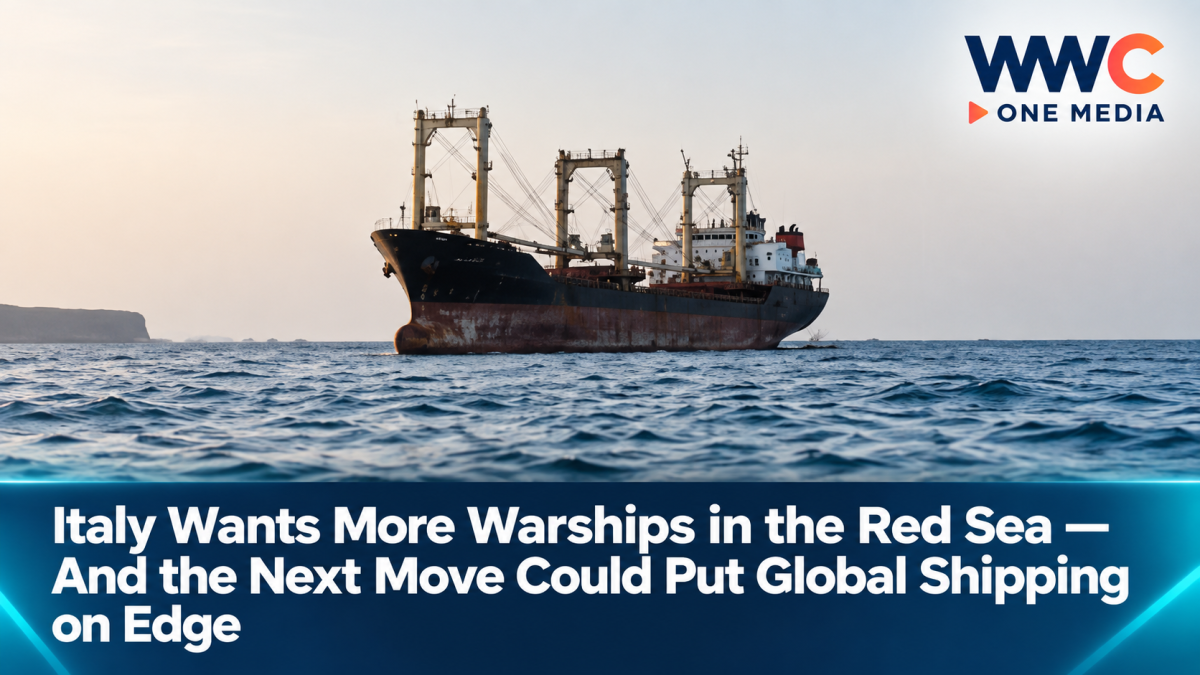
The Italian Navy’s Carlo Bergamini frigate escorted the Italian merchant vessel Jolly Oro through Bab el-Mandeb on a northbound transit under the EU’s ASPIDES mission.
The Navy described the operation as a concrete signal of the importance of maintaining close attention to commercial shipping safety in the area.
The escort also demonstrated that the issue is no longer merely theoretical for Italian shipping companies.
The Jolly Oro is owned by Ignazio Messina & C., and the escort was conducted as part of ASPIDES’ existing defensive mandate.
Why Bab el-Mandeb Matters So Much
Bab el-Mandeb is the maritime gateway connecting the Gulf of Aden to the Red Sea.
For vessels traveling between Asia and Europe, the route leads north through the Red Sea and toward the Suez Canal before entering the Mediterranean.
That makes the strait one of the critical links in global supply chains.
A prolonged disruption can force ships to take the much longer route around Africa’s Cape of Good Hope, increasing sailing time, fuel consumption, insurance exposure and potentially freight costs.
Reuters reported that roughly 40% of Italy’s trade passes through the Suez Canal, while about 7% of global oil output transits Bab el-Mandeb.
The Timing Is Particularly Sensitive
The latest security concerns arrive at a complicated moment for global shipping.
After avoiding the Red Sea during much of the Houthi attacks, shipping companies have increasingly begun testing or restoring Suez Canal services.
Lloyd’s List reported that 1,232 vessels transited the Suez Canal in August, up 28% year over year. However, traffic through Bab el-Mandeb remained substantially below pre-crisis levels.
That means the maritime industry is attempting to rebuild confidence in the route at precisely the moment security risks are rising again.
S&P Global reported that large crude carriers have been avoiding Bab el-Mandeb amid intensifying Houthi threats. Its vessel-tracking data showed no very large crude carriers had crossed the strait after Sept. 9, compared with 24 crossings during August and 63 during July.
Shipping Is Returning — But the Recovery Is Fragile
The picture is therefore more complicated than simply saying that the Red Sea is “closed.”
Some shipping companies are returning.
Others remain cautious.
Lloyd’s List reported that container traffic through the Bab el-Mandeb has recovered from its lowest levels, including increased use by some ultra-large container vessels. Yet overall activity remained about 70% below pre-Houthi-crisis levels in the data it cited.
That fragile recovery could be disrupted if attacks intensify or if insurers and shipping companies once again conclude that the security risks are too high.
What Operation ASPIDES Actually Does
The EU established Operation ASPIDES in February 2024 following repeated Houthi attacks against international commercial shipping.
Its mandate is defensive: protecting merchant vessels, safeguarding freedom of navigation and contributing to maritime security around the Red Sea, Gulf of Aden and surrounding waters.
The EU Council extended the mission through Feb. 28, 2027, with nearly €15 million allocated to its common operational costs for the period from March 2026 through February 2027.
The EU says ASPIDES continues to provide close protection for merchant vessels transiting the region.
Italy has been a major participant in the mission.
But Crosetto’s latest appeal highlights a potential capacity problem: the number of naval vessels available to protect commercial traffic may not be sufficient if the threat environment expands.
The Bigger Problem Is Not Just Italy
The Red Sea is a global shipping corridor, meaning the consequences of a prolonged security crisis would extend well beyond Italian companies.
Manufacturers, retailers, energy companies, shipping lines and consumers in Europe and Asia could all be affected by longer routes and higher transportation costs.
For European importers, the Suez route is particularly important because it provides a considerably shorter connection between Asian production centers and European markets than the Cape of Good Hope route.
Any sustained deterioration around Bab el-Mandeb could therefore put pressure on freight rates, delivery schedules and supply chains.
Italy Is Trying to Avoid a Repeat of the Earlier Shipping Crisis
The significance of Rome’s position becomes clearer when viewed against the disruption that followed the Houthi attacks that began affecting commercial shipping in late 2023.
Many major carriers diverted vessels around Africa rather than risk the Red Sea.
That helped protect ships but added thousands of nautical miles to some voyages.
Now, as carriers cautiously resume Suez services, Italy is pushing for stronger naval protection rather than waiting for another large-scale diversion.
Crosetto has argued that delays in responding to the security situation could translate into economic consequences because disrupted maritime routes mean longer delivery times and higher costs.
The Critical Question: Can Europe Provide Enough Ships?
That is now the central issue.
Italy has indicated that it could contribute another frigate, but Rome wants other European countries to increase their contributions as well.
The request comes as European governments are dealing with multiple security demands, making naval availability and financing important constraints.
The EU’s existing mission remains operational, but expanding the number of vessels would require participating countries to commit additional military and financial resources.
For shipping companies, the question is whether those additional resources arrive quickly enough to reassure operators and insurers.
Why This Matters to Global Trade
The Red Sea crisis demonstrates how quickly a regional security problem can become a global commercial issue.
A ship does not have to be attacked for global trade to feel the consequences.
If insurers raise premiums, carriers change routes, crews refuse dangerous passages or companies avoid a chokepoint altogether, the economic effects can spread across entire supply chains.
The latest developments therefore come at a particularly sensitive point: shipping companies are cautiously returning to a route that remains substantially below its pre-crisis level, while security conditions around Bab el-Mandeb are deteriorating again.
For Italy, the immediate priority is protecting its merchant vessels.
For Europe, the bigger challenge is maintaining freedom of navigation.
And for global trade, the unresolved question is whether the Red Sea can remain a commercially viable corridor if the security situation continues to worsen.