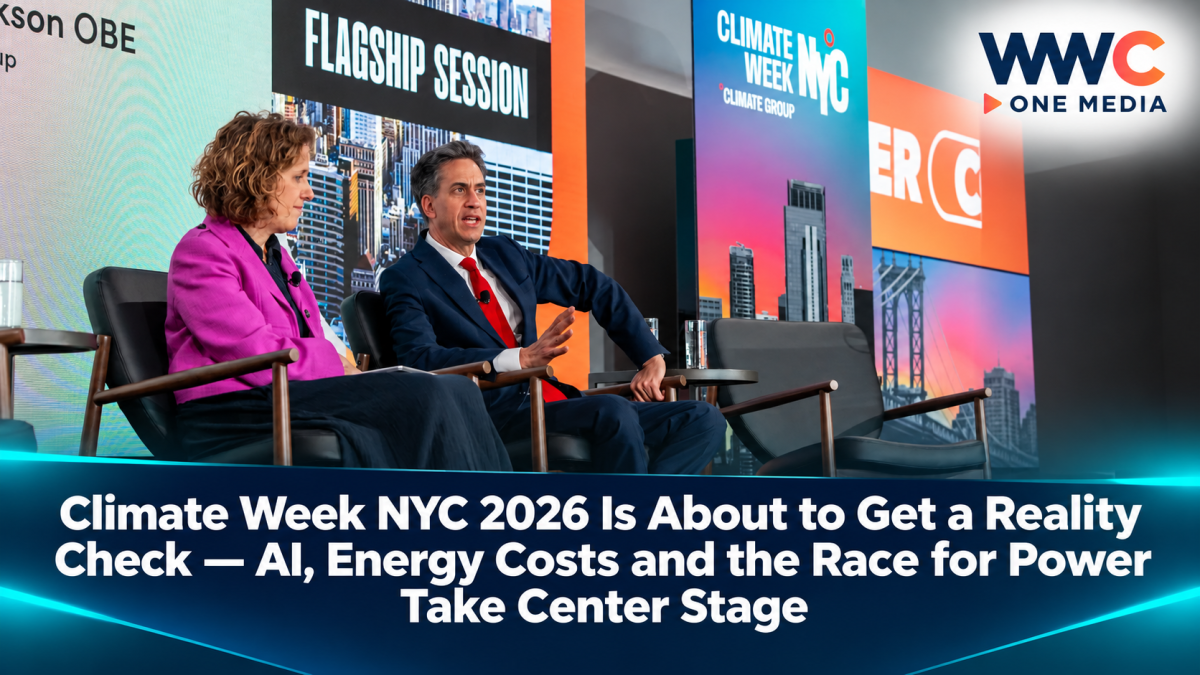
NEW YORK — Climate Week NYC returns this week with a noticeably different question hanging over the global climate conversation: How does the world accelerate the energy transition when electricity demand is exploding, infrastructure is under pressure and businesses are demanding affordable power?
The annual gathering, which runs from September 20 to 27, 2026, brings together governments, corporations, investors, scientists, activists and technology companies for more than 1,000 events across New York City.
But this year’s discussions are taking place against a rapidly changing energy landscape.
Artificial intelligence is driving demand for new data centers. Electrification is increasing the need for power. Supply chains remain vulnerable to geopolitical shocks. And companies are increasingly asking not only whether climate investments reduce emissions, but whether those investments can also improve competitiveness and energy security.
That makes Climate Week 2026 less about announcing another distant climate ambition and more about a difficult practical question:
Can the world’s energy systems actually deliver the transition at the speed businesses and governments now require?
The Theme Has Changed: From Ambition to Implementation
Climate Week NYC’s official organizers have placed energy, impact and action at the center of the 2026 program.
The organizers say the challenge has shifted from establishing climate ambition to actually implementing solutions, with outdated regulations, infrastructure constraints and market structures slowing progress.
The official program covers 12 major themes:
- Buildings and infrastructure
- Climate and health
- Energy and electrification
- Environmental justice
- Finance and clean growth
- Food and agriculture
- Industry and supply chains
- Nature, land and oceans
- Policy, governance and leadership
- Sustainable living, cities and communities
- Technology and AI
- Transport and travel
The breadth of the agenda reflects how deeply climate policy has become intertwined with the broader economy.
Energy prices affect household budgets.
Grid capacity affects data-center investment.
Climate regulations affect corporate planning.
And extreme weather affects infrastructure and insurance.
The climate transition is increasingly being treated as an economic and industrial issue, not simply an environmental one.
AI Has Become One of the Biggest Energy Stories
One of the most consequential additions to the climate conversation is artificial intelligence.
The explosive expansion of AI requires enormous amounts of computing power, and that means data centers require enormous amounts of electricity.
Climate Week’s official program includes a session titled “Powering AI: Who Wins When Demand Outpaces the Grid?”
The discussion is scheduled to examine how rapidly expanding data centers are competing with industry, transportation and cities for clean and affordable electricity.
The issue is becoming increasingly difficult to ignore.
AI companies need power quickly.
Utilities need time to build generation and transmission infrastructure.
Communities need reliable electricity.
And governments are under pressure to expand grids without undermining emissions-reduction goals.
That creates a new competition for electricity.
The Grid Is Becoming the New Climate Battleground
For years, the climate debate often centered on how quickly economies could replace fossil fuels with renewable energy.
Now another problem has moved toward the center:
Can the electricity grid handle everything that is being electrified at once?
Electric vehicles, heat pumps, industrial electrification and data centers are all increasing electricity demand.
At the same time, aging transmission infrastructure can limit how quickly new generation reaches customers.
The official Climate Week program specifically identifies grid expansion, cooling systems, water infrastructure and resilient buildings as critical physical foundations for the next phase of the transition.
That means climate investment is increasingly becoming infrastructure investment.
Energy Affordability Is Another Major Pressure Point
The timing is important because consumers and businesses are confronting higher energy costs in several markets.
Axios reported that energy costs have moved toward the center of the 2026 Climate Week conversation, with AI-driven electricity demand, infrastructure constraints and geopolitical developments contributing to concerns about affordability.
That creates a politically and economically sensitive problem.
Climate policies can require investment.
But consumers and businesses ultimately have to pay for energy systems.
If the transition is perceived as making electricity substantially more expensive, public and political support can become more difficult to maintain.
The challenge for policymakers is therefore increasingly twofold:
Reduce emissions while keeping energy reliable and affordable.
The Business World Has Not Walked Away From Clean Energy
Despite political uncertainty in Washington and policy rollbacks at the federal level, corporate investment in clean energy has continued.
Reuters reported that businesses in the United States remain active in clean-energy investment because of factors including cost, energy security and the need for reliable electricity.
The report noted that renewable energy and battery storage account for roughly 90% of planned new U.S. power generation over the following year, according to the analysis it cited.
That suggests an important shift in the business case.
Companies are not necessarily investing in clean energy only because of climate targets.
They are also looking at:
- electricity costs;
- energy security;
- supply reliability;
- customer demand;
- regulatory risk; and
- long-term competitiveness.
That broader economic argument could become one of the defining themes of Climate Week.
Bloomberg Green Is Bringing Business Leaders Into the Conversation
Bloomberg’s own Bloomberg Green New York program will take place September 22–23, bringing together business executives, policymakers and climate innovators.
The event is designed to examine how climate intersects with technology, the economy, policy and communities.
That reflects the broader direction of Climate Week.
The conversation is increasingly about implementation rather than declarations.
Who will finance the transition?
Who will build the infrastructure?
Who will supply the electricity?
Who will absorb the cost?
And which technologies can scale fast enough?
Finance Is Becoming Just as Important as Technology
Climate Week’s official agenda includes finance and clean growth as one of its 12 core themes.
That is significant because climate technologies increasingly require enormous amounts of capital before they can reach commercial scale.
Renewable generation needs financing.
Transmission networks need financing.
Battery manufacturing needs financing.
Low-carbon industrial projects need financing.
And emerging technologies often require years of investment before generating meaningful returns.
BloombergNEF said ahead of Climate Week that banks facilitated nearly equal volumes of low-carbon and fossil-fuel finance in 2025.
Its analysis of more than 2,000 global banks found that the balance had improved from the previous year but remained below the level needed to meet global climate goals.
That leaves a major question for investors:
Where will the next wave of climate capital come from?
AI Could Complicate the Energy Transition — Or Accelerate It
AI’s role in the energy transition is likely to be one of the more complicated discussions this week.
On one side, AI is increasing electricity demand through data centers.
On the other, AI can potentially help optimize power grids, improve renewable forecasting, manage industrial processes and increase energy efficiency.
Climate Week’s AI programming reflects that tension.
The official program includes discussions about AI-enabled optimization, private power deals, grid prioritization and 24/7 carbon-free electricity.
The question is therefore not simply whether AI consumes more electricity.
It is whether technological improvements can help energy systems become efficient enough to accommodate that additional demand.
The Iran War Has Also Changed the Energy Conversation
Geopolitical risk is another factor shaping the 2026 climate discussion.
BloombergNEF’s pre-Climate Week analysis specifically identifies the AI data-center buildout and the Iran war as two major forces reshaping global energy systems.
Energy security has therefore become increasingly difficult to separate from decarbonization.
Governments want cleaner energy.
They also want reliable domestic power.
Businesses want predictable electricity prices.
And geopolitical shocks can suddenly disrupt fossil-fuel markets.
That combination may strengthen the economic argument for diversification of energy sources, even when the immediate motivation is energy security rather than emissions reduction.
Climate Week Is Also Looking Beyond Energy
Although energy is likely to dominate the business conversation, the agenda is far broader.
Food and agriculture, nature, health, buildings, transportation and supply chains all have dedicated programming.
The official event themes also emphasize adaptation and resilience, education, youth leadership and a just transition across multiple areas.
That reflects another reality of climate policy.
Even if emissions were reduced rapidly, communities would still have to deal with climate-related risks already built into the system.
Cities need resilient infrastructure.
Companies need more robust supply chains.
Farmers need adaptation strategies.
And insurers need to manage increasingly complicated physical risks.
Governors Island Becomes a Climate Innovation Hub
One of the largest concentrations of Climate Week programming will take place across New York’s five boroughs, including Governors Island.
The Trust for Governors Island and the New York Climate Exchange have organized events covering urban resilience, environmental data and climate solutions.
The programming includes discussions on:
- resilient urban energy systems;
- environmental data;
- climate innovation;
- urban resilience;
- climate solutions; and
- community engagement.
That focus on cities is particularly important because urban areas are simultaneously major consumers of energy and some of the places most exposed to heat, flooding and infrastructure stress.
Food and Agriculture Are Also Moving Into the Spotlight
Climate Week will also examine how food systems are adapting.
Food Tank is opening its Climate Week program with a Sept. 20 event focused on young farmers and the future of food systems, highlighting agricultural innovation and climate resilience.
Agriculture presents a particularly difficult challenge.
Farmers must increase resilience while dealing with changing weather patterns, water availability, input costs and consumer expectations.
At the same time, food production itself contributes to greenhouse-gas emissions.
The sector therefore has to address both adaptation and mitigation.
Buildings Could Become a Huge Part of the Transition
Buildings and infrastructure are another major focus.
The official Climate Week program emphasizes retrofits, energy efficiency, grid expansion, cooling systems, water infrastructure and resilient housing.
This is where climate policy meets everyday life.
A more efficient building can reduce energy consumption.
Better cooling can protect people during heat events.
Modernized electrical systems can accommodate greater electrification.
And resilient construction can reduce damage from extreme weather.
The challenge is scale.
Retrofitting millions of buildings requires financing, skilled workers, regulatory changes and long-term planning.
The Corporate Climate Message Is Also Changing
Businesses are increasingly being asked to demonstrate tangible economic value from sustainability programs.
ERM, one of the organizations participating in Climate Week, said this year’s discussions will include regulatory clarity, climate finance, corporate action and responsible AI.
That reflects a broader corporate shift.
The question is no longer simply:
“What is your company’s climate target?”
It is increasingly:
“How does your climate strategy affect costs, growth, resilience and competitiveness?”
That is a much harder question for executives—and potentially a much more consequential one for investors.
Climate Week 2026 Comes Before COP31
The timing of the New York gathering also matters internationally.
Climate Week NYC takes place ahead of COP31 in Antalya, Türkiye, in November.
The organizers describe the New York meetings as an opportunity to move from commitments toward implementation before the next major UN climate summit.
That means ideas discussed in New York could feed into the diplomatic and financial negotiations that follow.
Governments will be looking at targets.
Businesses will be looking at investment opportunities.
Investors will be looking at returns and risks.
And climate advocates will be looking for evidence that commitments are turning into measurable action.
The Biggest Question May Be Who Gets the Power
Climate Week 2026 is arriving at a moment when electricity itself is becoming a strategic resource.
AI companies need it.
Manufacturers need it.
Cities need it.
Electric vehicles need it.
And renewable-energy projects need access to the grid.
That creates a new layer of competition.
The transition is no longer only about replacing one type of energy with another.
It is also about who gets connected to the grid, how quickly new power can be built, who pays for infrastructure and how much electricity consumers ultimately pay.
The Climate Conversation Is Getting More Complicated
That may be the most important takeaway from this year’s Climate Week.
Climate policy is increasingly colliding with energy security, artificial intelligence, industrial policy, finance and geopolitics.
The transition remains a major global investment opportunity, but it is also becoming a massive infrastructure challenge.
The solutions being discussed in New York will therefore be judged not only by their emissions impact.
They will also be judged by whether they are affordable, reliable, scalable and capable of surviving rapidly changing economic conditions.
More than 100,000 people are expected to participate across the week’s 1,000-plus events.
But the real measure of Climate Week 2026 will come after the conference halls empty.
Can the ideas discussed in New York actually build more power, unlock more investment and deliver lower-carbon energy fast enough to meet the world’s rapidly changing demands?
That is the question that could follow climate leaders all the way to COP31—and well beyond.