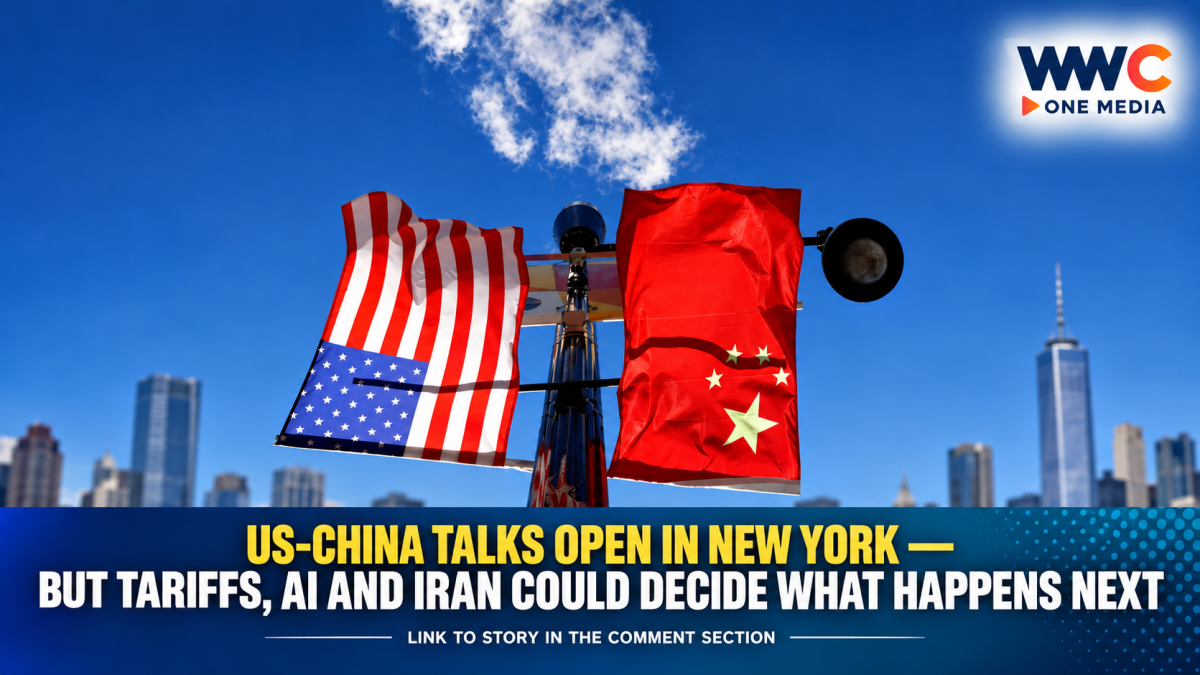
NEW YORK — High-level US and Chinese officials are set to meet in New York on Sunday, September 20, in a crucial round of discussions covering tariffs, artificial intelligence, trade and the economic fallout from the war involving Iran — just days before US President Donald Trump is scheduled to meet Chinese President Xi Jinping in Washington.
US Treasury Secretary Scott Bessent and Chinese Vice Premier He Lifeng are expected to lead the talks. US Trade Representative Jamieson Greer is also due to participate.
Reuters reported that Bessent and He are scheduled to meet at JPMorgan Chase’s headquarters in Manhattan, with the bank providing the venue but not participating in the talks. The meeting comes as New York prepares for the United Nations General Assembly, bringing heightened security to the city.
The discussions are intended to lay the groundwork for the Trump-Xi summit on September 24, with both governments facing pressure to prevent renewed escalation in their economic relationship.
Tariff truce faces another test
At the center of the negotiations is the fragile US-China tariff truce, which is due to expire in November.
Washington and Beijing have been working to maintain a measure of stability after years of escalating tariffs and trade restrictions. The immediate focus is expected to include reducing barriers affecting American agricultural and energy products and keeping trade flowing in less-sensitive sectors.
Reuters reported that the September 24 summit could include discussions about extending the tariff arrangement, Chinese purchases of US goods and Washington’s demands for greater access to critical minerals. Beijing, meanwhile, is seeking relief from some US technology restrictions.
The talks also come as Washington considers additional tariffs linked to concerns over excess manufacturing capacity. Bloomberg-sourced reporting said an announcement on potential new duties has been delayed until after the leaders’ meeting.
That leaves the New York negotiations with a delicate objective: prevent the current trade détente from unraveling while neither side gives up its broader economic demands.
AI emerges as a new US-China battleground
Artificial intelligence is also moving rapidly up the agenda.
Washington and Beijing are increasingly competing over advanced chips, AI models, computing infrastructure and the rules governing the rapidly developing technology.
Reuters previously reported that US and Chinese officials were preparing dedicated discussions on AI safety, including possible cooperation over risks such as AI-enabled cyberattacks.
Bessent has said the two countries should explore ways to manage shared AI risks and avoid a complete separation of their technology systems. At the same time, Washington continues to restrict China’s access to certain advanced semiconductor technologies, while Beijing argues that US technology controls are aimed at limiting China’s technological development.
The result is an unusual mix of competition and potential cooperation: both countries want technological advantages, but officials also recognize that uncontrolled AI risks could cross national borders.
Iran adds another layer of tension
The Iran conflict is complicating the US-China relationship further.
Washington is seeking greater pressure on Iran’s economic lifelines and has been urging other countries to reduce business ties with Tehran. China, however, remains a major buyer of Iranian oil.
Reuters has reported that Iran has used a barter-like mechanism involving Chinese imports and Iranian oil to work around sanctions, illustrating the depth of the economic relationship between Tehran and Chinese businesses.
That makes China’s energy relationship with Iran a potentially difficult subject for Bessent and He.
The issue has become even more significant because disruptions around the Strait of Hormuz have threatened regional energy flows. Bloomberg-sourced reporting said Washington is pressing financial institutions over Iran-related transactions, while Chinese companies and banks could face greater scrutiny if US sanctions are expanded.
For Beijing, the conflict also has direct economic consequences because prolonged disruption to energy supplies could affect China’s refiners and broader industrial economy.
Rare earths, agriculture and technology remain key bargaining chips
Rare-earth materials are another major issue.
China dominates important parts of the global rare-earth supply chain, including materials and magnets used in automobiles, electronics, defense equipment and other high-technology industries.
According to reporting cited by Bloomberg, Chinese officials could offer additional rare-earth export permits as part of negotiations, although details of what Beijing might seek in exchange have not been disclosed.
Agricultural trade could provide another area for practical progress, with soybeans and other US farm products among the issues expected to receive attention.
The negotiations therefore span several interconnected economic pressure points — from tariffs and farm exports to semiconductors, artificial intelligence and critical minerals.
The bigger test comes on September 24
The New York meeting is not the final destination.
Its significance lies in what it could prepare for the Trump-Xi summit in Washington on September 24.
Reuters reported that the leaders’ agenda is expected to extend beyond trade, including Taiwan, Iran, AI governance and efforts to curb the flow of fentanyl precursors from China.
For now, both sides appear focused on managing areas of conflict without allowing negotiations to spiral into another broad trade confrontation.
But the number of issues on the table means the margin for disagreement remains substantial.
The New York talks could therefore become an important test of whether Washington and Beijing can preserve their fragile economic détente — or whether tariffs, technology restrictions, energy security and geopolitical disputes begin pulling the world’s two largest economies in different directions again.