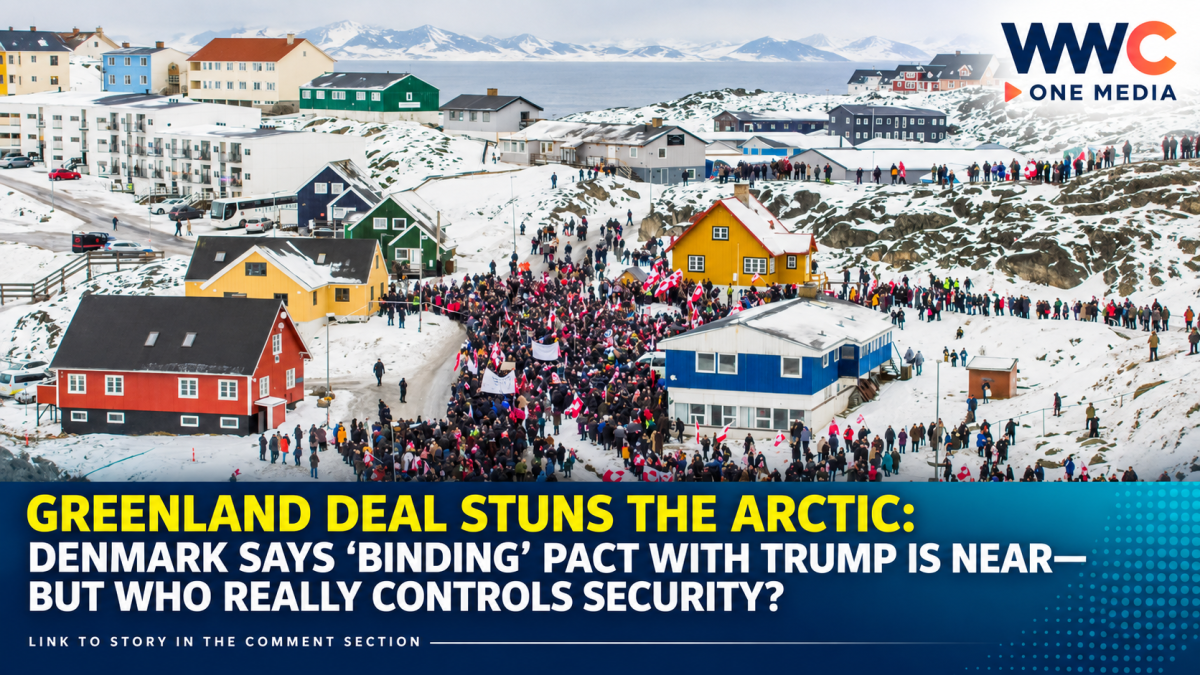
COPENHAGEN — Denmark and Greenland have welcomed a new security agreement with the United States that would significantly expand Washington’s military role in Greenland, while insisting that the Arctic territory’s sovereignty and the Greenlandic people’s right to self-determination will remain intact.
The agreement, announced by U.S. President Donald Trump on September 18, is expected to be formally signed by the United States, Denmark and Greenland during the United Nations General Assembly in New York next week. However, key provisions have not yet been publicly released, and parliamentary approval in Denmark and Greenland is still required before the agreement can take effect.
Trump described the emerging arrangement as giving Washington “permanent control” over Greenland’s security, saying the United States would have the ability to take whatever measures it considers necessary to defend Greenland and U.S. security interests.
But Copenhagen and Nuuk have emphasized a crucial distinction: the agreement does not transfer sovereignty over Greenland to the United States.
Danish Prime Minister Mette Frederiksen said the arrangement recognizes the sovereignty and territorial integrity of the Kingdom of Denmark as well as the Greenlandic people’s right to self-determination. Greenland Prime Minister Jens-Frederik Nielsen likewise said the agreement recognizes Greenland’s interests.
What the Greenland deal actually changes
According to Reuters, the United States, Denmark and Greenland have agreed to allow Washington to develop a significant military presence on the strategically located Arctic island.
The arrangement would also prevent U.S. adversaries from establishing military bases there. A U.S. State Department official said the deal would bar non-NATO bases and prevent China and Russia from establishing military facilities in Greenland, while also creating restrictions on sensitive investments by potential adversaries.
The precise size of the planned U.S. military presence, however, remains unclear.
Reuters also reported that it is not yet known whether Washington would receive any formal authority over Greenland’s foreign policy or natural resources. Those unanswered questions are likely to be closely watched as the agreement moves toward formalization.
Denmark calls it a security breakthrough
Danish Foreign Minister Lars Løkke Rasmussen described the expected agreement as a potential end to months of uncertainty surrounding Greenland.
He said a binding agreement could strengthen security in the Arctic and North Atlantic while respecting Denmark’s stated red lines.
Channel NewsAsia reported that Danish officials view the agreement as consistent with their position that Greenland remains under Danish sovereignty. The deal also comes against the backdrop of an existing U.S.-Danish defense framework that has already allowed American military activity in Greenland.
The United States already operates the Pituffik Space Base in northwestern Greenland. The facility supports missile-warning, missile-defense and space-surveillance operations for the United States and NATO.
A dramatic shift from Trump’s earlier Greenland push
The agreement marks a major change from the confrontation that dominated headlines earlier in Trump’s administration.
Trump had repeatedly argued that the United States needed control of Greenland for national security and had previously called on Denmark to sell the territory to Washington. His refusal to rule out using force to acquire the island created tensions with Denmark, a fellow NATO member.
Denmark and Greenland repeatedly rejected the idea that Greenland was for sale.
The new agreement therefore stops short of the territorial acquisition Trump had previously discussed. Instead, it focuses on military access, Arctic security and limiting the presence of rival powers.
The Associated Press reported that the agreement emerged after months of quiet negotiations involving U.S., Danish and Greenlandic officials.
Greenland’s future remains a central issue
Greenland is an autonomous territory within the Kingdom of Denmark, with its own government and extensive self-government powers.
Its location makes it strategically important to North American and Arctic security. More than two-thirds of Greenland lies within the Arctic Circle, putting the island near important North Atlantic and Arctic routes and closer to North America than mainland Denmark.
The territory is also drawing increasing attention because of its mineral resources and the broader geopolitical competition taking place in the Arctic.
But Greenlandic public opinion remains an important factor. Reuters reported that some residents in Nuuk expressed skepticism about increasing U.S. influence and emphasized that Greenland should not come under American control.
NATO welcomes the agreement
NATO has welcomed the emerging arrangement.
A NATO spokesperson said the agreement could help advance security, stability and cooperation in the Arctic and North Atlantic, according to Reuters.
That makes the Greenland agreement significant beyond the United States and Denmark. The Arctic territory has become an increasingly important part of the broader security environment involving NATO, Russia, the United States and other Arctic powers.
The biggest question is still unanswered
For now, the headline-grabbing phrase “permanent control” comes from Trump’s description of the agreement, while Denmark and Greenland are stressing that their sovereignty remains untouched.
The full text of the agreement has not yet been made public.
That means the most consequential details—including the extent of America’s military presence, the precise security authorities Washington would exercise and how the arrangement would interact with Greenland’s future political status—remain to be clarified.
The next major test is expected at the United Nations General Assembly, where the three governments plan to sign the agreement.
Until the text is released and the required parliamentary steps are completed, the Greenland deal remains an emerging framework rather than a fully implemented settlement.
And that is where the real story begins: Trump says Washington has secured permanent security control—but Denmark and Greenland say their sovereignty is still firmly in place.