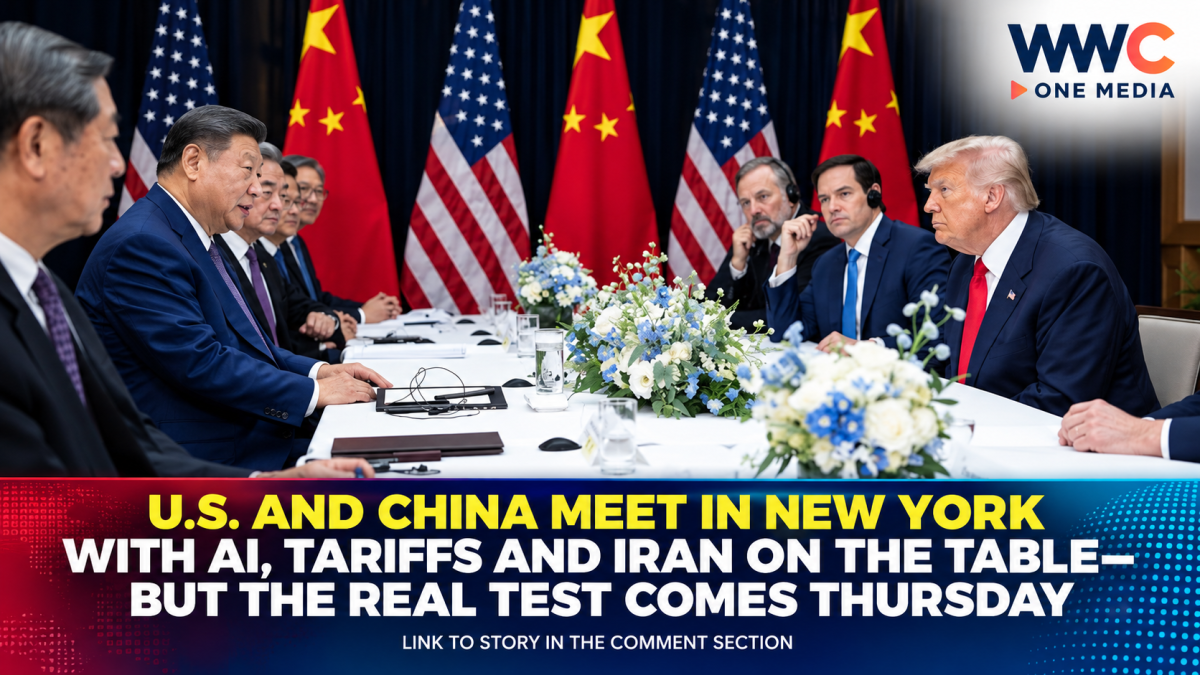
NEW YORK — The United States and China are opening another round of high-level talks in New York as officials race to contain tensions over trade, artificial intelligence, critical minerals and the war involving Iran—just days before President Donald Trump is scheduled to meet Chinese President Xi Jinping in Washington.
U.S. Treasury Secretary Scott Bessent and Chinese Vice Premier He Lifeng are expected to lead the discussions on Sunday, September 20, while U.S. Trade Representative Jamieson Greer is also set to participate.
The talks are intended to lay groundwork for the Trump-Xi summit scheduled for September 24, according to Bloomberg and Reuters.
But the agenda is considerably broader than tariffs.
AI Has Become a New Flashpoint
Artificial intelligence is emerging as one of the most complicated issues between Washington and Beijing.
The two countries are competing over advanced AI models, computing infrastructure and the semiconductor technology needed to train increasingly powerful systems.
Reuters reported that Bessent plans to discuss AI as well as trade, rare earths and other economic issues with He.
Bessent has also indicated that Washington is willing to discuss what he described as shared AI risks with Beijing, including concerns about the growing separation—or “bifurcation”—of the two countries’ technology systems.
Axios reported that the U.S. position includes discussions involving both open- and closed-weight AI models.
The timing is notable because U.S. technology companies have recently intensified their debate over how quickly frontier AI should advance, while Chinese officials have pushed back against calls for a slowdown.
Reuters reported earlier this week that the AI rivalry is expected to feature prominently when Trump and Xi meet.
The two governments therefore face an unusual dilemma: they are simultaneously competitors in AI and potential partners in managing some of the technology’s risks.
Tariffs and the Trade Truce
Trade remains the immediate economic issue.
The United States and China have been operating under a fragile tariff truce, with the current arrangement set to expire in November.
Bloomberg reporting cited by other outlets says Washington and Beijing have been working to reduce tariffs on certain American energy and agricultural products, while broader discussions have focused on maintaining stability in the relationship.
The two sides are also discussing market access and implementation of previous commitments.
U.S. officials have indicated that Washington wants more balanced trade, including improved access for American farmers and manufacturers.
At the same time, Bloomberg reporting said an announcement involving potential new U.S. tariffs related to concerns about excess manufacturing capacity has been delayed until after the Trump-Xi meeting.
That leaves the upcoming presidential summit as a potentially important moment for determining whether the current trade truce can be extended.
Rare Earths Add Another Layer of Pressure
Critical minerals are another major point of friction.
China dominates significant parts of the global rare-earth supply chain, making Chinese exports strategically important to industries ranging from electronics to automobiles and defense.
Bloomberg reported that Beijing could potentially offer additional permits for rare-earth exports as part of the negotiations, although the details of any possible arrangement remain unclear.
For Washington, maintaining access to critical minerals is closely connected to broader concerns about supply-chain security.
For Beijing, rare-earth controls provide an important source of economic leverage at a time when Washington continues restricting China’s access to certain advanced technologies.
Then There Is Iran
The Middle East is adding another complication.
The ongoing conflict involving Iran has disrupted energy flows and created economic risks well beyond the region.
China is particularly important because it is a major buyer of Iranian oil.
Bloomberg reporting says the United States is pressing Beijing over Iran-related trade and financial flows, while the Treasury Department has increased pressure on institutions involved in transactions connected to Iran.
Reuters reported that Bessent has already held private discussions with Chinese officials about the issue and hopes to make further progress during the New York meetings.
The energy dimension is significant.
Any prolonged disruption involving the Strait of Hormuz could affect oil supplies and prices across the global economy. China has also publicly called for an end to the conflict and the reopening of the strategic waterway.
Recent reporting from The New York Times said Chinese Foreign Minister Wang Yi met Iranian Foreign Minister Abbas Araghchi in Beijing and reiterated China’s calls for an end to the war and the reopening of the Strait of Hormuz.
Washington Wants Stability—But the Disputes Remain
The immediate objective of the New York talks appears to be preventing another escalation before Trump and Xi sit down.
Bloomberg reporting cited analysts who described the current approach as less about fundamentally transforming U.S.-China relations and more about maintaining stability and preventing another tariff confrontation.
That does not mean the major disagreements have disappeared.
Taiwan remains a significant Chinese concern, while Washington continues to scrutinize China’s technology policies, trade practices and access to advanced computing.
The two governments are also competing for influence over the future of AI and the global technology supply chain.
The Associated Press noted that cooperation on AI governance is complicated by deep strategic mistrust, with Washington concerned about China’s technological rise while Beijing views some U.S. technology restrictions as attempts to contain its development.
The Trump-Xi Meeting Is Now the Bigger Test
The New York discussions are therefore more than another round of trade negotiations.
They are a prelude to the Trump-Xi summit, where the two leaders are expected to address some of the most consequential issues in the U.S.-China relationship.
A limited agreement on tariffs, rare earths or other economic issues could reduce immediate pressure on businesses and supply chains. But AI restrictions, Taiwan, Iran and strategic technology competition are considerably more difficult questions.
For now, negotiators are trying to keep the relationship from deteriorating before the presidents meet.
The bigger question is whether they can do more than simply postpone the next confrontation.
Because when Trump and Xi sit down in Washington on September 24, the New York talks will reveal just how much room for compromise is actually left.