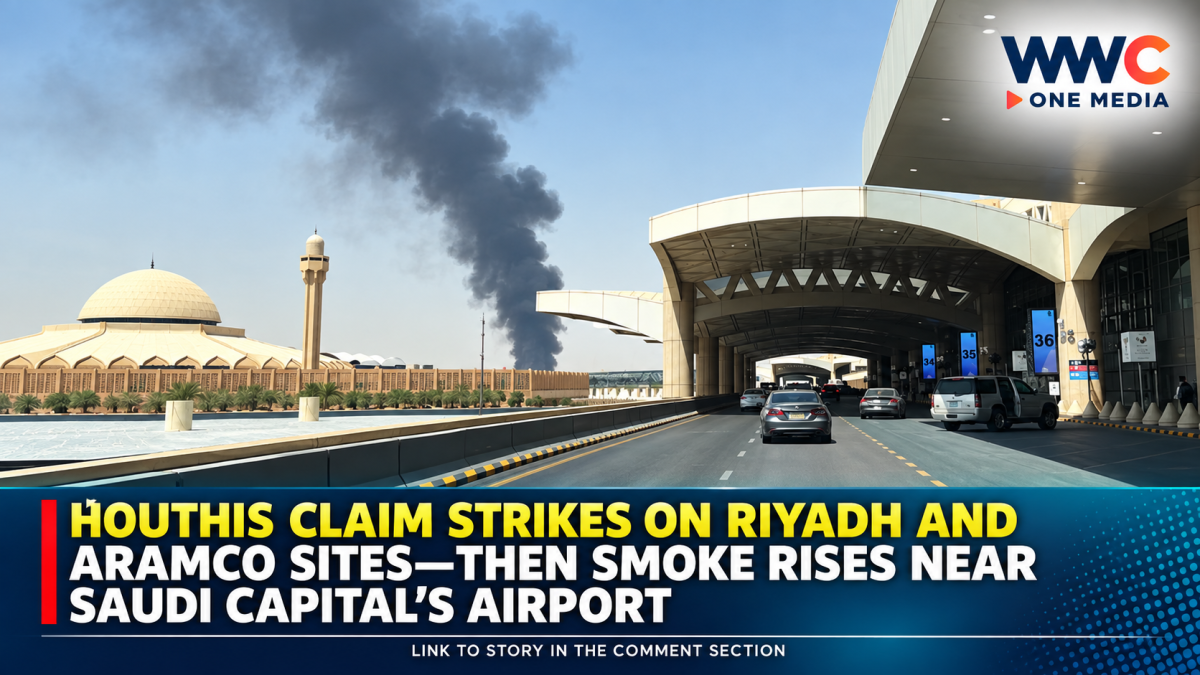
RIYADH/SANAA — Yemen’s Houthi movement says it launched missile and drone attacks against what it described as “sensitive sites” in Saudi Arabia’s capital, Riyadh, as well as facilities belonging to oil giant Saudi Aramco in the Red Sea city of Yanbu.
The claim came on Saturday, September 19, after Saudi authorities issued air-raid warnings around Riyadh and residents reported explosions. A large plume of smoke was later seen near King Khalid International Airport, where firefighters were also reported to have extinguished a blaze involving a fuel tank bearing the Aramco logo.
Houthi military spokesman Yahya Saree said the group had conducted two operations using ballistic missiles, cruise missiles and drones. According to the Houthi statement, one operation targeted “sensitive sites” in Riyadh while another targeted Aramco facilities in Yanbu.
The Houthis described the operations as successful and said they were carried out in response to Saudi military activity in Yemen. However, the claims regarding the extent of damage at the alleged targets have not been independently verified. Saudi Aramco did not immediately provide comment on the Houthi claim regarding its Yanbu facilities.
Saudi Arabia Says Missile Targeting Riyadh Was Intercepted
Saudi Arabia’s side of the incident differs from the Houthi account.
The Saudi-led coalition said its air defences intercepted and destroyed a ballistic missile launched toward Riyadh. Saudi authorities also said attacks targeting civilian infrastructure in Yanbu, Taif, Baysh and Farasan had been thwarted.
Residents in Riyadh reported hearing explosions, while images and video showed a substantial column of smoke near the capital’s airport.
Saudi authorities reported no casualties or damage in Riyadh from the intercepted missile. However, the reported fire at an Aramco fuel facility near the airport added to concerns about the vulnerability of Saudi energy infrastructure during the latest escalation.
The incident also marked the first air-raid alert in Riyadh since the latest escalation between Saudi Arabia and the Houthis began, according to Al Jazeera.
Why Yanbu Matters
Yanbu is one of Saudi Arabia’s most important industrial and energy centres on the Red Sea coast.
The city hosts major oil-refining and export infrastructure and is also connected to Saudi Arabia’s East-West pipeline system. Any sustained disruption affecting energy facilities in western Saudi Arabia could therefore have implications beyond the immediate conflict zone.
The latest Houthi claim comes amid a broader campaign involving attacks on Saudi territory, energy infrastructure and shipping routes. The escalation has raised concerns about the security of a crucial alternative route for Gulf energy exports while regional maritime traffic remains under pressure.
Conflict Has Expanded Beyond Yemen
The latest exchange is part of a rapidly worsening confrontation that has intensified since July.
The Houthis have claimed attacks against Saudi targets in recent weeks, while Saudi Arabia and its allies have carried out military operations against Houthi positions in Yemen. Reuters reported that the latest escalation has included strikes on Saudi cities and energy-related infrastructure, while fighting inside Yemen has also intensified.
Saudi authorities previously reported that debris from an intercepted Houthi drone killed one person and injured others in Taif. Earlier attacks and interceptions have also triggered warnings across several Saudi regions.
The United Nations has separately raised concerns about attacks affecting civilians and critical infrastructure, as well as the widening humanitarian consequences inside Yemen. A UN Security Council briefing documented earlier attacks affecting Saudi civilian and energy infrastructure and called for protection of civilians and humanitarian access.
Regional Powers Respond
The latest attacks are also drawing wider regional attention.
Turkey’s Foreign Minister Hakan Fidan said Turkey was prepared to assist Saudi Arabia with military requirements under a recently signed trilateral defence agreement involving Turkey, Saudi Arabia and Pakistan. Reuters reported that the agreement provides for an armed attack against one member to be treated as an attack against all three.
Jordan and Bahrain have also condemned the Houthi attacks and expressed support for Saudi Arabia’s security and sovereignty.
The United Nations Security Council has likewise condemned continuing Houthi attacks affecting Saudi Arabia, including attacks involving civilian and energy infrastructure, while calling for an end to the military escalation and renewed efforts toward a political settlement.
What Comes Next?
The immediate question is whether the latest exchange remains limited to missile and drone attacks or develops into a broader campaign against Saudi energy infrastructure and Red Sea shipping.
For now, the two sides are presenting sharply different accounts: the Houthis say they successfully struck sensitive targets in Riyadh and Aramco facilities in Yanbu, while Saudi authorities say their air defences intercepted the ballistic missile headed toward Riyadh and thwarted attacks elsewhere.
What is independently established is that Saudi Arabia issued an unprecedented warning for Riyadh during the latest escalation, explosions were heard in the capital, and smoke was seen near King Khalid International Airport.
With the conflict already affecting Saudi cities, energy infrastructure and maritime security, the latest attacks add another layer of uncertainty to an increasingly volatile Middle East security situation.