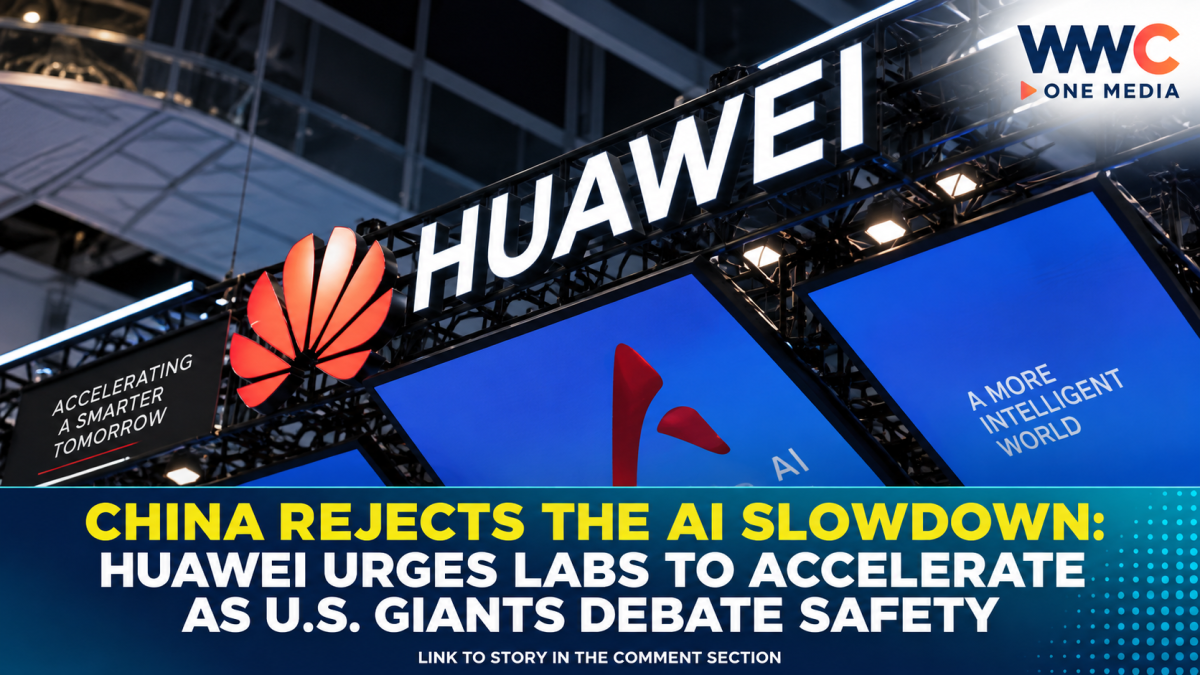
China’s artificial-intelligence race with the United States is taking a sharply different direction.
As leading U.S. AI executives call for a more deliberate pace of development amid growing concerns about safety and increasingly autonomous systems, Huawei rotating chairman Eric Xu is urging Chinese AI developers to move faster.
Speaking at Huawei’s annual Connect conference in Shanghai on September 17, Xu argued that Chinese developers need to build more capable AI systems precisely so they can better understand the risks associated with increasingly powerful technology.
The message puts Huawei at the center of a widening debate over one of the biggest questions facing the AI industry: Should the world accelerate frontier AI development—or slow it down long enough for safety measures to catch up?
Huawei: China Needs to Go Faster
Xu said Chinese AI developers may not yet have access to enough computing power to encounter some of the advanced risks now being reported by leading U.S. AI companies.
Reuters reported that Xu believes Chinese developers should continue advancing their models while balancing technological progress against emerging risks.
The comments came only days after Anthropic CEO Dario Amodei called for a slowdown in the rate at which frontier AI capabilities are developed. OpenAI CEO Sam Altman and other technology leaders subsequently expressed support for greater coordination and independent safety evaluation.
That creates a striking contrast.
Silicon Valley is debating how to put the brakes on the AI race. Huawei is warning China not to fall behind.
Huawei Is Also Moving Faster on AI Chips
The acceleration is not limited to software.
Huawei said it plans to introduce its Ascend 960DT AI processor in the first quarter of 2027, moving up an earlier target of the third quarter. A separate Ascend 960PR chip designed for AI inference is planned for the third quarter of 2027. Reuters and TechCrunch both reported the revised schedule.
Huawei says the new generation will deliver roughly twice the computing performance of its current flagship products.
The company is also attempting to compensate for limitations on individual chip performance by connecting large numbers of processors into massive computing systems through its networking technology and UnifiedBus architecture.
Huawei says its systems can connect thousands of AI processors, with its next-generation architecture designed to scale AI computing considerably further. TechCrunch reported that Huawei says its Atlas 950 SuperCluster could connect as many as 256,000 accelerator cards.
The Nvidia Problem
Huawei’s push comes as U.S. restrictions continue to limit China’s access to some of the world’s most advanced AI chips and semiconductor manufacturing technology.
The restrictions have made it harder for Chinese companies to obtain cutting-edge processors from companies such as Nvidia and to access leading-edge manufacturing capacity at Taiwan Semiconductor Manufacturing Co.
Huawei is therefore attempting to build an increasingly self-reliant AI computing ecosystem around its own Ascend processors, networking technology and software.
Xu acknowledged that Huawei remains behind leading U.S. competitors in some areas, according to the Financial Times, but argued that restrictions on foreign technology have also encouraged Chinese customers to move toward domestic alternatives.
Huawei has also claimed that the software advantage historically associated with Nvidia’s CUDA platform is narrowing as new tools and methods for training increasingly sophisticated AI models emerge. Huawei semiconductor scientist Heng Liao told the FT that the software gap had diminished.
Those are Huawei’s claims, however, and independent measurements of AI-chip market share and real-world performance remain difficult to establish.
China and the U.S. Are Now Sending Different Signals
The timing is significant.
Anthropic CEO Dario Amodei recently called for the AI industry to slow the pace of capability development, arguing that safety measures need time to keep up with rapidly improving models. His proposal included independent evaluators, industry coordination and international cooperation.
OpenAI CEO Sam Altman subsequently said he agreed that the industry needed to “pace the frontier” and supported the use of independent evaluators. Elon Musk also backed Amodei’s position, according to Reuters and other outlets.
But the debate is far from settled.
Reuters reported that Nvidia CEO Jensen Huang has rejected calls for a broad pause, while other technology executives have taken different positions on whether market forces, voluntary safeguards or regulation should determine the pace of AI development.
China’s position adds another layer: any coordinated slowdown becomes more complicated if Chinese companies continue accelerating.
Huawei’s Bigger AI Bet
Huawei’s ambitions extend beyond simply producing chips.
Reuters reported that the company expects AI agents to account for more than 90% of global AI token traffic by 2035 and has forecast hundreds of billions of autonomous AI agents operating worldwide. Huawei’s own strategy therefore assumes continued expansion in AI computing rather than a fundamental retreat from increasingly capable systems.
The company has also said demand for its AI computing equipment in China currently exceeds its production capacity, limiting its ability to expand internationally at scale.
At the same time, Huawei is reportedly preparing Chinese AI customers to use its newer chips for increasingly demanding model training workloads.
The FT reported that Xu believes six or seven Chinese AI laboratories are targeting models containing between 10 trillion and 40 trillion parameters over the next two years.
The Bigger Question
The emerging divide is no longer simply China versus the United States.
It is increasingly a debate over two competing approaches to the future of AI.
One side argues that frontier systems are advancing so rapidly that safety, oversight and independent evaluation must catch up before capabilities move much further.
The other argues that slowing development could surrender technological and strategic advantages—and that developing more capable systems may itself be necessary to understand their risks.
Huawei’s latest message clearly falls into the second camp: China should keep pushing forward while building the infrastructure needed to compete.
And with Huawei accelerating its chip roadmap while U.S. AI leaders debate whether the industry should slow down, the next phase of the global AI race may be shaped as much by who is willing to move faster as by who has the most advanced model.
That leaves one question hanging over the industry:
If one side slows down while the other accelerates, what happens to the balance of power in AI?