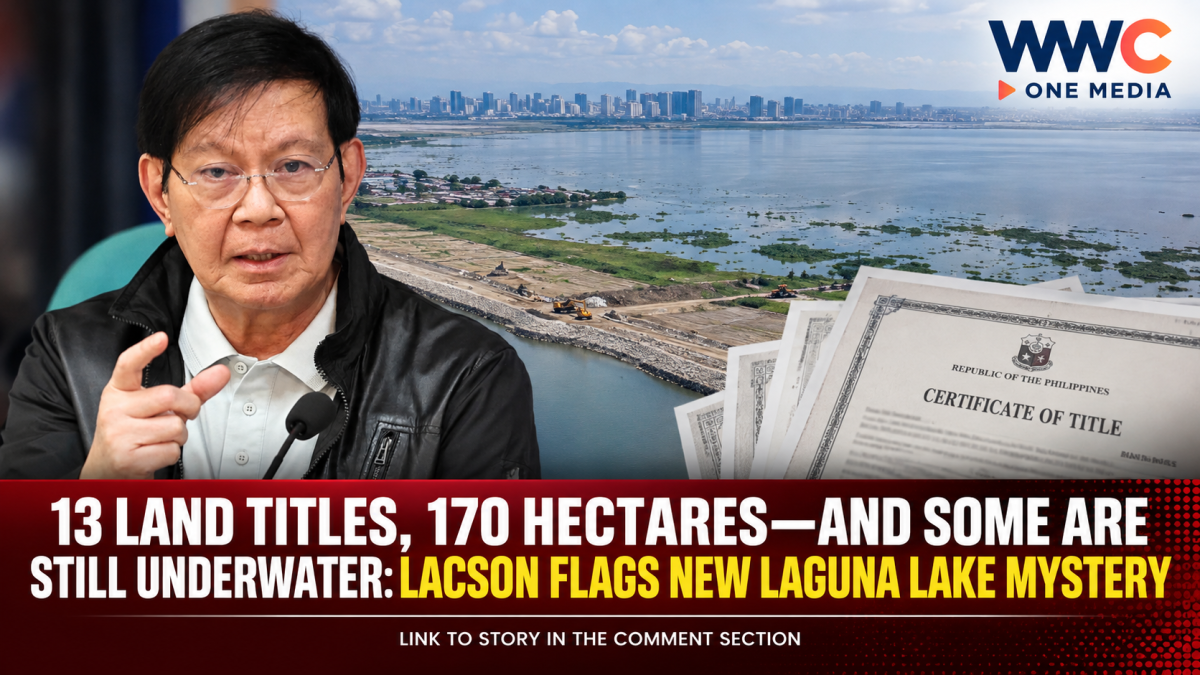
MANILA, Philippines — A new development in the controversy over reclamation along the Taguig side of Laguna Lake is raising questions about how land titles were issued in areas that Philippine Reclamation Authority (PRA) data reportedly show include portions that remain underwater.
Sen. Panfilo “Ping” Lacson said updated PRA information has identified at least 13 land titles covering about 170 hectares of alleged unauthorized encroachment on the Taguig side of Laguna Lake.
What makes the finding particularly striking, Lacson said, is that the PRA’s review using digital and satellite maps found that some of the titled areas are still covered by water.
“There are titled areas that are still water,” Lacson said, according to reports of his remarks.
The senator said the 170 hectares on the Taguig side represents nearly one-third of an estimated 560 hectares of reclaimed or encroached area covering portions of Laguna Lake in Rizal and Laguna.
From 85 hectares to 170 hectares
The latest figure is double Lacson’s earlier estimate.
On Sept. 12, Lacson said information from the PRA showed approximately 170 hectares on the Taguig side alone had been covered with soil, compared with an initial estimate of 85 hectares.
The senator has called for the government to examine the areas and determine what should happen to land allegedly reclaimed without the necessary authorization. He has also said that any forfeiture of illegally reclaimed areas should not replace possible legal action against those responsible.
The land-title issue was already under investigation
The latest revelation follows earlier findings involving land titles connected to allegedly unauthorized reclamation.
In late August, Lacson said the Land Registration Authority (LRA) was reviewing the history and origins of titles covering approximately 38.83 hectares of alleged illegally reclaimed areas in Taguig.
According to the LRA-related information cited by Lacson, some original certificates of title were issued through judicial or ordinary land-registration proceedings, while other properties were covered by patents. The agency was asked to trace the titles’ history and determine how they were issued.
Lacson subsequently identified four parcels totaling roughly 38.8 hectares that he described as being covered by allegedly “fraudulently” issued titles. Four additional parcels, he said, did not have plotted title lots appearing in the LRA’s digital records.
The four parcels cited in those earlier disclosures included:
- 9,204 square meters covered by an administrative patent and an Original Certificate of Title;
- 5,000 square meters covered through judicial/ordinary land registration;
- 181,077 square meters covered by a homestead patent and a Transfer Certificate of Title; and
- 193,027 square meters covered by a Transfer Certificate of Title.
The allegations remain subject to investigation; descriptions such as “fraudulently issued” and “illegally reclaimed” are allegations made in connection with the ongoing inquiry, not final judicial findings.
Billions in government projects also under scrutiny
The controversy extends beyond the land titles.
Lacson has previously claimed that at least ₱3.713 billion in government funds went toward completed, ongoing and suspended Department of Public Works and Highways (DPWH) flood-control and multipurpose projects located along portions of the Taguig lakeshore that are now under scrutiny because of the alleged reclamation issues.
The senator said the amount did not include other projects he alleged involved questionable appropriations and so-called “ghost” projects.
The findings have been submitted to the Office of the Ombudsman, which is conducting a fact-finding investigation into allegations surrounding projects in Taguig. Lacson’s team has said it submitted at least 45 case studies and supporting official documents.
Cayetano disputes Lacson’s characterization
The allegations have also fueled a public dispute between Lacson and Senate Minority Leader Alan Peter Cayetano, whose political base is Taguig.
Cayetano has rejected Lacson’s characterization of the Taguig projects, arguing that the city has been unfairly singled out. In a Sept. 19 Facebook livestream, Cayetano accused Lacson of portraying Taguig’s lakeshore projects in what he described as a malicious manner and questioned whether similar scrutiny was being applied elsewhere.
Earlier, Cayetano said that if properties were ultimately proven to have been illegally titled, the government could benefit because those properties could potentially revert to the state. He also welcomed the examination of the land titles.
Meanwhile, Lacson has maintained that the investigation should continue and that the evidence gathered by his team should be evaluated by the appropriate government agencies.
The question now: How were the titles issued?
The latest PRA finding shifts the controversy toward a potentially more fundamental question: How could areas identified through satellite and digital mapping as still underwater be covered by land titles?
That question cannot be answered solely by the senator’s allegations. It requires examination of the individual titles, historical maps and surveys, registration records, reclamation permits, environmental clearances and the legal basis under which the properties were titled.
For now, the 13 titles covering 170 hectares are part of an ongoing government inquiry. Whether individual titles are valid, voidable or were improperly issued will ultimately depend on the findings of the relevant agencies and, where applicable, legal proceedings.
What is already clear is that the Laguna Lake controversy has expanded from questions about reclamation and public infrastructure spending to a much deeper examination of how land could have been titled in an area that mapping data indicates still includes water.
And that could be the next major question investigators have to answer.