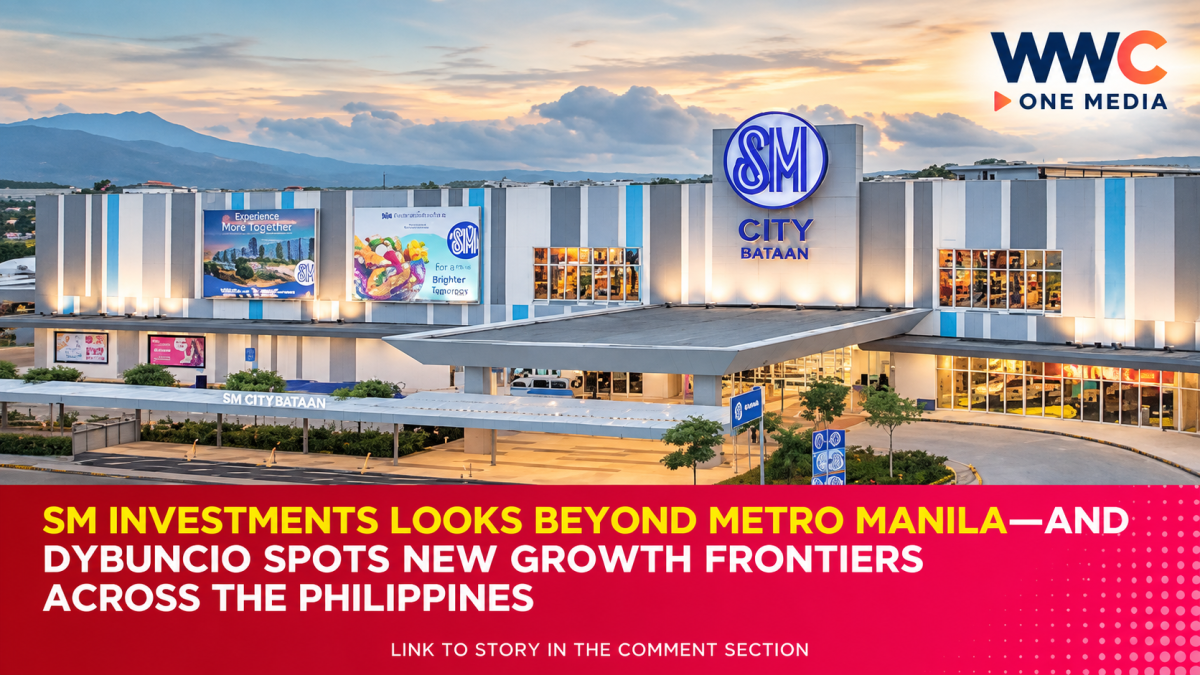
SM Investments Corp. (SMIC) is looking beyond Metro Manila for its next wave of growth, with President and CEO Frederic C. DyBuncio pointing to rising incomes, changing consumer behavior and expanding regional markets as opportunities the conglomerate wants to capture.
Speaking at the 24th MAP International CEO Conference, held under the theme “In the Age of Flux: Scaling the Next Inflection Points,” DyBuncio said SM’s nearly seven decades of operating in the Philippines have reinforced the importance of taking a long-term view rather than reacting only to short-term economic cycles.
“That potential is increasingly visible beyond Metro Manila,” DyBuncio said, pointing to rising incomes and evolving consumer aspirations across the regions.
The next growth story may be outside the capital
The message is significant for a conglomerate whose businesses span retail, banking, property and portfolio investments.
Rather than concentrating growth only in established economic centers, DyBuncio said businesses need to pay closer attention to where the next generation of consumer demand is emerging.
SM’s strategy is already reflected in its continued expansion beyond traditional economic hubs. SM Prime, for example, has identified emerging regional centers as part of its geographic expansion strategy, while SMIC’s portfolio includes businesses in logistics, food manufacturing, natural resources, office properties and other sectors.
The broader economic data also provides context for the company’s regional focus. The Philippine Statistics Authority reported that all 18 regional economies grew in 2025. Western Visayas recorded the fastest growth at 6.4%, followed by Caraga at about 5.7% and the Negros Island Region at about 5.7%. Davao Region grew 5.15%, while several other regions also expanded faster than or around the national growth rate of 4.4%.
SM’s numbers show why regional expansion matters
The regional push comes as SMIC enters the second half of 2026 with stronger financial results.
SM Investments reported ₱45.9 billion in consolidated net income for the first half of 2026, an 8% increase from ₱42.6 billion a year earlier. Revenue rose 6% to ₱339.2 billion.
GMA News reported that SM Retail’s net income increased 5% to ₱8.9 billion, while SMIC’s mall business generated ₱41.8 billion in revenue, up 8%. Its banking businesses posted mid-teens loan growth, while portfolio investments also contributed stronger results.
Importantly, SMIC executives said its provincial expansion plans remain on track, even as the company reviews its capital-expenditure guidance.
Technology can identify the opportunity—but executives still have to act
Another major theme at the MAP conference was the growing role of artificial intelligence and data in corporate decision-making.
Executives can use technology to identify patterns in consumer behavior and market conditions faster. But DyBuncio’s message was that having more data does not automatically determine the right business decision.
Leadership still has to determine what matters, where capital should go and when to invest.
That distinction could become increasingly important as businesses navigate changing consumer habits, artificial intelligence, economic uncertainty and shifting regional demand.
Why the provinces are becoming harder for big business to ignore
The shift toward regional markets is not unique to SM.
A recent Colliers report on Visayas and Mindanao identified Cebu, Davao and Iloilo among emerging growth centers, citing infrastructure development, residential demand, outsourcing activity and tourism as factors supporting expansion outside Metro Manila. The report projects roughly 45,000 condominium units to be delivered across VisMin from 2026 to 2029, with Cebu and Davao leading supply.
For SM, the opportunity stretches across several interconnected businesses. More regional consumers can potentially support retail and mall activity, while population and business growth can create demand for housing, offices, financial services, logistics and other services.
SM’s structure also allows its individual businesses to fund their own expansion while contributing earnings and dividends to the parent company, according to industry coverage of the group’s strategy.
The bigger story, therefore, may not simply be about SM opening more stores or developing more properties.
It is about where the Philippines’ next major centers of consumer demand will emerge—and how quickly large companies can position themselves there.