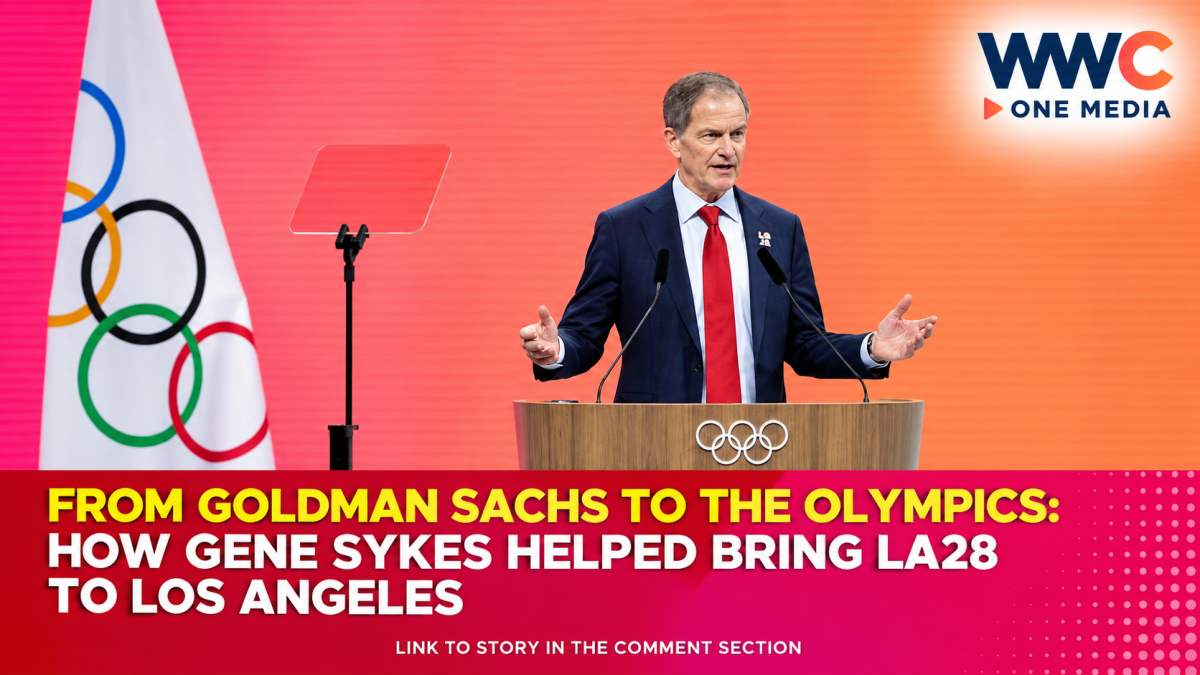
LOS ANGELES — For decades, Gene Sykes has operated in one of the most powerful corners of Wall Street, advising companies on billion-dollar mergers and acquisitions at Goldman Sachs.
But one of his most consequential assignments had nothing to do with a corporate takeover.
It involved convincing the International Olympic Committee that Los Angeles should host the 2028 Olympic and Paralympic Games.
Sykes, Goldman Sachs’ co-chairman of Global Mergers and Acquisitions and Global Technology, Media and Telecom, took a leave from the investment bank in 2015 to become chief executive of Los Angeles’ Olympic bid committee. He led the campaign that ultimately helped secure the 2028 Games for the city.
Now, with LA28 approaching, Sykes is wearing an even bigger Olympic role.
He has served as chair of the U.S. Olympic & Paralympic Committee board since 2022 and became a member of the International Olympic Committee in 2024.
The story offers an unusual intersection of Wall Street deal-making, international diplomacy, sports business and one of the world’s largest global sporting events.
The banker who left Goldman to sell Los Angeles to the IOC
Sykes joined Goldman Sachs in 1984 and became a partner in 1992. He later rose to become one of the firm’s senior M&A executives.
But in 2015, he stepped away from his Goldman responsibilities to take on an unpaid position running Los Angeles’ Olympic bid.
At the time, the campaign was competing for the 2024 Summer Olympics, and the financial stakes were enormous.
The Los Angeles Times reported that the bid committee expected to spend roughly $50 million campaigning for the Games, while the eventual Olympics could cost billions to stage.
Sykes brought a very different skill set to the campaign.
Rather than being a traditional sports executive, he came from the world of corporate transactions, negotiations and strategic finance.
That background became part of the appeal of his appointment.
Sports Business Journal reported in 2015 that Goldman Sachs supported Sykes’ decision to take the job, while then-Goldman CEO Lloyd Blankfein publicly backed his effort to lead the campaign.
Los Angeles didn’t initially win 2024—but it got something bigger
The Olympic campaign took an unexpected turn.
Instead of selecting Los Angeles for 2024, the IOC awarded those Games to Paris while Los Angeles received the 2028 Olympics as part of an unusual dual-award arrangement.
That decision was finalized in 2017.
The USOPC says Sykes oversaw the successful campaign that ended with the IOC awarding Los Angeles the 2028 Games.
For Los Angeles, the extended timeline also provided an opportunity to develop a different Olympic model.
Rather than constructing a huge collection of new venues, the city and organizers planned to rely heavily on existing infrastructure.
The IOC’s later publication on the LA bid noted that the ability to reuse existing infrastructure—and even consider university residences for the Olympic Village—was an important factor in making the bid financially feasible.
That approach has become one of the defining characteristics of LA28.
The “no-build” Olympics
Los Angeles is pursuing what organizers describe as a “no-build” approach, relying primarily on existing venues and temporary facilities rather than constructing an entirely new Olympic city.
That is particularly significant because Olympic hosting has become increasingly controversial in cities where massive construction programs have generated cost overruns and public opposition.
LA28’s model is designed to reduce that exposure.
The organizers are also working with the city on a framework intended to protect Los Angeles taxpayers and establish how city services will be reimbursed.
LA28 says its proposed agreement with Los Angeles is designed to deliver the Games at zero cost to the city, while providing financial protections and funding for services associated with hosting.
A separate agreement reached between Los Angeles and LA28 in 2026 addresses reimbursement for services such as traffic control, trash collection and public safety.
The Los Angeles Times reported that the agreement includes provisions intended to protect taxpayers, although some financial risks remain and additional venue-level service agreements still have to be completed.
The financial side is where Sykes’ Wall Street background matters
The Olympics are not simply a sporting event.
They are a massive financial operation involving sponsorships, broadcasting rights, ticketing, infrastructure, tourism, security and government services.
That makes Sykes’ background in M&A and corporate finance particularly relevant.
In his recent Bloomberg Odd Lots appearance, Sykes discussed both sides of his career—his decades at Goldman Sachs and his role in the Olympic and Paralympic ecosystem. The conversation also examined how a city finances and organizes a major event such as the Olympics.
The comparison is revealing.
An M&A banker spends much of his professional life assessing businesses, negotiating complex transactions and bringing different parties together around a financial structure.
An Olympic bid requires many of the same broad disciplines—but on a far larger civic and international stage.
Los Angeles had to persuade IOC officials, coordinate with city and national stakeholders, secure financial commitments and present a credible plan for hosting the Games.
LA28 is now becoming an economic story
The approaching Olympics are also generating increasingly large economic projections.
A September 2026 analysis commissioned by LA28 and conducted by the Los Angeles County Economic Development Corporation estimated that the Games could generate between $20.5 billion and $40.6 billion in economic output across the Greater Los Angeles region.
The study estimated that the Olympics and Paralympics could support as many as 224,000 jobs, while generating between $5.1 billion and $5.9 billion in tax revenue for federal, state and local governments.
The projected economic activity is expected to come from several sources, including infrastructure spending, LA28’s own expenditures and spending by visitors.
The study estimates that approximately 2 million visitors could travel to the region for the Games.
However, these are projections rather than guaranteed outcomes.
The Los Angeles Times noted that a comparable economic forecast for the Paris 2024 Olympics ultimately fell short of expectations, underscoring the uncertainty surrounding large-event economic forecasts.
Sponsorship has become another critical piece
For LA28, corporate partnerships are essential to the financial model.
The organizing committee has been building a sponsorship portfolio involving major companies across industries.
That landscape received another major boost in 2026 when JPMorgan Chase became the first bank to join the International Olympic Committee’s Worldwide Olympic Partner program.
The agreement covers LA28 and the French Alps 2030 Winter Games, while JPMorgan Chase will also serve as a founding partner of LA28 in retail banking and as the official bank of Team USA and LA28.
The deal illustrates the scale of corporate interest surrounding the Games.
Olympic sponsorship is no longer simply about putting a logo inside a stadium. Companies increasingly use the Games to connect their consumer brands, financial services, technology and employee programs to a global audience.
The Olympic business model is being tested again
Los Angeles’ experience is being closely watched because the economics of hosting the Olympics have changed dramatically.
The 1984 Los Angeles Games are often remembered for their financial success, but subsequent Olympics have produced very different outcomes.
LA28 is attempting to reduce some of the traditional risks by using existing venues and relying heavily on private financing and commercial revenue.
Yet there are still significant uncertainties.
The 2023 LA Times reported that the most recent Olympic budget at that time was approximately $6.9 billion, with organizers planning to cover costs through IOC payments, sponsorships, ticket sales and other revenue. It also noted that Los Angeles and California legislators had agreed to serve as a financial backstop for costs that LA28 could not cover.
The 2026 city agreement is intended to further define who pays for services associated with the Games and how potential shortfalls are handled.
Sykes’ role has grown far beyond the original bid
Sykes’ involvement did not end when Los Angeles won the bid.
He left the CEO position at the end of 2018 but remained involved with LA28 and later moved into a broader leadership role within the U.S. Olympic movement.
In July 2022, he was elected chair of the USOPC board.
Two years later, he was unanimously approved as an IOC member.
That gives Sykes an unusual perspective.
He is simultaneously connected to:
Wall Street.
U.S. Olympic leadership.
The international Olympic movement.
Los Angeles’ preparations for 2028.
And that combination makes his career particularly unusual even within the upper ranks of global sports administration.
The Games are also confronting a changed Los Angeles
The city that won the bid in 2017 is not exactly the same city preparing to host the Games in 2028.
Los Angeles has faced major debates over housing affordability, homelessness, transportation, public safety and infrastructure.
Those issues are now part of the broader conversation about what the Olympics should leave behind.
LA28 says its plans include commitments involving economic empowerment, workforce development, accessibility, sustainability, arts and culture and human rights, in addition to its long-term sports legacy programs.
The organization has also committed $160 million toward youth sports programs across Los Angeles, according to its proposed city agreement.
Whether those commitments translate into measurable long-term benefits will become clearer after the Games.
A different kind of Wall Street story
Sykes’ story is unusual because it demonstrates how Wall Street expertise can move into a completely different arena.
He spent decades helping corporations navigate complex transactions.
Then he took a leave from Goldman Sachs to lead an Olympic campaign.
The campaign initially sought the 2024 Games.
Instead, Los Angeles ended up with 2028.
Now Sykes is helping oversee the broader U.S. Olympic movement as LA prepares to welcome the world.
The financial challenge ahead is substantial: organizers have to deliver a global sporting event, manage costs, secure commercial revenue, coordinate government services and demonstrate that the Games can create a lasting benefit for the region.
At the same time, Los Angeles is preparing for an Olympic event projected to bring billions of dollars in economic activity and hundreds of thousands of jobs to Southern California.
For Sykes, the journey that began with a Goldman Sachs executive stepping away from Wall Street in 2015 has become something much larger.
The banker who once helped sell Los Angeles to the Olympic movement now sits inside that movement—and the next deal is no longer about winning the Games.
It is about proving that Los Angeles can deliver them.