
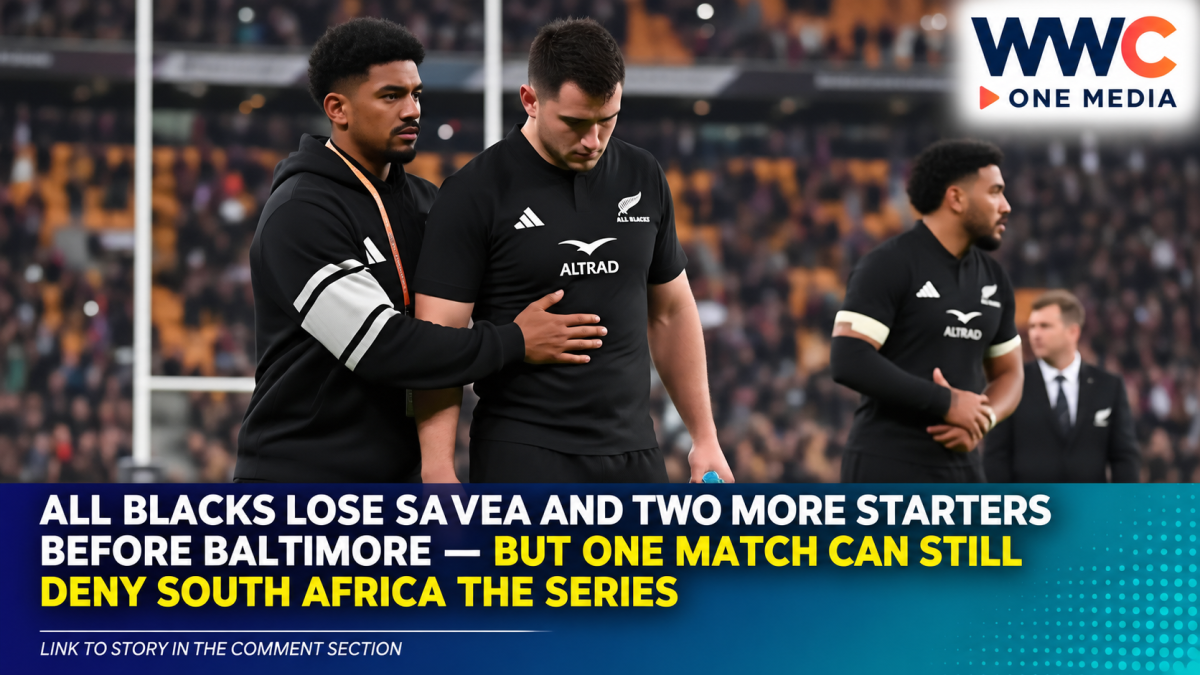
JOHANNESBURG — The All Blacks were already facing a difficult assignment in Baltimore.
Now they will have to attempt it without their captain — and two more men who started beside him in Johannesburg.
New Zealand confirmed that Ardie Savea, Quinn Tupaea and Luke Jacobson will all miss the fourth and final Test against South Africa after suffering injuries during Saturday’s bruising 29-24 loss at FNB Stadium.
Savea dislocated his shoulder.
Tupaea suffered damage to the medial collateral ligament in his knee.
And Jacobson, who assumed the captaincy on the field after Savea was forced off, has subsequently been diagnosed with an elbow injury. 1News reports it as an elbow-tendon injury.
All three are heading home rather than continuing with the squad to the United States.
For New Zealand, it means the final chapter of its four-Test battle with the Springboks will begin with three new holes in a starting lineup already carrying the scars of an extraordinarily physical series.
And there is no room left for another defeat.
South Africa leads 2-1.
Savea scored twice — then the match changed
The loss of Savea is particularly painful because he had been one of New Zealand’s most influential players before his injury.
The All Blacks captain crossed for two tries in the opening 26 minutes, helping New Zealand repeatedly punish South African mistakes and establish early momentum.
But Savea left the field approximately nine minutes before halftime with the shoulder injury. Reuters reported that New Zealand had been setting the early tempo before South Africa gradually imposed its greater forward power.
The Springboks ultimately came from behind to win 29-24 in front of 87,976 spectators at Soccer City/FNB Stadium.
Both sides scored four tries.
South Africa got scores from Kurt-Lee Arendse, Jesse Kriel and Malcolm Marx, along with a penalty try. New Zealand’s other tries came through Will Jordan and Samisoni Taukei’aho after Savea’s brace.
The match was tied 12-12 at halftime.
New Zealand then retook the lead after the break, only for the Springboks to respond almost immediately.
From there, the Boks’ pack increasingly dictated the contest.
Jacobson inherited the captaincy — then joined the casualty list himself
There is a particularly cruel twist in Luke Jacobson’s injury.
When Savea went off, Jacobson took over the captaincy on the field.
Less than a day later, he too was ruled out of Baltimore.
1News says the 29-year-old flanker suffered an elbow-tendon injury, while the initial Reuters/CNA report described it more generally as an elbow injury.
Jacobson had started at openside flanker in Johannesburg alongside Peter Lakai and Savea in New Zealand’s loose-forward trio. The official All Blacks team sheet confirms that all three were starters for the third Test.
His absence means coach Dave Rennie must replace not merely another starting forward but one of the team’s most experienced loose forwards.
Potential combinations will become clearer only once New Zealand names its Baltimore squad and match-day 23.
Tupaea’s injury creates another selection problem
The midfield has also taken a significant hit.
Quinn Tupaea started at outside centre beside Jordie Barrett and had become an important part of Rennie’s preferred midfield combination.
He suffered an MCL injury during the Johannesburg Test and will also return to New Zealand.
Anton Lienert-Brown was among the backline replacements for the third Test and gives Rennie an experienced alternative, but New Zealand has not yet announced its Baltimore starting midfield.
That distinction matters.
It would be premature to present any replacement combination as confirmed.
Could Savea and Tupaea miss the rest of 2026?
Possibly — but that is not yet confirmed.
1News reported that the injuries to Savea and Tupaea may keep them out for the remainder of the year, while AP reported that return-to-play timelines for Savea, Tupaea and Jacobson were still to be determined.
So an accurate headline should not state that their 2026 seasons are definitely finished.
Further medical assessment will determine that.
That is especially significant for Savea.
The 32-year-old has captained New Zealand throughout this tour and entered Saturday’s match with 111 Test caps, according to the official team announcement.
Losing him for Baltimore is confirmed.
Losing him for the rest of the calendar year is not.
South Africa has suffered its own major loss
The Springboks are not leaving Johannesburg intact either.
Star winger Cheslin Kolbe suffered a broken jaw during Saturday’s match and will miss the Baltimore finale.
Kolbe had also been handling South Africa’s goalkicking during the series.
After his departure, Sacha Feinberg-Mngomezulu assumed the kicking duties and contributed seven points in the Springboks’ victory, according to AP.
So both teams will reach the United States without one of their most dangerous players.
But numerically, New Zealand’s immediate injury damage is heavier: three confirmed starters from Johannesburg are out.
The kicking battle quietly mattered
The final score was separated by only five points.
That makes one statistic especially difficult for New Zealand.
AP reported that All Blacks fly-half Ruben Love left seven of a possible nine points from his kicks at goal, while South Africa was able to maintain scoreboard pressure after Kolbe’s departure.
In a contest where both teams scored exactly four tries, those missed opportunities became magnified.
It also illustrates why describing the defeat simply as South Africa overpowering New Zealand would miss part of the story.
The Springboks’ forward strength mattered.
But so did errors, discipline and points that New Zealand failed to convert.
Rennie described the margin between the teams as small while acknowledging that the All Blacks needed to be more disciplined.
South Africa’s maul delivered the decisive blow
One of the pivotal moments came late in the second half.
After New Zealand’s Will Jordan kicked the ball dead, the resulting sequence eventually gave South Africa a platform from which its forwards drove a maul more than 20 metres.
Hooker Malcolm Marx finished the move in the 66th minute.
It was the type of sequence New Zealand had spent much of the series trying to prevent: the Springboks converting field position into a contest of raw forward power.
Feinberg-Mngomezulu then kicked a penalty with 10 minutes remaining, pushing South Africa 12 points clear.
Taukei’aho’s final-whistle try reduced the final margin to five, but the comeback came too late.
The series has completely reversed since Test One
Three Tests ago, the picture looked very different.
New Zealand opened the Test portion of the tour by beating South Africa 33-16 at Ellis Park, outscoring the Springboks five tries to one.
South Africa then responded with a 33-26 victory in Cape Town, leveling the series at 1-1.
Saturday’s 29-24 win turned the series again.
The sequence is now:
New Zealand 33-16 South Africa
South Africa 33-26 New Zealand
South Africa 29-24 New Zealand
That leaves the Springboks one victory or draw away from taking the series outright.
New Zealand’s only route to denying them that distinction is winning in Baltimore and finishing 2-2.
And a 2-2 draw would produce one of rugby’s strangest trophy outcomes
There is an unusual wrinkle.
The specially created Rugby’s Greatest Rivalry Trophy is literally made in two halves, joined magnetically.
New Zealand Rugby says that if one nation wins the series, that country receives both halves.
But if the four Tests finish tied, each nation keeps one half of the trophy.
That makes Baltimore unusually straightforward.
South Africa wins or draws: both halves go to the Springboks.
New Zealand wins: the trophy itself is divided.
For an All Blacks team suddenly missing Savea, Tupaea and Jacobson, that half-trophy may now represent the difference between salvaging the tour and watching South Africa complete a remarkable comeback from 1-0 down.
Baltimore is more than a novelty Test
The Sept. 12 match will take place at M&T Bank Stadium, home of the NFL’s Baltimore Ravens.
New Zealand Rugby lists the stadium’s capacity at 70,257 and says Baltimore will become the sixth Test the All Blacks have played on U.S. soil.
The match was designed as the spectacular American finale to a revived extended New Zealand-South Africa tour.
Instead, it has become a test of squad depth.
Rennie must replace his captain.
He must rebuild his loose-forward unit.
He must reconfigure his midfield.
And he must do it after consecutive defeats against the reigning heavyweight of the rivalry.
The injuries did not start this weekend
This tour had already demanded replacements before the Johannesburg defeat.
After the opening Test, prop Ethan de Groot and lock Josh Lord entered World Rugby’s concussion protocols, prompting New Zealand to call Ofa Tu’ungafasi and Jamie Hannah into the touring squad.
Those cases should not be automatically added to the current Baltimore unavailable list without a fresh team update.
But they underline how much disruption the All Blacks have absorbed over the course of the tour.
And the latest injuries strike at particularly sensitive positions.
Savea is the captain and No. 8.
Jacobson is a starting flanker who took over the leadership during the Test.
Tupaea is a starting centre.
That is considerably harder to absorb than losing three players from the fringes of the squad.
One reporting discrepancy is worth watching
There is also a small but important difference between reports about replacements.
The AP report published after the match said neither side planned to replace its injured players in the touring squad.
A later 1News report, however, said the All Blacks would reinforce their squad for Baltimore, with the additions still to be confirmed.
Because 1News’ account appears to reflect a later New Zealand-specific update, the safest wording for publication is:
New Zealand is expected to bring in reinforcements, but no replacement names had been confirmed at the time of writing.
That avoids presenting an early report as the final position.
Rennie’s problem goes deeper than filling three jerseys
Replacing injured players is the obvious task.
Replacing what they provide is harder.
Savea gives New Zealand ball-carrying power, breakdown presence, leadership and attacking instinct.
Jacobson brings work rate and defensive physicality.
Tupaea has helped create continuity in a midfield that has undergone considerable selection experimentation.
And Baltimore comes only a week after an 80-minute confrontation Rennie described as physically and tactically close.
South Africa will have its own problems without Kolbe.
But the Springboks also have something New Zealand does not:
A 2-1 series lead and the ability to finish the job without necessarily having to win.
The final Test has suddenly become a test of depth
When this four-Test series began, the story was framed around history.
Could New Zealand recreate the achievement of its famous 1996 tour?
Could South Africa establish supremacy over its oldest rival?
Could two of international rugby’s most successful nations turn a traditional rivalry into a modern global spectacle?
Three Tests later, the question has become much more immediate.
Can the All Blacks survive without three of the men who started in Johannesburg?
South Africa has already recovered from losing the opening Test.
New Zealand now has to recover from losing two matches in succession — and from losing its captain, starting centre and starting flanker at almost exactly the worst possible moment.
Baltimore was supposed to be the grand finale.
For the All Blacks, it has become a rescue mission.
WWC ONE MEDIA M.J.E

Leave a Reply