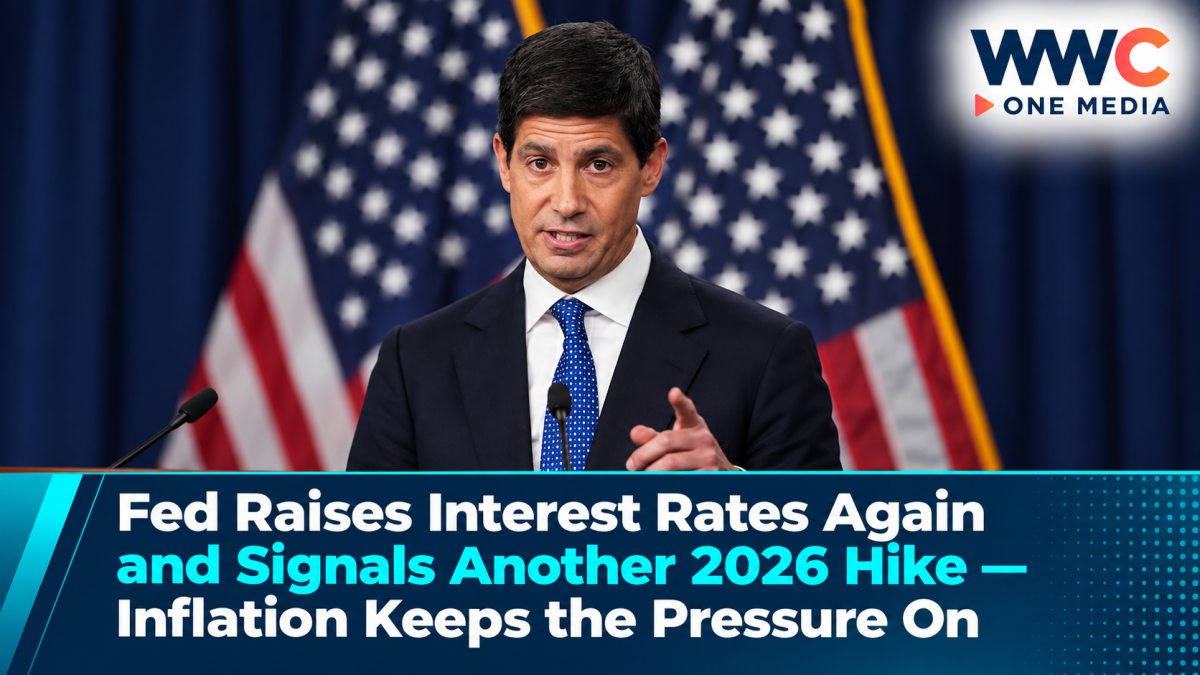
WASHINGTON — The U.S. Federal Reserve has raised interest rates for the first time since 2023 and signaled that borrowing costs could move even higher before the end of the year, as policymakers confront inflation that remains well above the central bank’s 2% target.
The Federal Open Market Committee voted unanimously on September 16 to increase the federal funds target range by 25 basis points to 3.75%–4%. It was the first rate increase since July 2023.
But the rate hike itself was only part of the story.
The Fed’s updated projections showed that 16 of 18 policymakers who submitted rate forecasts expect at least one additional quarter-point increase before the end of 2026, while two expect rates to remain at their current level. Fed Chair Kevin Warsh apparently did not submit a rate projection.
That means the central bank has effectively reopened the possibility of a renewed tightening cycle after spending much of the previous period moving toward lower borrowing costs.
Why the Fed is hiking again
The central problem is inflation.
The Fed said inflation remains elevated and that the latest rate increase is intended to support a more timely return to its 2% inflation objective.
At the same time, the central bank said economic activity continues to expand at a solid pace, domestic spending remains resilient, productivity growth is strong and capital investment is robust.
That combination gives policymakers more room to focus on price pressures rather than immediately prioritizing weaker growth.
The latest decision also comes against the backdrop of higher energy prices linked to the ongoing conflict in the Middle East.
Reuters reported that the rise in energy costs has made the inflation outlook more difficult for policymakers, particularly because a sustained increase in oil prices can feed through into transportation, household and business costs.
The inflation forecast just moved higher
The Fed’s September projections show how much the inflation outlook has changed.
Policymakers now see headline PCE inflation at 3.7% in 2026, up from the 3.6% projection issued in June.
The median forecast falls to 2.3% in 2027, 2.1% in 2028 and 2% in 2029.
Core PCE inflation, which excludes food and energy prices, is projected at 3.4% for 2026, before declining to 2.5% in 2027 and 2.2% in 2028.
Those numbers remain well above the Fed’s 2% objective in the near term.
That is one reason the central bank is not treating the September hike as a one-off event.
Another hike is now in the Fed’s baseline projections
The updated rate projections put the median federal funds rate at 4.1% at the end of 2026.
With the current target range centered at 3.875%, that median is consistent with another 25-basis-point increase.
The median projection then keeps the policy rate at 4.1% at the end of 2027 before bringing it down to 3.9% in 2028 and 3.6% in 2029.
But those figures should not be interpreted as a guaranteed schedule.
The Fed’s projections are individual policymakers’ assessments of the appropriate future policy path based on their economic outlook. They can change as inflation, employment, energy prices and other conditions change.
Reuters reported that Fed officials expect one more increase this year but then generally see rates holding steady in 2027.
The economy is not collapsing
One of the most important details in the Fed’s latest projections is that policymakers did not pair the rate hike with a sharply deteriorating growth forecast.
Instead, the median forecast for 2026 real GDP growth was raised to 2.3% from 2.2% in June.
Growth is projected at 2.4% in 2027, 2.2% in 2028 and 2.1% in 2029.
That suggests the Fed’s baseline scenario is not one of an immediate recession.
The central bank is attempting to cool inflation while maintaining an economy that it currently describes as expanding at a solid pace.
Unemployment is expected to remain relatively stable
The labor market outlook is also relatively steady.
The Fed’s median projection puts the unemployment rate at 4.1% at the end of 2026, unchanged from the June projection.
It is also projected at 4.1% in 2027, 2028 and 2029.
That is significant because monetary policy becomes more difficult when inflation is high but employment is weakening sharply.
For now, the Fed’s forecasts imply that policymakers see room to keep fighting inflation without expecting a major deterioration in the labor market.
Warsh’s first major test
The September decision was also significant because it marked the first rate-setting decision under Fed Chair Kevin Warsh.
Reuters reported that Warsh joined the unanimous decision to raise rates.
The decision came despite political pressure from President Donald Trump, who has publicly advocated substantially lower interest rates.
The Fed’s statutory mandate, however, is centered on maximum employment and price stability.
The September statement emphasized the inflation problem and said the latest move would support a timelier return to the 2% goal.
The Fed is watching energy prices closely
Oil has become one of the biggest complications for the inflation outlook.
The ongoing Middle East conflict has pushed energy prices higher, raising the possibility that inflation could remain elevated for longer than policymakers previously expected.
Reuters reported that central banks around the world are now responding to renewed inflation pressures associated with higher energy costs, with the Federal Reserve, European Central Bank and Bank of Japan all having moved toward tighter policy while the Bank of England has maintained rates but signaled concern about inflation.
This creates a difficult global environment.
If energy prices remain high, central banks may have less room to lower borrowing costs.
If high rates eventually weaken demand substantially, however, policymakers could face pressure in the opposite direction.
A new global rate-hike cycle?
The Fed’s decision is part of a broader shift in global monetary policy.
The European Central Bank has also been moving toward tighter policy, while the Bank of Japan recently raised its policy rate to its highest level since 1995.
The Bank of England, meanwhile, left rates unchanged but signaled that persistent inflation could require additional action.
The developments have raised the possibility of a renewed global tightening cycle after years in which investors had largely expected major central banks to move toward lower interest rates.
The difference this time is that inflation is being influenced not only by domestic demand but also by geopolitical shocks and energy markets.
What higher US rates mean for borrowers
The Fed’s policy rate directly affects the broader cost of borrowing throughout the U.S. economy.
Higher rates can increase financing costs for:
- Credit cards
- Auto loans
- Mortgages
- Business loans
- Corporate debt
- Consumer financing
The effects are not always immediate or identical because many loans carry fixed rates or are priced using different benchmarks.
But over time, tighter monetary policy generally raises the cost of credit and can slow interest-sensitive spending and investment.
What happens to stocks?
Higher interest rates can also affect stock valuations.
When government bond yields rise, investors have a potentially more attractive alternative to riskier assets.
Higher borrowing costs can also reduce expected corporate earnings by increasing financing expenses and potentially slowing consumer and business demand.
Reuters reported that investors are now focusing on the future path of rates, Middle East tensions and other risks as they assess U.S. equities after the Fed’s decision.
The market response, however, is not necessarily straightforward.
Some investors may interpret higher rates as evidence that policymakers believe economic growth remains strong enough to tolerate tighter financial conditions.
Others may focus on the inflation risk and the possibility of rates remaining high for longer.
Treasury yields are another warning signal
Bond markets have already been reacting to the prospect of prolonged higher rates.
The U.S. 10-year Treasury yield moved above 5% during the week, reflecting investor concern about inflation, government borrowing and the future path of monetary policy.
Higher long-term Treasury yields matter beyond Wall Street.
They influence borrowing costs throughout the economy, including mortgages and corporate financing.
They can also affect currencies and capital flows around the world.
Asia will feel the Fed’s decision
The impact does not stop at U.S. borders.
Higher U.S. rates can strengthen the dollar relative to other currencies by making dollar-denominated assets more attractive, although exchange rates are influenced by many factors.
For emerging markets, a stronger dollar can increase the local-currency cost of servicing dollar-denominated debt.
It can also put pressure on central banks that want to reduce their own interest rates.
CNA reported that Asian markets are particularly sensitive to the Fed’s policy because changes in U.S. rates affect capital flows, currencies and the region’s borrowing conditions.
For countries such as the Philippines, Indonesia and other emerging economies, the combination of higher U.S. rates and elevated oil prices can be particularly important because both can affect currencies, inflation and external financing conditions.
The dollar gets another potential tailwind
The prospect of another Fed hike can support the U.S. dollar if investors conclude that U.S. interest rates will remain higher than those in other major economies.
But currency movements are not determined by interest rates alone.
The dollar also responds to economic growth, fiscal policy, risk sentiment, geopolitical developments and expectations about future Fed decisions.
That means the September hike does not guarantee a stronger dollar indefinitely.
The biggest question is what happens after the next hike
The Fed’s latest projections provide an important clue.
Policymakers expect another increase in 2026, but their median forecasts do not show a long series of aggressive hikes.
Instead, the projected rate path rises to 4.1% at year-end 2026 and remains there through 2027 before declining in subsequent years.
That suggests the current policy debate is less about a return to the extremely aggressive tightening seen in 2022–2023 and more about whether inflation requires a modest additional restriction of financial conditions.
Still, the outlook could change quickly.
A sustained rise in oil prices could push inflation higher.
A sharp slowdown in employment could make further hikes less appropriate.
And a combination of stronger-than-expected growth and persistent inflation could force policymakers to tighten further.
Investors now have a difficult equation to solve
The market is effectively watching three numbers:
Inflation.
Economic growth.
Interest rates.
If inflation falls rapidly while growth remains healthy, the Fed could eventually have room to ease.
If inflation remains high, another hike becomes more plausible.
If inflation stays elevated while growth and employment weaken sharply, policymakers face a much harder trade-off.
That is why the Fed’s latest projections matter beyond the September meeting.
The message from Washington is clear — but the path isn’t
The Federal Reserve has now moved rates higher for the first time since 2023.
Its policymakers have signaled that another increase is likely in 2026, while the central bank’s updated forecasts show inflation remaining above target for longer than previously expected.
At the same time, the Fed expects economic growth to remain positive and unemployment to stay around 4.1%.
That combination gives policymakers a relatively narrow path to navigate.
For households, businesses and investors, the practical question is no longer whether the Fed has returned to rate hikes.
It has.
The bigger question is how far the central bank will go — and whether inflation finally starts moving decisively toward 2% before another increase becomes necessary.