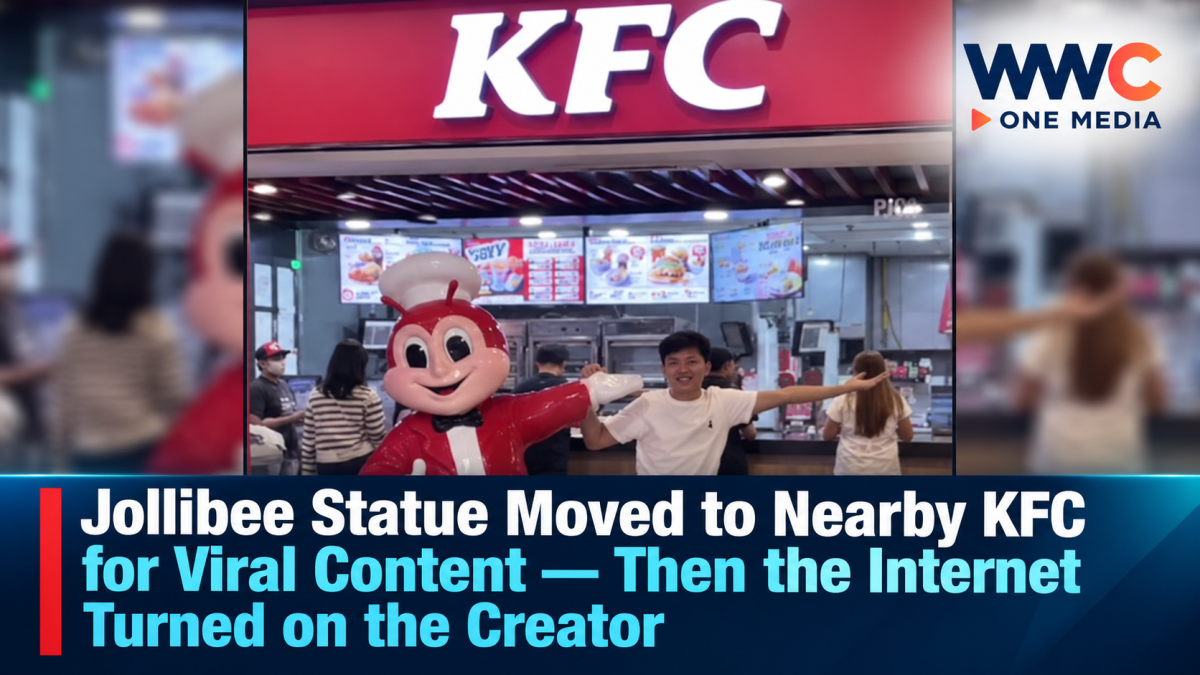
A social-media stunt involving a life-size Jollibee mascot figure has sparked a heated online debate after a content creator was filmed moving the figure from a Jollibee branch to a nearby KFC.
The video, featuring content creator Hansol Hard, showed him taking the Jollibee figure and bringing it into the neighboring fast-food establishment. He also posed with the mascot before moving it inside KFC.
The stunt was apparently made for entertainment content, but what followed was anything but lighthearted.
Screenshots of the video were posted on X on September 16 by an account identified as @pepeshawarma, with the post questioning whether the Jollibee figure had been taken without authorization. The post quickly attracted attention and criticism from Filipino social-media users.
The creator’s own caption reportedly joked about the mascot’s arrival at KFC, adding to the impression that the incident was staged as a humorous crossover between two competing fast-food brands.
But online reactions quickly shifted from laughter to a much more serious question:
Was the stunt still a joke if the property was moved without permission?
The video that triggered the backlash
The controversy began after footage showed Hansol Hard moving the Jollibee mascot figure away from its original location and taking it into a KFC branch located only a few establishments away.
The figure was then positioned inside KFC while the creator filmed the stunt.
Interaksyon reported that the creator posted the content on Facebook with the caption, “Welcome KFC daw, sabi ni Jobee,” presenting the move as a joke.
The video itself became the subject of a separate social-media post, where the uploader criticized what they described as the unauthorized removal of Jollibee property.
That post was subsequently shared widely, turning what may have started as a short-form prank into a broader debate about the limits of content creation.
Social media users were divided
Not everyone reacted the same way.
Some commenters appeared to regard the stunt as harmless entertainment.
Others argued that the issue was not whether the video was funny, but whether the creator had permission to move the mascot in the first place.
Comments questioned whether getting views and engagement justified physically moving an item belonging to a business.
Others argued that content creators should understand the difference between a harmless prank and conduct involving another person’s or company’s property.
Interaksyon quoted one commenter saying content creation should not come at the expense of “respect, honesty, consent, and accountability.”
The discussion quickly became bigger than the Jollibee-versus-KFC joke itself.
Was it actually theft?
This is where the story requires an important distinction.
Several social-media commenters described the incident as taking property.
But the available reporting does not establish that a court or law-enforcement agency has determined that the creator committed theft.
PhilNews reported that the online criticism centered on the allegation that the Jollibee figure had been moved without authorization.
Under Article 308 of the Philippine Revised Penal Code, theft involves taking another person’s personal property without consent and with intent to gain.
Whether a particular incident satisfies those legal elements depends on facts that are not publicly established in the reporting reviewed, including authorization, ownership, intent and the circumstances surrounding the removal.
Therefore, calling the incident a proven case of theft would go beyond the verified information currently available.
Jollibee has not been publicly reported as filing a complaint
Another important point is what hasn’t been established.
The reports reviewed do not establish that Jollibee has filed a criminal complaint against Hansol Hard over the incident.
There is also no verified court ruling or police finding establishing criminal liability.
The controversy at this stage is primarily a social-media backlash over an alleged unauthorized removal of a company mascot figure.
That distinction matters, particularly as viral posts can quickly turn allegations into statements of fact.
Why the Jollibee mascot matters
For Jollibee, the mascot is far more than an ordinary decoration.
Jollibee is the flagship brand of Jollibee Group, which describes the restaurant as the Philippines’ largest fast-food chain and one of its global brands with operations across Asia, North America and Europe.
Life-size Jollibee figures are commonly associated with the chain’s restaurant locations and branding.
Jollibee’s official Kids Party program also identifies the Jollibee mascot as part of its event offerings, illustrating the mascot’s role in the company’s customer-facing brand experience.
That helps explain why some users viewed the removal of a physical mascot differently from an ordinary prank involving an individual’s personal belongings.
The KFC connection made the video even more provocative
The destination of the mascot was also significant.
It wasn’t simply moved to another location.
It was taken into KFC, a direct competitor in the fast-food market.
That gave the video an obvious punchline: Jollibee’s iconic mascot suddenly appeared inside a rival restaurant.
From a content perspective, the setup was designed to generate attention.
But the same element that made the video potentially entertaining also helped fuel the backlash.
Critics argued that the rivalry between the brands did not automatically give someone permission to move a branded object belonging to one company into another establishment.
The “clout” debate
The incident has also revived a familiar argument surrounding viral content in the Philippines:
How far should creators go to get views?
Social-media platforms reward content that produces strong reactions.
Pranks, public stunts, surprise interactions and brand-related jokes can quickly generate shares and comments.
But the pursuit of viral engagement can also create consequences when creators cross boundaries involving private property, businesses, public safety or personal consent.
In this case, the controversy was not simply about a Jollibee mascot appearing at KFC.
It became a discussion about whether content creation should have limits when other people’s property or business premises are involved.
A simple prank became a bigger brand conversation
The incident is particularly striking because both Jollibee and KFC are among the most recognizable fast-food brands operating in the Philippines.
Jollibee Group describes Jollibee as its flagship brand and highlights the chain’s international expansion.
KFC Philippines, meanwhile, operates its own nationwide restaurant network and multiple ordering and delivery channels.
The mascot stunt therefore placed two major commercial brands into an unexpected social-media narrative without either brand being reported as having organized the stunt.
That is one reason the video attracted attention so quickly.
The bigger lesson for Filipino content creators
The controversy highlights a problem that is becoming increasingly relevant as social-media creators turn everyday environments into content studios.
A creator may see a funny opportunity.
A business may see an unauthorized interference with its property.
Viewers may see either a harmless prank or a line being crossed.
Those perspectives can collide within minutes once a video becomes viral.
And once an incident spreads online, the consequences can extend far beyond the original joke.
What happens next?
For now, the verified story remains relatively simple:
A content creator was filmed moving a Jollibee mascot figure to a nearby KFC for a video. The footage was shared online, a social-media user accused the creator of taking the property without authorization, and the incident triggered widespread criticism and debate.
What remains unclear is whether Jollibee authorized the stunt, whether the creator had permission to move the figure, whether the company intends to take any action, or whether the incident will remain nothing more than a viral social-media controversy.
And that is ultimately what has turned a seemingly simple fast-food prank into a much bigger conversation:
When does chasing the next viral video stop being a joke — and start crossing someone else’s line?