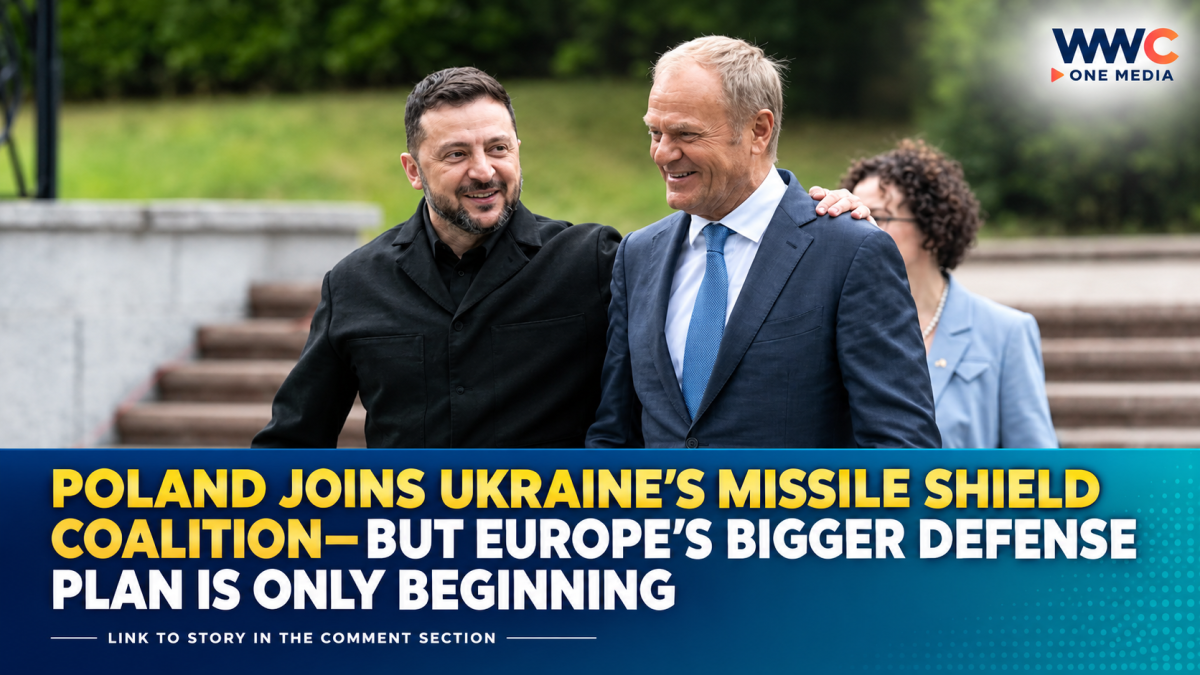
WARSAW/KYIV — Poland has joined a European anti-ballistic missile coalition led by Ukraine, adding another major NATO country to an effort aimed at developing a new generation of missile-defense capabilities for Europe.
Polish Prime Minister Donald Tusk announced Warsaw’s entry into the initiative on September 18 during a summit in western Ukraine hosted by President Volodymyr Zelenskyy.
“From today, Poland is part of this major project,” Tusk said in a video posted on social media, adding that the two sides had agreed on the framework and form of Poland’s participation. Reuters reported the announcement.
The move expands the coalition originally established in July by Ukraine and nine European countries: Denmark, France, Germany, Italy, the Netherlands, Norway, Spain, Sweden and the United Kingdom. Poland’s accession brings the participating countries to 11.
Europe seeks a new missile-defense architecture
The coalition was created to develop an integrated European capability against ballistic-missile threats. Its founding declaration describes the initiative as purely defensive and says the planned architecture is intended to complement existing missile-defense systems rather than immediately replace them.
The initiative is closely associated with Freyja, a European anti-ballistic missile project designed to combine technologies and expertise from Ukraine and European defense industries.
Ukraine wants a prototype, or minimum viable product, for the system during the first half of 2027, according to a senior Ukrainian official cited by Reuters in July. The project is being developed with participation from a range of European defense companies, while Ukrainian defense company Fire Point is a key industrial partner.
The project is also being presented as a potential lower-cost complement to systems such as the US-made Patriot. European governments have faced growing pressure to expand missile-defense capacity as the war in Ukraine exposes shortages in interceptors and other air-defense resources.
Why Poland’s participation matters
Poland’s decision is significant because of its geographic position on NATO’s eastern flank and its direct security concerns linked to the war in Ukraine.
Poland was not among the original 10 members when the coalition was announced in Paris in July. At the time, Warsaw had indicated that participation would depend in part on the role Polish defense companies could play in the project. Tusk has since said the framework for Poland’s involvement has been agreed.
Zelenskyy welcomed Poland’s entry and said Ukraine was ready to share military technologies and experience developed during the war with its Polish partners.
The Ukrainian government says the coalition’s work will involve governments, military institutions and defense industries working together on requirements, research, development, manufacturing, testing and eventual deployment of new capabilities.
Freyja is designed to complement existing defenses
The coalition does not mean Europe is abandoning systems already in service.
Ukraine’s National Security and Defense Council says Freyja is intended to create an additional layer within a broader European missile-defense architecture. Ukraine is expected to contribute interceptor technology and battlefield experience, while European partners bring expertise in areas including radar, sensors, communications and other components.
Reuters reported in September that Europe’s push for alternatives reflects concerns over dependence on sophisticated US missile-defense systems and shortages of interceptors, while European countries are also pursuing systems such as the French-Italian SAMP/T-NG.
The broader objective is therefore not simply the creation of one new weapon, but the development of a more integrated European approach to detecting, tracking and intercepting ballistic threats.
Poland also announces new Ukraine aid
Tusk’s announcement came with another pledge of support for Kyiv.
The Polish prime minister said Warsaw had prepared a new “significant” aid package for Ukraine, although he did not disclose its contents or value. Zelenskyy thanked Poland for the package following their bilateral meeting.
The announcement was made during the first summit of the newly established Carpathian Eight, a regional format involving Ukraine, Poland, Romania, Slovakia, the Czech Republic, Austria, Hungary and Serbia. The gathering focused on regional cooperation involving security, energy, logistics and trade. Reuters reported that more than 50 agreements worth over €1 billion were signed during the wider summit, with more than half related to renewable energy.
A wider European defense effort
Poland’s entry comes as European governments increasingly seek greater capacity to defend their airspace and reduce vulnerabilities exposed by Russia’s war against Ukraine.
The original anti-ballistic coalition declaration said participating countries would establish common operational requirements, technical working groups and a roadmap toward initial operational capabilities. It also called for joint research, development and information-sharing.
For Ukraine, the project offers an opportunity to turn battlefield experience against Russian missile attacks into technology developed jointly with European partners. For European participants, it represents another effort to build greater industrial and technological capacity in missile defense.
The immediate test, however, will be whether the coalition can turn its political agreement into a functioning system on the ambitious timetable already set for Freyja.
With Poland now inside the coalition, Europe’s proposed missile shield has gained another major participant—but the difficult work of developing, testing and integrating the system is still ahead.