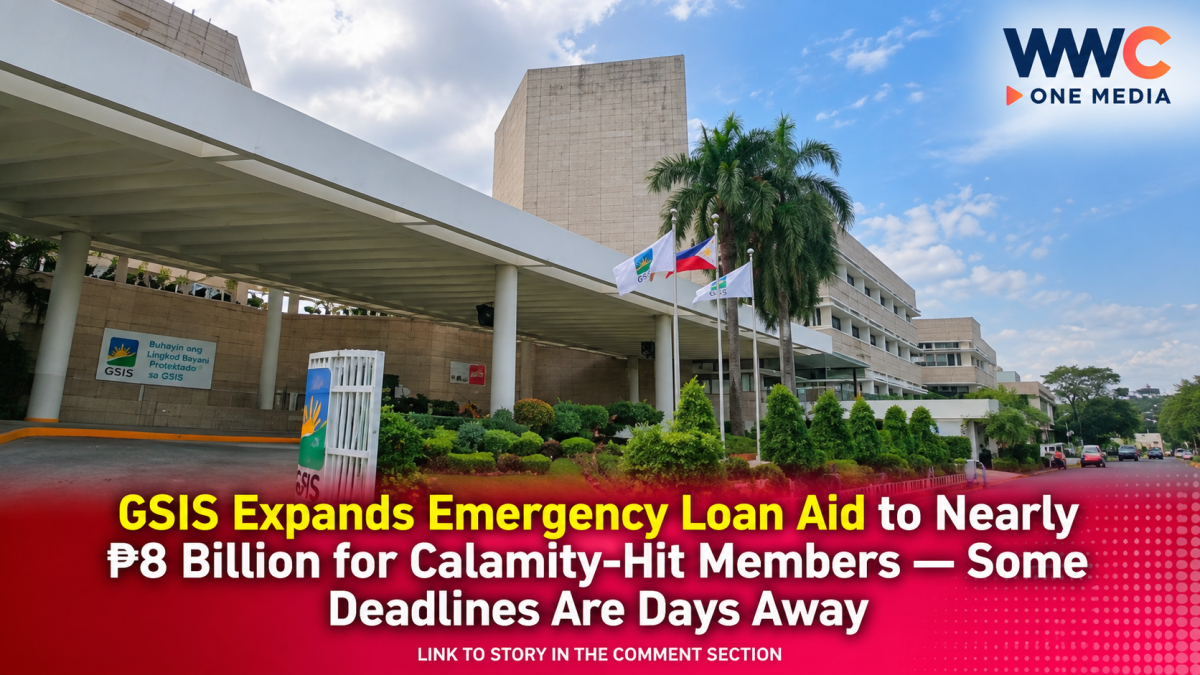
MANILA, Philippines — Government workers and pensioners affected by recent typhoons and widespread flooding now have access to a much larger financial lifeline after the Government Service Insurance System (GSIS) expanded its emergency-loan assistance to nearly ₱8 billion.
The expanded program covers 317,721 active members and old-age and disability pensioners in 16 calamity-hit areas affected by Typhoons Luis, Maymay and Neneng, as well as the enhanced southwest monsoon, or habagat.
The expansion is significant because GSIS had previously earmarked approximately ₱4.4 billion for emergency loans covering nine affected areas. The latest expansion effectively brings the available assistance to nearly twice that earlier allocation as more local governments declared states of calamity.
But eligible borrowers need to pay close attention to the deadlines: applications begin closing as early as September 20, 2026, depending on the affected area.
Up to ₱40,000 for qualified borrowers
Under the GSIS Emergency Loan Program, qualified members and pensioners without an existing emergency loan may borrow ₱20,000.
Those who already have an emergency loan may borrow up to ₱40,000, although their outstanding balance from the previous emergency loan will be deducted from the new loan proceeds.
The loan carries 6% interest computed in advance and is payable over 36 monthly installments.
GSIS says the monthly amortization is:
- ₱655.56 for a ₱20,000 loan
- ₱1,311.11 for a ₱40,000 loan
The emergency loan is also covered by loan redemption insurance under applicable GSIS rules.
Who can qualify?
For active GSIS members, eligibility requires that they either work for an agency located in, or reside in, a declared calamity area.
They must also:
- Be in active service and not on leave without pay
- Have the required premium contributions
- Have no due and demandable GSIS loan
- Have no pending administrative or criminal case
- Meet GSIS’s required minimum take-home pay after deductions
GSIS’s current emergency-loan guidelines specify that qualified active members must have premium contributions equivalent to at least three monthly contributions for both the personal and government shares within the six months before application.
For old-age and disability pensioners, they must reside in a declared calamity area and retain at least 25% of their basic monthly pension after the loan deduction.
The clock is already ticking
The application periods differ by locality.
According to GSIS and PNA, the earliest deadline is September 20 for qualified borrowers in Hagonoy, Bulacan, and Masinloc, Zambales.
Other deadlines include:
- September 26: Bulacan, except Calumpit and Hagonoy; Bataan; Zambales, except Olongapo City and Masinloc; and La Trinidad, Benguet
- September 27: Nasugbu, Batangas, and Paluan, Occidental Mindoro
- October 2: Other municipalities in Benguet, except Baguio City and La Trinidad; Tarlac; and Pangasinan, except Dagupan City, Mangaldan and Sta. Barbara
- October 3: Imelda, Zamboanga Sibugay
- October 7: Occidental Mindoro
- October 9: Olongapo City
- November 12: Cavite
- November 16: Rodriguez, Rizal
The staggered deadlines reflect the different dates on which the affected local governments were placed under states of calamity.
How the latest expansion happened
GSIS initially announced approximately ₱4.4 billion in emergency loans for 166,789 members and pensioners in nine affected areas.
As additional areas were declared under states of calamity, the pension fund expanded the program.
GSIS officials have said the coverage is being updated as local governments issue the necessary calamity declarations. PNA previously reported that the agency was monitoring other areas affected by heavy rains and flooding for possible inclusion.
The latest expansion therefore isn’t a blanket ₱8-billion cash distribution.
Rather, it is the total emergency-loan allocation made available to qualified borrowers across the newly covered areas. Actual loan proceeds depend on individual eligibility and applications.
Applications can be filed through GSIS Touch
Qualified members and pensioners can apply through the GSIS Touch mobile application, with approved proceeds credited to their accredited GSIS eCard or UMID card.
The digital application is particularly important during disasters because affected members may have difficulty traveling to government offices.
PNA previously reported that GSIS also provides assistance through its offices for members who cannot access the online system because telecommunications services have been disrupted by a calamity.
GSIS has been repeatedly expanding calamity assistance
The latest move follows a series of emergency-loan releases this year.
In July 2026, GSIS earmarked ₱520.08 million for 21,153 eligible members and pensioners affected by separate emergencies in Bagulin, La Union, and Negros Occidental.
The pension fund also previously announced emergency-loan assistance for areas affected by Typhoon Maymay and the southwest monsoon.
The pattern shows how the program is designed to expand geographically when local governments formally declare areas under a state of calamity.
This is a loan, not a cash grant
That distinction is important for members considering the assistance.
The GSIS Emergency Loan provides immediate access to borrowed funds, but the money must be repaid over 36 months, with interest computed in advance.
For a ₱20,000 loan, the stated monthly amortization is ₱655.56, while a loan of up to ₱40,000 carries a monthly amortization of ₱1,311.11, subject to the applicable deductions and GSIS rules.
Members should therefore check their individual eligibility, existing loan balance and resulting take-home pay or pension before applying.
GSIS has substantial experience with emergency lending
The emergency-loan expansion comes as GSIS continues to operate a much broader lending program for government employees.
In 2024, GSIS reported disbursing more than ₱289 billion through its Multi-Purpose Loan programs, benefiting more than 1.2 million government employees.
The figures illustrate the scale of GSIS’s lending operations beyond calamity assistance.
But the emergency program serves a different purpose: providing short-term financial assistance to qualified members and pensioners whose communities have been officially declared disaster areas.
What affected members should check now
For those in the covered areas, the most important details are eligibility, location and application deadline.
Members should verify that their municipality or city is included in the current GSIS coverage before applying and should not assume that living in a province affected by flooding automatically qualifies them.
The state-of-calamity declaration and GSIS’s designated coverage determine eligibility.
The deadlines are also not uniform, meaning two borrowers in the same province could potentially face different application dates depending on their municipality.
For the earliest-covered communities, the deadline is already approaching.
With nearly ₱8 billion now allocated for emergency loans covering more than 317,000 members and pensioners, GSIS is substantially expanding its financial response to the latest series of typhoons, flooding and monsoon-related disasters.
For thousands of government workers and pensioners trying to recover from damaged homes, disrupted livelihoods and unexpected expenses, the immediate question is no longer whether assistance exists.
It’s whether they qualify—and whether they can apply before their local deadline expires.