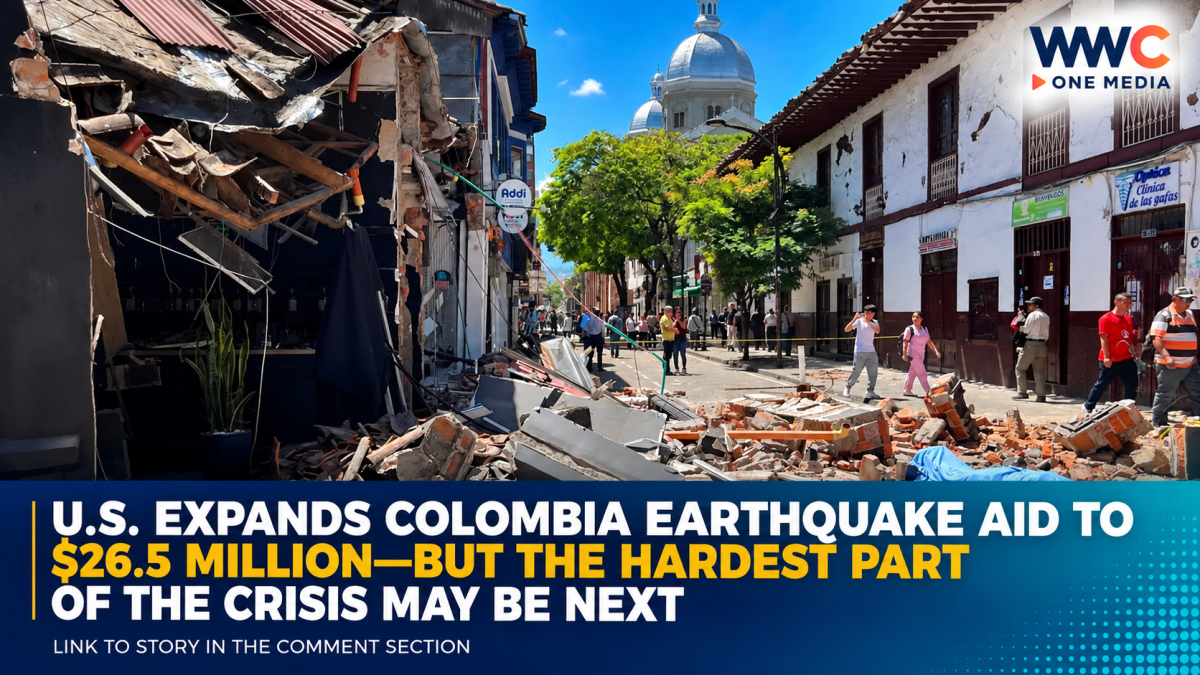
WASHINGTON/BOGOTÁ — The United States has expanded its humanitarian response to Colombia’s devastating 7.4-magnitude earthquake, bringing total U.S. assistance linked to the disaster to $26.5 million, while relief operations increasingly shift from emergency rescue to recovery and reconstruction.
The additional $11 million announced by the U.S. Department of State on August 14 came days after the earthquake struck western Colombia on August 10. The funding is supporting food, health, protection and shelter assistance, as well as structural assessments carried out with humanitarian organizations.
The U.S. response has also included logistical and search-and-rescue support.
According to the State Department, U.S. Southern Command helped transport relief supplies from a U.S. prepositioning facility in Miami to Colombia. Planned shipments included shelter materials, water and hygiene supplies, along with hundreds of Starlink kits intended to help humanitarian organizations and Colombian authorities maintain communications during relief operations.
Two urban search-and-rescue technical support teams from Fairfax County, Virginia, and Los Angeles County, California, were also deployed to Colombia. The teams provided coordination, communications and structural-engineering support to Colombian-led rescue operations.
Colombia earthquake leaves hundreds dead
The August 10 earthquake became one of Colombia’s most serious natural disasters in years.
The United Nations Development Programme reported that, as of August 27, official figures stood at 331 deaths, 4,449 injuries and 143 people missing, with 364 people rescued. Its rapid assessment estimated approximately $13.2 billion in structural damage and about 16.9 million cubic meters of debris.
The scale of the disaster extended well beyond collapsed buildings. The United Nations reported that the earthquake affected 16 departments and nearly 196,000 families, damaging homes, livelihoods, health facilities and almost 4,000 educational facilities.
By September 4, PAHO/WHO reported that 331 people had died, 4,519 had been injured and 122 remained missing, with more than 466,000 people affected across 498 municipalities. The agency said health authorities were continuing to maintain essential services, strengthen disease surveillance and address emerging health needs.
U.S. support goes beyond emergency cash
The $26.5 million figure represents more than a direct financial contribution.
The State Department said the assistance covers humanitarian food, health, protection and shelter programs and post-earthquake structural assessments through organizations including the International Federation of Red Cross and Red Crescent Societies, the International Organization for Migration, UNICEF, the World Food Programme and World Vision.
The United States also said it had made available $200 million to the Colombia Pooled Fund through its broader contribution to the U.N. Office for the Coordination of Humanitarian Affairs. That fund can be used for earthquake-related needs as well as other humanitarian needs in Colombia.
Secretary of State Marco Rubio later told Colombian President Abelardo de la Espriella that Washington’s response included the $26.5 million in emergency humanitarian assistance, search-and-rescue teams and C-130 airlift flights supporting Colombia’s recovery.
Recovery now becomes the bigger challenge
While the initial emergency response focused on finding survivors and delivering basic supplies, international agencies say the next phase will involve rebuilding communities and restoring essential services.
Doctors Without Borders reported in early September that urgent needs remained three weeks after the earthquake, particularly in communities facing poverty, limited access to health care and the presence of armed groups. Its teams identified continuing needs involving medical care, mental-health support, food and materials for rebuilding damaged homes.
The United Nations has likewise emphasized safer reconstruction, restoration of services and strengthening local capacity rather than simply replacing damaged infrastructure.
That makes the recovery considerably more complicated than the initial emergency response. Colombia must address damaged housing, schools, health facilities and livelihoods while also dealing with communities that already faced significant socioeconomic challenges before the earthquake.
Earthquake response becomes part of wider U.S.-Colombia ties
The disaster response has also unfolded against a broader period of closer U.S.-Colombia engagement.
Rubio visited Colombia in September as part of a regional trip that included Ecuador and Peru. Discussions with Colombia’s government covered earthquake recovery as well as security and economic cooperation.
The earthquake response has therefore taken place alongside wider negotiations between Washington and Bogotá.
Colombian President Abelardo de la Espriella also asked the Trump administration to temporarily suspend U.S. tariffs affecting Colombian products, arguing that tariff relief could help businesses dealing with the economic consequences of the disaster. The U.S. assistance announced by Washington and the tariff issue are separate policy matters, although both have featured prominently in recent U.S.-Colombia discussions.
The next test: rebuilding Colombia’s hardest-hit communities
The immediate search-and-rescue phase may have passed, but the humanitarian emergency has not simply disappeared.
PAHO/WHO said in September that health authorities were still working to stabilize essential services one month after the earthquake, while U.N. agencies have shifted their emphasis toward safer reconstruction and restoring schools, homes and basic services.
For Colombia, the challenge now is transforming emergency assistance into a sustained recovery program capable of rebuilding damaged communities and reducing vulnerabilities that existed before the earthquake.
For Washington, the $26.5 million response represents a substantial humanitarian commitment following the disaster. But with the damage assessment running into billions of dollars, the scale of Colombia’s recovery needs remains far larger than emergency relief alone.
The rescue phase may be ending. The much longer battle to rebuild Colombia is only beginning.