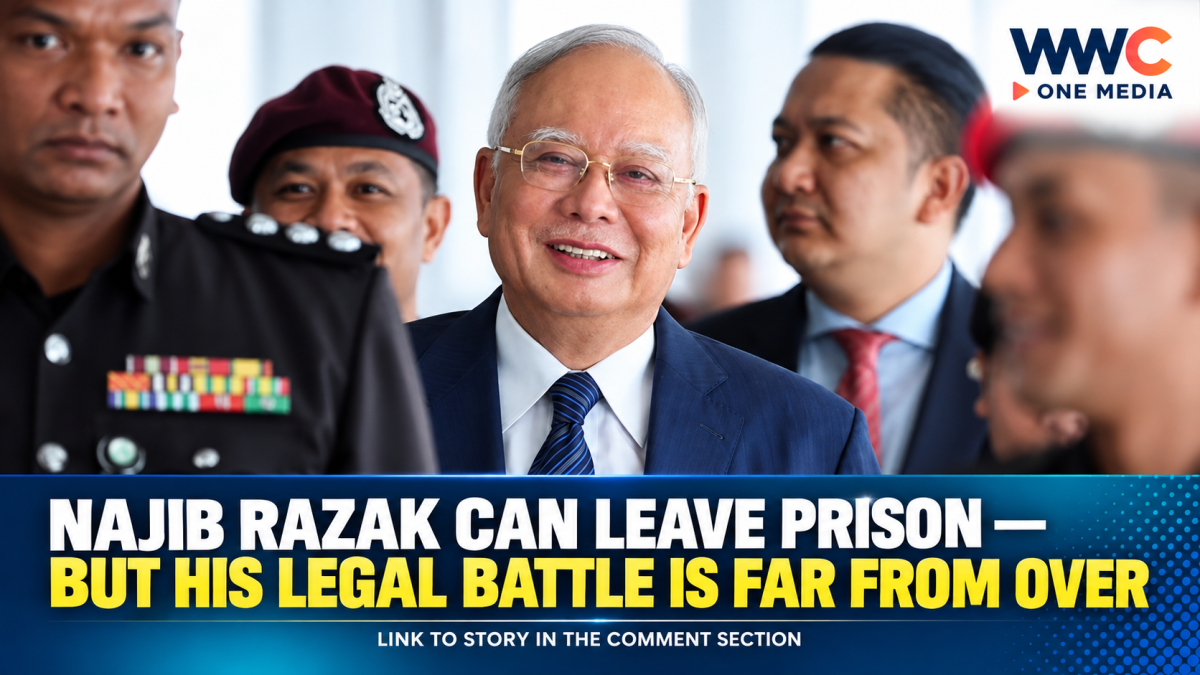
KUALA LUMPUR, Sept. 18, 2026 — Former Malaysian prime minister Najib Razak has been allowed to serve the remainder of his prison sentence under house arrest, in a major development that opens a new chapter in one of Malaysia’s most closely watched corruption cases.
The decision was announced on Friday after the Federal Territories Pardons Board met with King Sultan Ibrahim Sultan Iskandar.
Under the conditional pardon, Najib can serve the remainder of his sentence at home until Aug. 23, 2028, provided he pays a RM50 million (about US$12.3 million) fine and complies with the conditions attached to the order. If those conditions are breached, the pardon can be revoked and he would have to return to prison.
But the move does not end Najib’s legal troubles.
In fact, several major questions now remain over how the house-arrest arrangement will work, what restrictions will apply and what happens to his separate 1MDB-related convictions and other outstanding legal cases.
From a 12-year sentence to house arrest
Najib has been imprisoned at Kajang Prison since August 2022 after Malaysia’s Federal Court upheld his conviction in the SRC International case.
The case involved seven charges — abuse of power, criminal breach of trust and money laundering — relating to RM42 million transferred from SRC International into accounts linked to Najib.
His original sentence was 12 years in prison and a RM210 million fine.
In January 2024, the Pardons Board reduced the prison term to six years and cut the fine to RM50 million.
Friday’s decision represents a further change: instead of remaining in prison for the balance of that sentence, Najib can now serve it under house arrest.
The development is particularly significant because Malaysia has not previously had a comparable case in which a convicted prisoner was permitted to serve the remainder of a sentence under house arrest, according to legal experts cited by CNA.
Why the house-arrest decision is legally significant
The unusual arrangement comes after years of legal controversy surrounding an alleged 2024 royal addendum that Najib’s legal team said had instructed that he serve his reduced sentence at home.
A 2025 High Court ruling found that the purported house-arrest order could not be implemented under the existing legal framework. The court noted questions concerning the Pardons Board process and the statutory mechanisms available for releasing prisoners.
The Federal Court proceedings subsequently established that the addendum existed, but the legal debate over how such an order could be implemented remained significant.
Legal experts now say Friday’s new conditional pardon creates a different situation — but potentially raises another set of questions.
CNA reported that Malaysia has no specific statutory framework expressly setting out a conventional house-arrest regime for prisoners. Possible enforcement mechanisms could include prison officers stationed at the residence, electronic monitoring and restrictions on visitors or movement, although the precise conditions attached to Najib’s arrangement have not been publicly detailed.
That leaves an important question:
What exactly will “house arrest” mean in Najib’s case?
The other sentence that could change everything
Friday’s decision also does not erase Najib’s separate conviction in the much larger 1Malaysia Development Berhad (1MDB) case.
In December 2025, the High Court convicted Najib on 25 charges involving abuse of power and money laundering connected to approximately RM2.2 billion in 1MDB funds.
He was sentenced to 15 years in prison and fined RM11.38 billion.
Najib has appealed that conviction and sentence.
The distinction is crucial.
According to legal analysis reported by CNA, the new conditional pardon applies to the SRC International sentence. It does not automatically wipe out the separate 1MDB sentence.
If Najib ultimately loses his appeal in that case and the conviction and sentence remain in force, he could potentially face imprisonment again after his current sentence ends.
The Attorney-General has also confirmed that Friday’s conditional pardon applies specifically to the SRC International case.
A political development as well as a legal one
Najib’s release from prison could also have political consequences.
The former premier remains an influential figure within UMNO, the United Malays National Organisation, which is part of Prime Minister Anwar Ibrahim’s governing coalition.
Reuters reported that Najib’s return from prison could intensify political tensions inside the coalition, particularly because Anwar’s administration has repeatedly emphasized its commitment to fighting corruption.
CNA reported that political analysts believe Najib’s departure from prison could strengthen morale within UMNO, while potentially creating difficulties for Anwar in managing competing positions within his unity government.
The political context is particularly sensitive because Pakatan Harapan and Barisan Nasional — historically opposing political forces — are currently governing together.
Before Friday’s decision, Pakatan Harapan had publicly stressed that people convicted of high-profile corruption offences should serve court-imposed sentences in full.
Following the announcement, DAP secretary-general Anthony Loke said the party respected the King’s constitutional power of pardon while reiterating its position on the rule of law and the fight against corruption.
UMNO launches fundraising effort for RM50 million fine
The RM50 million payment is another immediate issue.
UMNO president Ahmad Zahid Hamidi said the party had launched a nationwide donation drive to help raise the amount required under the conditional pardon.
The initiative adds another unusual dimension to the case, as Najib’s supporters mobilise to meet a financial condition attached to his release from prison.
The payment requirement does not, however, resolve Najib’s separate legal exposure.
Najib still faces other legal and financial battles
Beyond the SRC and 1MDB criminal cases, Najib remains involved in other proceedings.
The Star reported that these include civil claims, additional criminal cases and a substantial outstanding tax dispute involving the Malaysian Inland Revenue Board.
The newspaper reported that Najib also faces an approximately RM1.69 billion tax liability, while a separate civil case involving SRC International has resulted in a judgment of roughly US$1.3 billion against him.
These proceedings mean that Friday’s announcement should not be interpreted as the end of Najib’s legal saga.
Instead, it changes the circumstances under which he will face the next stages of those proceedings.
What happens next?
Several questions now move to the centre of attention:
First: What specific restrictions will govern Najib’s house arrest?
Second: How will authorities monitor compliance?
Third: What happens if the conditions of the conditional pardon are breached?
Fourth: What will happen to Najib’s separate 15-year sentence if his 1MDB appeal fails?
And finally: How will his return from prison affect Malaysia’s political landscape ahead of the next general election, which is constitutionally due by February 2028?
For now, one thing is clear: Najib Razak is set to leave prison, but the legal and political story surrounding Malaysia’s former prime minister is far from finished.