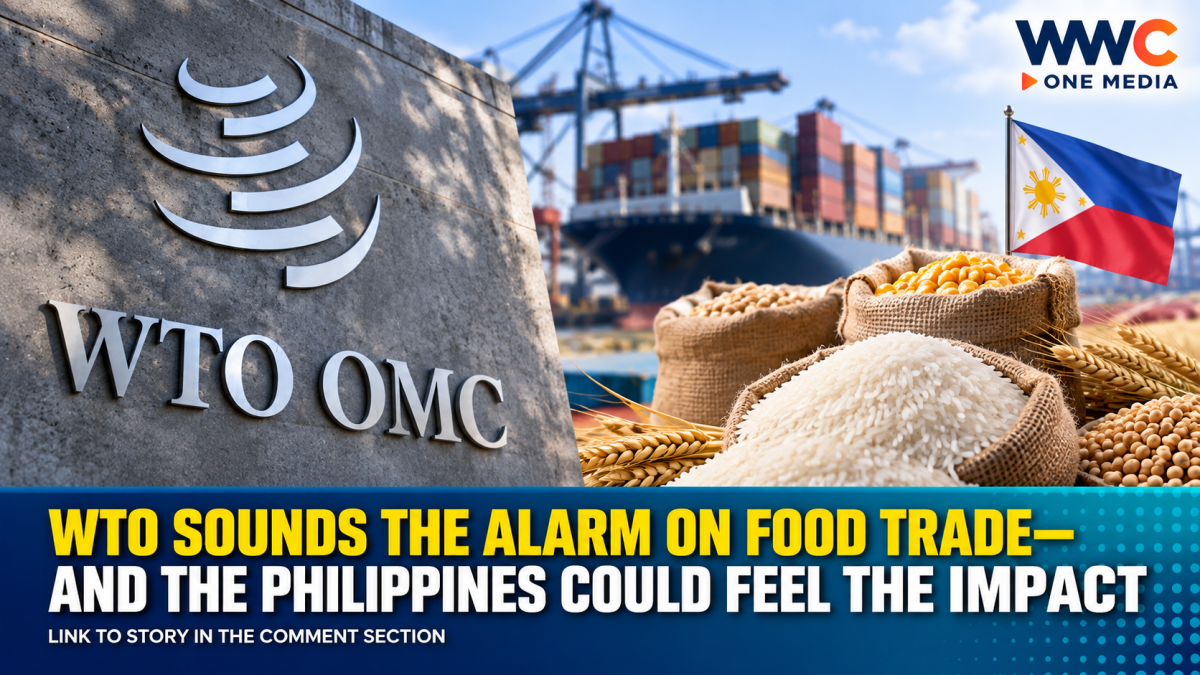
The World Trade Organization (WTO) is urging governments to keep food trade open and predictable as geopolitical tensions, extreme weather and disruptions to global supply chains continue to put pressure on food security.
The warning comes as the global trading system faces growing fragmentation. In its 2026 World Trade Report, released September 15, the WTO said stronger multilateral cooperation could raise global GDP by about 2.9% and global exports by 17.9% by 2050, while a breakdown of the rules-based trading system could significantly reduce global economic output.
The issue is particularly important for food-importing countries such as the Philippines, where rice and other agricultural commodities remain closely tied to international markets.
Why open food trade matters
The WTO says international trade can strengthen food security by allowing food to move from areas with surpluses to countries facing shortages. A predictable trading environment can also help stabilize supplies when production is disrupted by extreme weather, conflict or other shocks.
The organization has already adopted measures aimed at preventing trade restrictions from worsening humanitarian food shortages. At its 2022 ministerial conference, WTO members agreed to exempt food purchased by the World Food Programme (WFP) for humanitarian purposes from export prohibitions or restrictions.
The broader challenge, however, is becoming more complicated.
The UN Food and Agriculture Organization (FAO) reported in July that the value of global food and agricultural trade had increased roughly fivefold since 2000 to about $2 trillion, making countries increasingly interconnected—and potentially more exposed to shocks moving through international markets.
Philippines faces its own food-security pressures
For the Philippines, the debate over keeping food markets open comes as Manila tries to balance consumer prices, farmer protection and the need for reliable imports.
During the country’s 2026 WTO Trade Policy Review, the Philippine government said its rice tariff system was designed to be transparent and predictable. Under Executive Order 105, rice tariffs adjust according to international prices within a defined 15% to 35% range in 2026. The government said the mechanism allows the country to respond to global market movements while addressing domestic food-security concerns.
The Philippines also initiated a WTO-notified safeguard investigation into certain rice imports in March 2026. Such an investigation is intended to determine whether increased imports are causing, or threatening to cause, serious injury to the domestic industry; any safeguard action must meet WTO requirements.
Meanwhile, the country’s agriculture authorities have warned that food security cannot be treated solely as a domestic issue.
Agriculture Secretary Francisco Tiu Laurel Jr. said in September that geopolitical tensions, climate shocks and volatile energy and farm-input costs could disrupt food supplies across Southeast Asia. Speaking at the ASEAN-India Ministerial Meeting on Agriculture and Forestry, he called for stronger regional cooperation on food security, climate resilience and agricultural supply chains.
President Ferdinand Marcos Jr. has likewise said the government is prioritizing food supply amid continuing geopolitical disruptions and volatile energy prices. According to the Philippine News Agency, the government is also pursuing discussions with Vietnam on a possible long-term rice supply arrangement.
Global food risks remain elevated
The WTO’s agriculture committee has also been tracking the broader deterioration in food-security conditions.
At a May 2026 meeting, the WTO cited FAO estimates that 266 million people across 47 countries and territories experienced high levels of acute food insecurity in 2025. The WFP warned that food insecurity could remain at highly concerning levels in 2026, while disruptions to fertilizer shipments and the expected effects of El Niño could create additional risks for agricultural production.
FAO’s latest agricultural commodity report similarly argues that trade policy has an important role in helping food markets absorb shocks. It points to extreme weather, conflict, pandemics and economic disruptions as threats that can spread through increasingly interconnected food systems.
A difficult balancing act for governments
The WTO’s message does not mean countries cannot protect domestic producers or respond to emergencies. WTO rules contain mechanisms for measures such as safeguards, while governments also retain policy space for food-security programs under specific conditions.
The central challenge is balancing those domestic measures with the need to prevent excessive restrictions from disrupting international food supplies.
That challenge is becoming more urgent as the WTO itself warns that the global trading system is at a critical juncture. Reuters reported that the WTO’s latest assessment points to increasing tariffs, export controls, subsidies and geopolitical tensions as signs of growing fragmentation.
For the Philippines, where rice imports and international commodity prices can directly affect food prices, the debate over open trade versus domestic protection is therefore more than a global policy discussion—it has direct implications for consumers, farmers and the country’s food-supply strategy.