
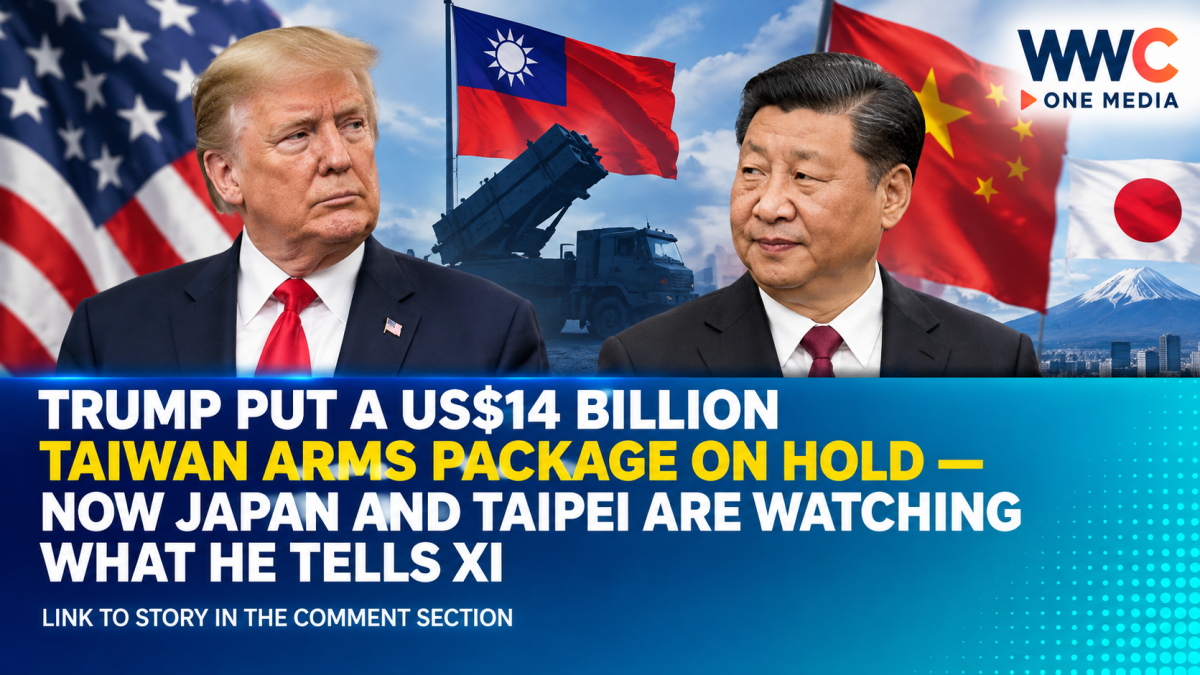
TOKYO/TAIPEI — A single sentence from Donald Trump next week could carry consequences far beyond Washington and Beijing.
As Chinese President Xi Jinping prepares for an expected September 24 summit with Trump in Washington, officials, lawmakers and analysts in Japan and Taiwan are closely watching whether the U.S. president keeps Washington’s longstanding language on Taiwan intact — particularly after Trump earlier described a major weapons package for the island as a bargaining tool in negotiations with Beijing.
Reuters, whose report was carried by The Japan Times, said concern has grown in Tokyo and Taipei that Trump could soften some aspect of U.S. support for Taiwan while pursuing economic agreements with China. That concern is based on interviews with officials, lawmakers and analysts; it is not evidence that Trump has agreed to such a concession.
That distinction is crucial.
Washington says its established Taiwan policy remains unchanged.
Trump said after his May summit with Xi that he made no commitments to the Chinese leader over Taiwan. Taiwan’s government has also said U.S. officials repeatedly assured it that longstanding policy remains in place.
But one unresolved issue has kept the anxiety alive:
a weapons package worth as much as US$14 billion is still awaiting Trump’s approval.
Trump himself called the arms package a “negotiating chip”
The controversy goes back to Trump’s May visit to China.
After meeting Xi in Beijing, Trump told reporters that the two leaders had discussed Taiwan extensively, including U.S. arms sales and whether Washington would defend the island if China attacked.
Trump said he had made no commitment to Xi.
But when asked about the major pending weapons package, Trump later said he was keeping it in abeyance and described the sale as a “very good negotiating chip,” according to Reuters.
That language unsettled some officials and specialists because U.S. arms sales to Taiwan have historically been framed around Taiwan’s defense requirements and U.S. law rather than as a straightforward trade bargaining instrument.
The Taiwan Relations Act states that it is U.S. policy to provide Taiwan with defensive arms and maintain America’s capacity to resist force or coercion threatening Taiwan’s security or social and economic system.
That does not mean every weapons request must automatically be approved.
But it explains why describing a major arms package as a negotiating chip attracted attention well beyond the weapons themselves.
The package could reach US$14 billion
Reuters reported in May that the proposed package could be worth up to US$14 billion and include advanced interceptor missiles. It remained awaiting presidential approval as of the latest September 17 reporting.
Trump’s administration had already approved an approximately US$11 billion arms sale in December 2025, which Taiwan described as historically large.
So the current uncertainty does not mean Trump has stopped all military support for Taiwan.
It concerns what happens to the next major package — and whether Beijing can influence that decision through broader U.S.-China negotiations.
Xi has made Taiwan an explicit priority before the meeting
Beijing has left little doubt about what it wants.
During a September 9 telephone conversation with Trump, Xi described Taiwan as “the most important issue in China-U.S. relations” and urged Washington to handle weapons sales to the island “with prudence,” according to China’s official account of the call.
China regards Taiwan as part of its territory and opposes U.S. military support for the democratically governed island.
Beijing has repeatedly said it prefers peaceful reunification but has not renounced the use of force.
Taiwan’s government rejects Beijing’s sovereignty claims and says its future should be determined by Taiwan’s people.
Those fundamentally conflicting positions are why seemingly minor changes in diplomatic wording attract such intense scrutiny.
Beijing wants Washington to take arms sales more seriously
Speaking at a defense forum in Beijing this week, former Chinese ambassador to Washington Cui Tiankai said reunification would contribute to stability and serve U.S. interests, according to Reuters.
Chinese officials and scholars have also argued that Washington can no longer dismiss Beijing’s objections to Taiwan arms sales.
China’s Foreign Ministry maintains that such sales interfere in what Beijing regards as an internal Chinese matter and has repeatedly called for them to stop.
The United States takes a different legal and policy position.
Washington recognises the People’s Republic of China as the government of China but maintains extensive unofficial ties with Taiwan and continues supplying defensive equipment under the Taiwan Relations Act.
America’s “one China policy” is often misunderstood
One of the easiest mistakes in reporting this issue is to describe Washington’s position as accepting Beijing’s sovereignty claim over Taiwan.
That is not accurate.
Under the longstanding U.S. “one China policy,” Washington acknowledges Beijing’s position that Taiwan is part of China but does not itself endorse that sovereignty claim. U.S. policy is guided by the Taiwan Relations Act, the three U.S.-China joint communiqués and the Six Assurances.
The United States has traditionally opposed unilateral changes to the status quo and supported peaceful resolution of cross-Strait differences.
That carefully calibrated ambiguity has endured across Republican and Democratic administrations.
It is exactly why officials in the region are sensitive to even small changes in presidential language.
Trump still will not say whether U.S. forces would defend Taiwan
Another uncertainty concerns military intervention.
Former President Joe Biden repeatedly said during his presidency that U.S. forces would defend Taiwan if China attacked, although administration officials repeatedly said those remarks did not formally change American policy.
Trump has taken a different rhetorical approach.
After his May meeting with Xi, Trump said Xi directly asked whether the United States would defend Taiwan in an attack.
Trump said he declined to answer.
The Taiwan Relations Act requires the United States to provide defensive arms and maintain the capacity to resist force or coercion.
It does not contain an automatic treaty-style commitment requiring U.S. troops to enter a war whenever Taiwan is attacked.
That deliberate uncertainty is commonly described as strategic ambiguity.
Trump has so far preserved it.
Taiwan is trying to make sure its position reaches Washington before Xi does
Taipei is not waiting passively.
Senior Taiwanese official Shen Yu-chung said the government had been communicating its position clearly to the U.S. side ahead of the September summit and hoped there would be no outcome harmful to Taiwan.
Taiwan Foreign Minister Lin Chia-lung said he expected Xi to raise Taiwan during the talks but noted that Washington had repeatedly said its policy had not changed.
That echoes Taiwan’s official response after the May summit.
Taiwan’s Foreign Ministry said at the time that the Trump administration had repeatedly reaffirmed its longstanding Taiwan policy and continued supporting peace and stability across the Strait.
So Taiwan’s public position is not that Washington has abandoned it.
It is that Taipei wants established policy preserved.
Japan is trying to get Trump’s attention too
Japan has even more direct security reasons to watch Taiwan.
Reuters reported that Japanese Prime Minister Sanae Takaichi has sought an opportunity to speak with Trump before the Xi meeting, according to two Japanese government sources. A senior Japanese Foreign Ministry official travelled to Washington as part of efforts to arrange contact, the sources said.
Japan’s Foreign Ministry declined to confirm those working-level diplomatic moves.
Officially, Tokyo said it would follow the Trump-Xi summit closely and stressed the importance of U.S.-China relations contributing to international stability.
According to one Japanese government source cited by Reuters, Tokyo would prefer Trump to keep established diplomatic language on Taiwan and avoid allowing the issue to dominate the summit.
Again, those concerns are sourced views from Japanese officials and lawmakers — not evidence that Trump has decided to alter policy.
Japan’s concern goes beyond Taiwan itself
Any Taiwan crisis would have major implications for Japan.
Japan’s southwestern islands sit close to Taiwan, while U.S. forces maintain substantial bases in Japan under the U.S.-Japan security alliance.
Tokyo has increasingly emphasised that peace and stability across the Taiwan Strait matter to Japan’s security and the wider international community.
A Japanese parliamentary delegation visiting Taiwan last week reiterated that Japan wants Taiwan-related issues resolved peacefully through dialogue.
Takaichi also angered Beijing last year after saying Japan could potentially become involved under certain circumstances in a conflict over Taiwan, Reuters noted.
Beijing strongly objects to Japanese security involvement in Taiwan issues.
Taiwan is not technically a U.S. treaty ally
One terminology point is worth correcting.
Although the Reuters/Japan Times headline refers broadly to “U.S. allies,” Taiwan is not a formal U.S. treaty ally.
Japan is.
Washington terminated its formal diplomatic recognition of the Republic of China government in Taipei in 1979 and established diplomatic relations with Beijing.
U.S.-Taiwan ties have since operated through an unofficial relationship under the Taiwan Relations Act.
Taiwan is therefore more accurately described as a close U.S. security partner.
That difference matters when discussing what Washington is legally obligated to do in a crisis.
Taiwan is also spending much more on its own defense
Taipei has been trying to reduce doubts over whether it is doing enough for its own security.
Taiwan’s government has proposed raising 2027 defense-related expenditure by around 18%, taking the total above NT$1 trillion, or roughly US$31 billion, for the first time and above 3% of gross domestic product under the government’s broader accounting.
President Lai Ching-te has also set a longer-term goal of increasing defense spending further and has pushed investments in drones, missiles, resilience and indigenous weapons development.
Taiwan’s opposition-controlled legislature has contested parts of defense spending and procurement, however, meaning not every proposed allocation moves quickly through parliament.
That domestic political debate is separate from U.S. arms-sale decisions but directly affects Taiwan’s ability to absorb and field new systems.
Trump says Xi promised there would be no attack while he is president
Trump has repeatedly pointed to his personal relationship with Xi as a source of stability.
According to Reuters, Trump has said Xi personally assured him that China would not attack Taiwan while Trump remains in office.
That is Trump’s account of Xi’s assurance.
It is not a formal bilateral security guarantee, treaty or publicly negotiated agreement.
Beijing’s official position continues to reserve options over Taiwan and has not renounced force.
For that reason, governments in the region continue planning around military deterrence rather than relying solely on personal assurances exchanged between leaders.
The summit will be about much more than Taiwan
Trump and Xi are not meeting only over cross-Strait security.
Their governments are simultaneously wrestling with trade, artificial intelligence, semiconductor controls and broader economic competition.
Reuters reported this week that AI rivalry is expected to be a major issue in the September talks, including U.S. controls on advanced chips and Chinese objections to Washington’s technology restrictions.
That economic backdrop is exactly what worries some Japanese and Taiwanese officials quoted by Reuters.
Their concern is that Taiwan might become linked to a broader bargain covering trade, purchases of U.S. goods or technology restrictions.
But there is currently no verified agreement showing Trump has offered such a trade.
That possibility remains a concern expressed by officials and analysts, not an established fact.
The semiconductor stakes make Taiwan a global economic issue
Taiwan’s importance is not limited to military geography.
The island is the centre of global production for the most advanced semiconductors used in artificial intelligence systems, smartphones, data centres and other high-end electronics.
Reuters estimates Taiwan produces more than 90% of the world’s most advanced semiconductors.
That means a major conflict could disrupt supply chains worldwide even before considering the military and humanitarian consequences.
Raymond Greene, Washington’s de facto ambassador in Taipei, warned earlier this month that a Taiwan conflict could have catastrophic global economic consequences and stressed the Trump administration’s stated goal of maintaining peace and stability in the Indo-Pacific.
China says reunification would create stability; Taiwan says deterrence preserves it
The underlying disagreement could hardly be more fundamental.
Beijing says Taiwan is Chinese territory and that eventual reunification is necessary.
Chinese representatives argue that U.S. arms sales encourage separatism and increase tensions.
Taiwan says those arms help deter coercion and preserve the status quo by making military action more costly.
Taiwan’s Foreign Ministry has described U.S. weapons sales as part of a broader deterrence structure supporting regional stability.
Washington’s legal framework similarly links Taiwan’s defensive capacity with preserving peaceful resolution of the dispute.
These are competing policy arguments.
They should not be collapsed into a single undisputed account of what causes tension.
The key question on September 24 may be what Trump does not say
Because U.S. Taiwan policy has relied on carefully calibrated wording for decades, diplomacy may hinge on language rather than a dramatic signed agreement.
Reuters reported concern among Japanese officials and specialists that even subtle rhetorical changes could be interpreted in Beijing as evidence of declining U.S. commitment.
That is their assessment, not a certainty about how China would respond.
Trump could also simply repeat existing policy, which Taiwan says U.S. officials have continued to reaffirm.
The arms package provides a more concrete test.
If Washington approves it essentially intact, that would demonstrate continuation of military support despite Beijing’s objections.
If the package is delayed further, reduced or rejected, policymakers and analysts would scrutinise the explanation closely.
But until a decision is actually announced, anything beyond that is speculation.
For Japan and Taiwan, the anxiety comes from uncertainty rather than a confirmed U.S. retreat
That may be the most important distinction in the entire story.
Trump has not announced that Washington’s one China policy is changing.
He has not recognised Beijing’s sovereignty claim over Taiwan.
He has not announced an end to U.S. weapons sales.
He has not promised Xi that Washington would remain out of a Taiwan conflict.
And according to Trump himself, he made no Taiwan commitments during the May summit.
What he has done is leave major questions unresolved.
A US$14 billion arms package remains pending.
He has described that package as leverage.
He has refused to reveal how he would respond militarily to an attack.
And Xi has made clear that Taiwan will again be high on Beijing’s agenda.
That combination explains why September 24 matters.
The summit does not automatically signal a Taiwan policy shift.
But in a relationship where deterrence has depended for decades on carefully managed ambiguity, what Trump says about Taiwan — and what he decides about the US$14 billion weapons package afterward — could provide the clearest evidence yet of how his second-term China strategy fits with America’s longstanding commitments to the island.


Leave a Reply