
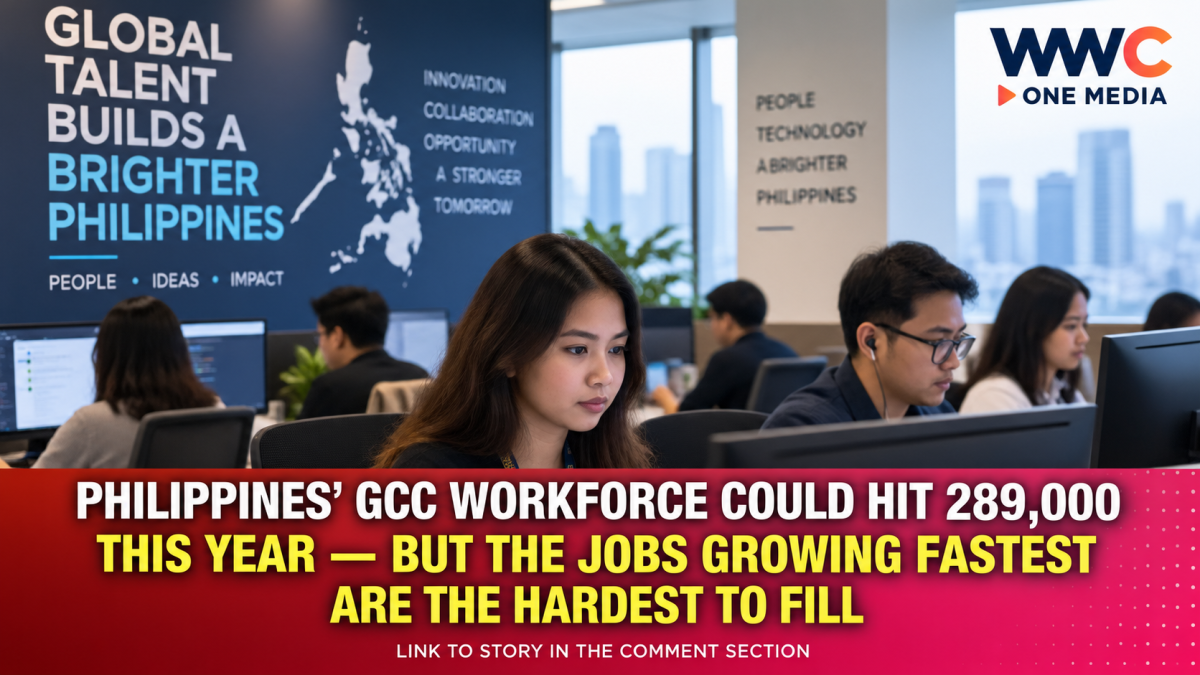
MANILA, Philippines — The Philippines built its global outsourcing reputation answering calls, processing transactions and handling back-office work for some of the world’s biggest companies.
Now multinational firms are entrusting Filipino workers with something much more valuable:
their own finance systems, cybersecurity operations, artificial intelligence projects, engineering work, risk management and strategic decision support.
That shift is fueling rapid growth in the country’s Global Capability Center, or GCC, sector, which is projected to employ around 289,000 professionals by the end of 2026, according to research cited by Panay News from Colliers, the IT & Business Process Association of the Philippines and executive-search firm ZMG Ward Howell.
Around 270,000 workers were employed across roughly 200 Philippine GCCs in 2025, meaning the forecast implies another 19,000 positions in a single year.
But the headline number hides the industry’s biggest challenge.
The fastest-growing jobs are increasingly the same jobs companies are struggling hardest to fill.
And as artificial intelligence spreads across corporate operations, the next phase of the Philippines’ outsourcing story may be determined not by how many workers the country has — but by how many possess the advanced skills global companies now demand.
First, What Exactly Is a GCC?
A Global Capability Center is different from the traditional image of a BPO company.
In conventional outsourcing, a multinational hires another company to perform services for it.
A GCC is generally an in-house offshore operation established or controlled by the multinational itself to perform important functions for the parent organization.
Think of a multinational bank running parts of its cybersecurity, financial analysis, technology development and compliance operations from Manila.
Or a global healthcare company placing analytics, revenue-cycle management and digital operations teams in Cebu.
The workers may be thousands of kilometers from headquarters, but they are embedded deeply within the corporation’s own global organization.
That distinction explains why GCCs are increasingly attractive.
They are not simply cheaper offices.
They can become centers for technology development, analytics, innovation, finance, engineering, cybersecurity and corporate transformation. Colliers says the Philippines has evolved from a largely cost-efficient outsourcing destination into a strategic enterprise capability hub supporting precisely these higher-value functions.
The Philippines Is Now Ranked No. 2 — But India Is Still Far Ahead
The Colliers study, citing Everest Group, describes the Philippines as the world’s second-largest GCC delivery location.
That is a significant achievement.
But “No. 2” should not be interpreted as meaning the Philippines is already close to the global leader.
India remains overwhelmingly dominant.
A 2026 Nasscom-Zinnov report cited by Reuters puts India at more than 2,100 GCCs employing approximately 2.36 million people and generating nearly $100 billion in revenue.
The Philippines, by comparison, has roughly 200 centers and about 270,000 employees today.
So the opportunity is enormous precisely because the gap remains enormous.
The Philippines does not have to overtake India to create hundreds of thousands of additional high-value jobs.
It only has to capture a larger share of companies that want a second or complementary Asian delivery base.
Why Companies Keep Looking at the Philippines
The country already has something difficult for new competitors to manufacture quickly:
more than three decades of IT-BPM experience.
The wider Philippine IT-BPM industry employed roughly 1.9 million people and generated $40.3 billion in revenue in 2025, according to IBPAP figures.
That enormous existing ecosystem gives GCC investors access to experienced accountants, financial-services professionals, customer-experience specialists, software developers, health-care workers and managers who already understand international business processes.
Colliers says GCCs are also benefiting from the country’s established office markets, English-speaking talent and mature business environment.
And multinational interest is already showing up in commercial real estate.
Office transactions involving GCCs jumped 67% year on year in 2025, substantially outpacing other occupier groups, according to Colliers.
That is more than a property statistic.
Companies do not lease large amounts of office space unless they expect people to occupy it.
These Are Not Just Call-Center Jobs
This may be the most important part of the story for Filipino workers.
The functions multinational corporations are increasingly moving into Philippine GCCs include:
- artificial intelligence and machine learning;
- cybersecurity;
- data and business analytics;
- finance and accounting;
- risk and regulatory compliance;
- software and cloud technology;
- engineering;
- healthcare technology;
- digital operations; and
- enterprise transformation.
That represents a fundamental change in the type of work the Philippines is competing for.
For decades, the country’s outsourcing advantage centered heavily on labor availability, English proficiency, customer service and cost.
Those advantages still matter.
But the next battle is increasingly about whether companies trust Philippine teams with systems, intellectual property, regulated processes and business-critical decisions.
That is a much higher-value proposition.
And AI Is Accelerating the Shift
Artificial intelligence could have been purely a threat to Philippine outsourcing.
Instead, GCC growth shows why the outcome may be more complicated.
Colliers says nearly half of Philippine GCCs are already experimenting with or deploying generative AI to improve productivity and service quality.
The report favors what it calls a “human-plus-AI” model: using AI to augment workers rather than simply removing humans from operations.
That fits the broader strategy IBPAP has been promoting.
IBPAP President and CEO Jack Madrid has repeatedly argued that Filipino digital workers need to be “rewired” for an AI-driven economy and that technology should complement human judgment, ingenuity and empathy rather than becoming the sole basis of service delivery.
But there is an uncomfortable second half to that argument.
AI may not eliminate the industry.
It can still eliminate particular tasks.
That means workers performing repetitive, rules-based activities face greater pressure to move into analysis, technology, client management, problem solving and other functions where human expertise creates additional value.
The Wider BPO Industry Has Already Lowered Its Long-Term Expectations
That pressure is visible in IBPAP’s revised forecasts.
In July, the industry group reduced its longer-term IT-BPM outlook amid rapid AI adoption, geopolitical uncertainty and changing global customer requirements.
For 2026, however, IBPAP still expects the broader industry to grow to around $42.3 billion in revenue and approximately 1.96 million full-time employees, up from $40.3 billion and roughly 1.9 million workers in 2025.
Its expectations for 2028 are now more cautious than the ambitious targets written several years earlier.
Madrid said the change reflected the need to be realistic about what the industry can achieve as technology changes the relationship between revenue and employee headcount.
That makes GCC expansion particularly important.
Even if routine outsourcing employment grows more slowly, multinational companies can still add highly specialized teams handling more valuable work.
In other words:
The industry may increasingly compete on revenue and capability per worker rather than simply adding hundreds of thousands of seats.
There Is Just One Problem: Companies Cannot Find Enough of the Right People
The ZMG Ward Howell findings cited in the report reveal the industry’s biggest bottleneck.
Business analytics, machine learning and artificial-intelligence positions are among the hardest jobs for GCCs to fill.
Machine-learning and AI engineers reportedly had the lowest candidate-to-job ratios across the locations examined, making them particularly difficult positions to recruit for.
And the issue may not simply be a shortage of jobseekers.
The report says hiring problems can indicate a qualification gap — meaning candidates exist, but too few meet the technical requirements employers need.
That difference matters.
The Philippines produces hundreds of thousands of college graduates.
But a company searching for an experienced cloud-security architect, AI engineer, quantitative analyst or regulatory-compliance specialist cannot automatically fill that role with a fresh graduate.
Advanced jobs require advanced skills.
And frequently, experience.
The ₱1.4-Billion Question Is Really About Skills
The broader IT-BPM industry has already been pouring money into retraining.
IBPAP previously estimated that companies were spending roughly $1.4 billion annually on upskilling and reskilling employees as automation and AI changed the nature of outsourced services.
That investment is no longer optional.
The report recommends expanding training in:
AI, cybersecurity, cloud computing, data analytics, healthcare technology, finance transformation, risk and compliance.
Universities will therefore become an increasingly important part of the GCC story.
Curricula built for yesterday’s outsourcing jobs may not produce workers ready for tomorrow’s engineering and AI requirements.
Some companies are already responding.
Recent reporting from Cebu described employers supporting graduate-level education for staff as AI adoption increases and companies look for stronger skills in critical thinking, leadership and complex problem solving.
The Boom May Not Stay in Metro Manila
The other major change could be geographic.
Metro Manila remains the first choice for many GCC investors because of its deep talent pool, established central business districts and large supply of PEZA-compliant office buildings.
But Colliers specifically identifies Cebu, Davao, Pampanga, Iloilo and Bacolod as increasingly important expansion locations.
The reason goes beyond cheaper rent.
Multinational companies increasingly want geographic diversification.
If every employee works in Metro Manila, a typhoon, earthquake, transport disruption, power problem or other major event could affect an enormous share of operations simultaneously.
Running teams across Manila, Cebu, Iloilo and other hubs spreads that risk.
Provincial expansion also opens access to workers who may not want or be able to relocate to Metro Manila.
For cities such as Iloilo and Bacolod, that could create a particularly important second wave of IT-BPM growth.
The first wave brought customer-service and back-office jobs.
The next could bring cybersecurity, analytics, finance and technology teams.
Smaller ‘Micro-GCCs’ Could Change the Formula Too
Another shift is emerging.
Not every multinational now needs to build an enormous Philippine campus employing 10,000 workers.
At a GCC industry forum earlier this year, executives described growing demand for “micro-GCCs” and “nano-GCCs” — smaller teams built around highly specialized corporate functions.
AI is helping make that possible.
A company might establish a Philippine center containing only a few hundred highly skilled people but give those employees responsibility for critical software, data, financial or compliance functions serving operations around the world.
That means the industry’s success can no longer be measured solely by office size.
A 300-person cybersecurity and data-engineering hub might create considerably more economic value than a much larger low-complexity processing operation.
The Global Market Itself Is Growing Fast
The opportunity is not limited to companies relocating existing jobs.
The underlying GCC market is expanding.
The white paper cited by Panay News projects the global GCC market to grow from around $100 billion in 2024 to $155 billion by 2027.
That is roughly 55% growth in three years.
Why?
Companies increasingly want strategic operations under their own control.
They want access to specialized talent.
They want multiple international delivery centers instead of depending on one geography.
And they want internal teams capable of deploying AI and other technologies securely across the enterprise.
The Philippines already has the outsourcing infrastructure needed to participate.
The competition is now over how much of that higher-value work it can capture.
But Other Countries Want the Same Jobs
India is only the largest competitor.
The Philippines also faces emerging and established service locations across Eastern Europe, Latin America, Southeast Asia, Africa and the Middle East.
IBPAP has previously identified countries including South Africa, Egypt, Poland, Colombia, Costa Rica and Vietnam as increasingly serious competitors for international business-services investment.
Some compete on costs.
Others offer deep engineering talent.
Others sit closer to major American or European time zones.
That means the Philippines cannot rely indefinitely on English skills and lower salaries.
Those advantages helped build the industry.
They will not automatically protect it.
The Real Battle Is Moving Up the Value Chain Faster Than AI Moves Down It
That may be the central lesson behind the 289,000-job forecast.
The good news is obvious.
Companies are still investing.
GCC employment is expanding.
Office demand is rising.
The Philippines has become one of the world’s most important locations for multinational corporate operations.
And artificial intelligence has not stopped companies from hiring.
But AI is changing who gets hired.
The jobs most vulnerable to automation are generally the predictable, repetitive activities that helped drive the first generation of outsourcing.
The jobs multinational companies increasingly want in GCCs involve deeper knowledge:
cybersecurity;
analytics;
engineering;
financial judgment;
healthcare expertise;
AI;
risk;
compliance;
and leadership.
That creates an unusual employment paradox.
The Philippines may have thousands of new GCC jobs coming.
But unless enough Filipino workers acquire the skills those positions require, some of the industry’s best opportunities could remain vacant.
The 289,000 figure therefore tells only half the story.
The more important number may eventually be how many of those workers can perform jobs that companies — and increasingly AI itself — cannot easily replace.
WWC ONE MEDIA M.J.E




Leave a Reply