
TOKYO — One of Japan’s most influential business publishers is confronting a trust problem inside the business that pays for journalism.
Nikkei Inc., publisher of the Nihon Keizai Shimbun, has acknowledged that sales employees overstated circulation figures for THE NIKKEI MAGAZINE, causing two advertisers to pay tens of millions of yen more than they should have for sponsored editions distributed between 2022 and 2026.
The scale goes well beyond a small bookkeeping error.
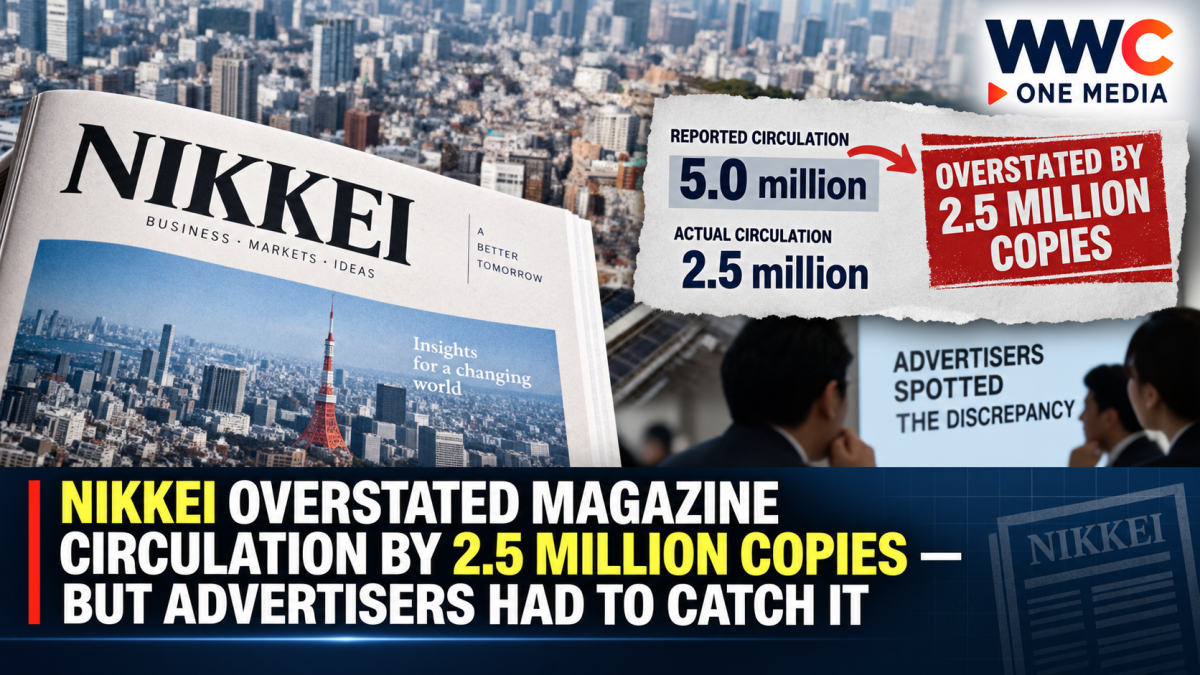
Across 29 issues distributed in the Tokyo metropolitan and Kansai regions, employees told advertisers that circulation was between roughly 15,000 and 250,000 copies higher per issue than the actual figure.
Added together, the overstated circulation reached approximately 2.5 million copies over about four years.
Nikkei says staff used outdated circulation figures or other incorrect numbers and, in some cases, distributed magazines outside areas specified by the advertisers.
The misconduct came to light only after the advertisers themselves raised questions.
Now the company has brought in an external lawyer to determine why it happened — and, crucially, whether there was any organisational involvement beyond the employees directly responsible.
That question may ultimately matter even more than the amount of money involved.
The disputed product was not an ordinary newspaper ad
The overcharging involved THE NIKKEI MAGAZINE, a glossy lifestyle and luxury supplement distributed inside Nikkei’s morning newspaper.
Nikkei markets the publication around fashion, watches, travel and other premium lifestyle themes and promotes its value to brands partly on the scale of its physical distribution.
Its current marketing portal advertises regular issues with a circulation of approximately 800,000 copies across Japan’s three major metropolitan regions.
That circulation figure matters commercially.
For an advertiser buying physical distribution, the number of copies is part of what it is paying for.
A brand expecting 300,000 copies is buying something materially different from one receiving 200,000.
That is why overstating circulation can directly affect price.
These were reportedly single-sponsor “buyout” editions
ITmedia reported that the affected issues were “buyout” editions, in which one advertiser effectively sponsors an entire special edition rather than merely buying an ad page inside a normal issue.
Nikkei’s own media guide describes such products as THE NIKKEI MAGAZINE STYLE editions, built entirely around one advertiser’s content.
An earlier official media guide gave a rough example of the economics:
an eight-page Tokyo-area special edition with 300,000 copies could cost around ¥20 million, excluding content-production expenses.
That helps explain why inflated circulation could produce overcharges running into tens of millions of yen over repeated campaigns.
These were not tiny classified advertisements.
They were large, custom publishing projects where distribution scale was central to the proposition being sold.
Nikkei says each advertiser paid tens of millions of yen too much
The publisher has not publicly identified the two advertisers in the reports available so far.
It has also not disclosed an exact combined overcharge.
Instead, it says each company paid “several tens of millions of yen” more than appropriate.
That wording is important.
It establishes that the improper charges were substantial, but it does not support publishing a precise total unless Nikkei later releases one.
Reports suggesting an exact combined loss would therefore be premature.
The most extreme discrepancy was 250,000 copies on a single issue
Nikkei says the gap between claimed and actual circulation varied widely.
At the low end, employees overstated an edition by about 15,000 copies.
At the high end, the difference reached roughly 250,000 copies.
For context, Nikkei’s current regular magazine marketing material cites circulation of around 800,000 copies.
A discrepancy of 250,000 is therefore not trivial in the context of the product.
It is large enough to materially change an advertiser’s understanding of how many physical copies would reach readers.
Staff also distributed copies outside the agreed areas
The circulation inflation was not the only issue.
Nikkei says employees in some instances distributed the booklet outside regions specifically designated by advertisers.
That can matter just as much as total volume.
Luxury retailers, department stores, property companies and other advertisers may design campaigns around precise geographic markets.
A brand paying for distribution in affluent parts of Tokyo, for example, may not consider an equivalent number of copies elsewhere to have equal value.
In advertising, where the audience is can matter as much as how large it is.
Advertisers discovered the problem
One of the most damaging details for Nikkei’s internal-control story is how the misconduct surfaced.
It was not initially identified through an internal audit.
According to Nikkei and Jiji Press reporting, the advertisers pointed out discrepancies, prompting the company to investigate.
That raises obvious questions about controls.
How were circulation numbers verified before invoices went out?
Who approved the figures supplied to clients?
Were promised distribution areas reconciled with actual delivery?
And why did the discrepancy persist across 29 issues and several years without being stopped internally?
Nikkei has not yet publicly answered those questions.
That is precisely why the external investigation matters.
An outside lawyer is examining whether the misconduct was organisational
Nikkei has commissioned an external attorney to investigate both the motive behind the misconduct and whether there was organisational involvement.
That phrasing is significant.
It means the company has not yet concluded publicly whether this was simply a small number of employees manipulating numbers on their own or whether weaknesses in management, incentives, supervision or business practices played a wider role.
Until that inquiry is complete, either conclusion would go beyond the known facts.
There has also been no public report in the cited coverage of criminal charges being filed.
So the case should be described as admitted overcharging and improper billing, not as a criminal conviction.
Nikkei says it will investigate whether similar problems existed elsewhere
Japanese reporting says the publisher also intends to examine whether comparable problems occurred in other advertising businesses and publish its findings once the investigation has progressed.
That broadens the stakes.
If the problem is confined to these 29 single-sponsor editions, the company faces a serious but contained breakdown.
If similar practices are found across other advertising products, the commercial and reputational consequences could become much larger.
For now, there is no evidence establishing that wider misconduct occurred.
It is being investigated.
Nikkei’s own advertising site is now reviewing magazine materials
There is another notable detail.
Nikkei’s Japanese marketing portal currently says materials for THE NIKKEI MAGAZINE have been taken offline while their contents are being checked.
The page tells advertisers that publication of those materials is temporarily suspended for review.
That is a visible consequence of the controversy inside the publisher’s own advertising operation.
Its English-language marketing page still describes the magazine as a premium product with approximately 800,000 copies for regular issues and promotes its single-brand special editions.
The economics show why circulation accuracy matters
Advertising rates for the magazine can be substantial even outside the special sponsored editions.
An official Nikkei media document for a December 2026 issue lists premium two-page placements at up to about ¥6.5 million, while other placements cost several million yen.
A July 2026 Luxe issue listed some premium placements as high as ¥6.8 million.
Those are published list prices for regular advertising products and are not the same contracts involved in the overcharging scandal.
But they illustrate the commercial scale of the magazine business.
When millions of yen are being exchanged for premium print exposure, audience measurement becomes fundamental.
Print advertising has always depended heavily on circulation credibility
For decades, newspapers and magazines sold advertisers two things:
the quality of their audience and the size of it.
Digital advertising complicated that model by introducing clicks, views, impressions, conversions and increasingly detailed audience analytics.
Print cannot usually provide that level of individual behavioural tracking.
Circulation therefore remains one of its most important proof points.
For an advertiser, circulation answers a basic question:
How many physical copies did I pay to reach?
If that number is unreliable, the commercial value of the entire media product becomes harder to assess.
That is why this case has implications beyond the immediate refund amounts.
It strikes directly at a metric central to print advertising.
Nikkei sells itself as a premium audience
THE NIKKEI MAGAZINE is explicitly positioned as a high-end advertising environment.
Its official site pitches fashion, watches, travel and luxury content to readers of the Nikkei newspaper, while its separate Luxe edition is marketed toward readers interested in premium lifestyles.
That positioning can justify premium advertising rates because brands are not merely buying raw distribution.
They are buying access to a specific audience associated with Japan’s leading business newspaper.
That makes advertiser trust particularly important.
Luxury and corporate brands expect precise control over brand placement, geography and circulation.
The two advertisers have not been named publicly
As of September 17, the affected companies have not been publicly identified in the principal reports.
Nikkei has therefore not disclosed which brands bought the disputed special editions.
Responsible reporting should avoid speculating based on past sponsors listed in historical marketing documents.
Nikkei’s older media guides show examples of brands that previously used single-sponsor editions, but that does not establish that any of those companies are the two affected advertisers in this case.
That distinction is essential.
Historical clients should not be linked to a current dispute without evidence.
Nikkei’s response is now about more than reimbursing money
The company says it takes the matter seriously because it undermines the trust of both advertisers and readers.
It has pledged to develop measures preventing a recurrence and to work to regain confidence.
The eventual financial remedy will matter.
But restoring credibility will probably require more than refunds.
Advertisers will want to know:
how circulation will be independently verified;
who is accountable for certifying numbers;
whether geographic distribution will be audited;
whether previous campaigns are being rechecked;
and how quickly clients will be told when data are wrong.
Until the external investigation is complete, Nikkei has not publicly laid out all of those measures.
The timing makes the problem particularly uncomfortable for legacy media
Japan’s newspapers, like print publishers around the world, are already competing against digital platforms that can offer advertisers highly granular audience data.
Traditional media still possess major strengths:
brand reputation, editorial authority, affluent readerships and trusted environments for premium advertising.
But those advantages rely heavily on credibility.
If an advertiser doubts the basic circulation number behind a campaign, print loses one of the foundational metrics on which its value proposition is built.
That is why a problem involving one luxury insert can become a broader reputational issue for the publisher.
This was not simply an estimate that happened to be wrong
Another accuracy point matters here.
Nikkei’s description goes beyond ordinary forecasting error.
Employees reportedly presented outdated circulation figures or other incorrect numbers, overstated expected distribution and billed advertisers using those figures.
In some cases, actual distribution was then shifted outside specified areas.
The company itself has acknowledged the resulting overcharges.
So the central factual question is no longer whether clients were billed too much.
Nikkei says they were.
What remains unresolved is why, who knew, and how far responsibility extended.
Twenty-nine issues make this harder to dismiss as a one-off mistake
A single wrongly entered number could plausibly be explained as human error.
The disclosed problem spans:
29 issues, two advertisers, multiple regions and roughly four years.
That does not prove senior management ordered or knew about the practice.
The external lawyer is investigating precisely that question.
But the duration and number of affected editions make internal controls a central part of the story.
The public will be looking not only at which employees entered the wrong figures, but at what systems allowed those figures to remain in use repeatedly.
The scale is best measured in copies, not just yen
“Tens of millions of yen” will naturally dominate headlines.
But the more revealing figure may be 2.5 million copies.
That is the cumulative amount by which circulation was overstated to the two advertisers across the affected editions.
Those copies did not necessarily represent 2.5 million completely nonexistent magazines in a simple sense.
Some cases involved outdated figures, inaccurate stated totals or distribution outside the regions advertisers had designated.
That nuance matters.
But commercially, the result was the same:
advertisers paid according to a reach Nikkei now acknowledges had been inaccurately represented.
The next disclosure will matter more than the first
Nikkei has already admitted the overcharging.
The next phase will answer the questions that determine how serious the scandal ultimately becomes.
Was the misconduct limited to particular sales employees?
Did supervisors know?
Were internal sales targets or incentives a factor?
Were circulation reports independently checked?
Did similar problems affect other products?
How much will advertisers be reimbursed?
Will any employees or executives face disciplinary action?
And will the external investigator’s findings be released in sufficient detail for advertisers to evaluate what went wrong?
Those answers are still pending.
For a business newspaper, the symbolism is particularly sharp
Nikkei spends every day reporting on corporate governance, accounting, disclosure, management failures and the credibility of companies.
Now one of those governance stories sits inside its own commercial operation.
That does not erase the work of its newsroom or imply that its journalism was involved.
The misconduct described by the company concerns advertising sales and circulation representations for a commercial magazine product, not the accuracy of Nikkei’s editorial reporting.
But the same word sits at the centre of both businesses:
trust.
Advertisers bought circulation based on figures supplied by Nikkei.
Those figures were wrong.
The advertisers noticed.
And after 29 affected issues and roughly 2.5 million overstated copies, an outside lawyer is now investigating how that happened.
The amount Nikkei eventually refunds will matter.
But for a publisher whose entire business depends on people believing its numbers, the harder bill may be rebuilding confidence in the numbers it sells.



Leave a Reply