
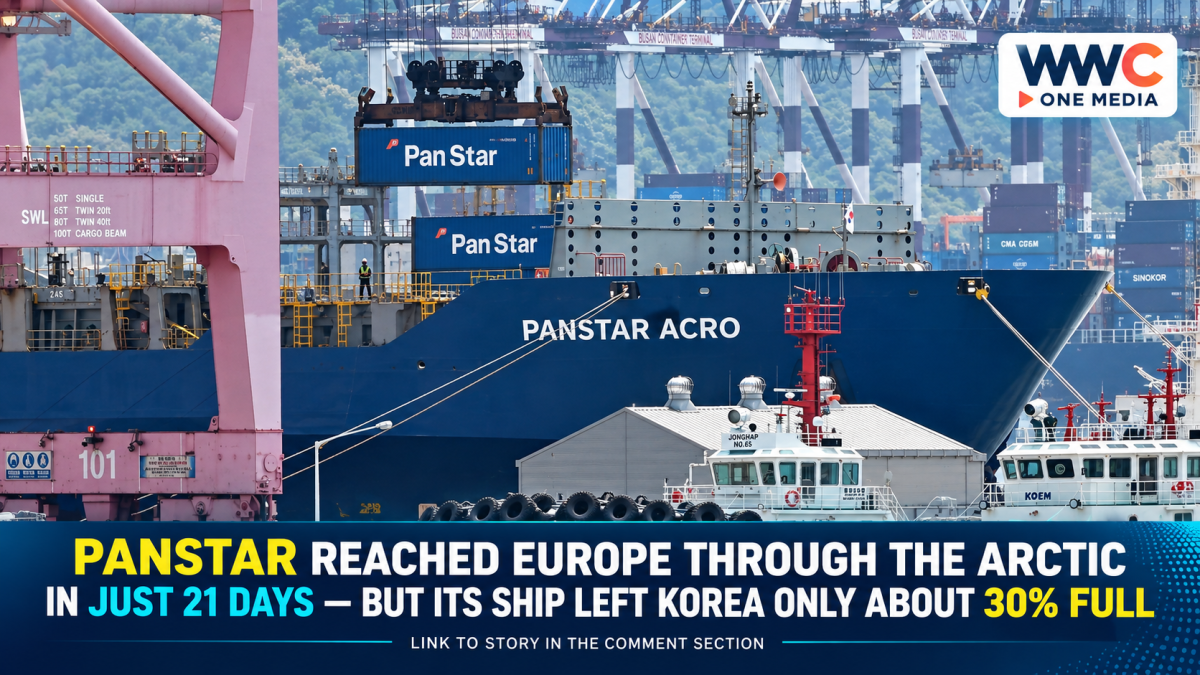
BUSAN, South Korea — September 17, 2026 — South Korea’s PanStar Group is preparing to make a much bigger bet on Arctic shipping after its PanStar Acro container vessel reached Europe in roughly three weeks through Russia’s Northern Sea Route — dramatically demonstrating how much time the polar corridor could potentially shave off conventional Asia-Europe shipping.
But speed is only half the story.
PanStar Chairman Kim Hyun-kyum says the company is considering as many as three Arctic voyages next year, before potentially increasing frequency later. The planned service would operate mainly between July and October, when Arctic waters are more navigable, with PanStar targeting expensive or time-sensitive cargo that is too slow for conventional sea freight but too costly to send by air.
The strategy comes after the 2,758-TEU PanStar Acro departed Busan on August 22 and reached Felixstowe, Britain, on September 12 — 21 days later. It subsequently continued toward Rotterdam in the Netherlands and Gdansk in Poland. Yonhap described it as the first voyage by a South Korean container ship to Europe through the Arctic route.
The important distinction is that the entire trial voyage is not yet finished. The vessel’s successful arrival in Europe completed the outbound Arctic leg, while its return to South Korea forms part of the wider test.
A shipping shortcut South Korea has wanted for years
The Northern Sea Route runs along Russia’s Arctic coast and can dramatically shorten the distance between Northeast Asia and northern Europe.
South Korean authorities previously estimated the Arctic passage could reduce sailing time by around 35% compared with conventional routes, while government calculations put the Busan-to-Europe distance at roughly 7,000 kilometres shorter than sailing through the Suez Canal.
That matters because disruptions in conventional shipping corridors have repeatedly exposed the vulnerability of global supply chains.
PanStar’s strategy is therefore not necessarily to replace the Suez Canal. Instead, the company wants to develop what Kim described as a fast point-to-point service, avoiding the numerous port calls that can stretch conventional Asia-Europe container schedules.
PanStar is particularly interested in temperature-sensitive chemicals, shipbuilding equipment, automotive components and large wind-turbine parts — goods where faster delivery can justify paying a premium, but where air freight may be impractical or prohibitively expensive.
For example, the trial vessel carried heavy industrial rings weighing around 20 tonnes, which Kim said can command freight rates several times those of standard container cargo.
But the first voyage also exposed the business problem
The Arctic shortcut may be fast, but PanStar has not yet demonstrated that it can consistently make money from it.
The PanStar Acro has a nominal capacity of 2,758 TEU, yet it departed Busan carrying 837 TEU in total — 737 TEU of commercial cargo plus approximately 100 empty containers. That represents only around 30% of the ship’s nominal TEU capacity. Cargo included chemicals, used vehicles and auto parts.
South Korean officials had earlier estimated potential demand of around 1,300 TEU, but preparations for the inaugural voyage were relatively short, contributing to the lower actual cargo volume. Officials have said that the voyage is intended to collect real-world data on distance, fuel use, operating expenses, freight rates and cargo demand before judging whether a regular Arctic service makes commercial sense.
And the Arctic itself did not cooperate perfectly.
Bloomberg reported that dense ice forced PanStar Acro to detour by roughly 350 kilometres, while unusually cold seawater created difficulties for the ship’s engines. PanStar also faced a sharp rise in fuel costs ahead of departure; Kim said the inaugural operation was therefore likely to record a loss.
That makes the next phase crucial: PanStar needs enough high-paying cargo in both directions, not simply a fast outbound trip from Korea.
China is already ahead
PanStar also isn’t entering an empty market.
Chinese carriers have been expanding Northern Sea Route operations, while several operators have announced seasonal Asia-Europe services across Arctic waters. Industry publication Seatrade Maritime reported that PanStar is competing alongside Chinese operators including Sea Legend, NewNew Shipping and OVP Shipping for cargo using the seasonal northern corridor.
Kim told Bloomberg that China represents PanStar’s main competitive challenge. Rather than trying to match giant container carriers in scale, PanStar plans to operate vessels of around 3,000 TEU or smaller and concentrate on speed-sensitive Korean and Japanese cargo. It could eventually cooperate with other South Korean and Japanese shipping companies to offer more frequent departures.
Seoul wants a regular Arctic route by 2030
The project carries ambitions well beyond PanStar.
South Korean President Lee Jae Myung has made Arctic shipping a national maritime priority, with officials hoping to develop the corridor into a regular trade route and strengthen Busan’s role as an international logistics hub by around 2030.
Traffic through the Arctic is already increasing. Reuters, citing Norway’s Centre for High North Logistics, reported that 88 ships made 103 Northern Sea Route transits in 2025, compared with 97 transits in 2024 and 43 in 2022, with Russian and Chinese vessels accounting for much of the activity.
Yet even South Korea’s broader expansion plan faces obstacles.
The Loadstar reported this week that Seoul has had difficulty attracting local companies willing to invest in costly ice-class container ships, despite government financial support. Shipping companies remain wary about uncertain cargo demand and the significantly higher cost of vessels capable of operating safely in Arctic conditions.
Russia, sanctions and climate remain unavoidable issues
There is another complication: much of the Northern Sea Route runs along Russia’s Arctic coastline.
The voyage therefore requires regulatory coordination involving Russia at a time when Moscow remains under extensive Western sanctions over its war in Ukraine. Reuters previously reported concerns among some Western diplomats about South Korea’s Arctic plans, although Seoul said it had conducted consultations intended to ensure the voyage complied with applicable rules.
Environmental groups also argue that growing Arctic shipping creates risks that extend beyond economics.
Shrinking sea ice is making northern passages increasingly accessible, but scientists warn that additional shipping can itself contribute to warming, including through emissions such as black carbon deposited on snow and ice.
That means PanStar’s successful European arrival answers only the easiest question: Can a Korean container ship get there quickly?
The much harder questions are whether PanStar can fill the ships, secure profitable return cargo, manage Arctic ice, keep insurance and operating costs under control, navigate sanctions-related complications and repeat the voyage reliably enough for customers to treat the Northern Sea Route as a real shipping service rather than an experiment.
For now, 21 days to Britain is an impressive proof of speed — not yet proof of a sustainable business model.




Leave a Reply