
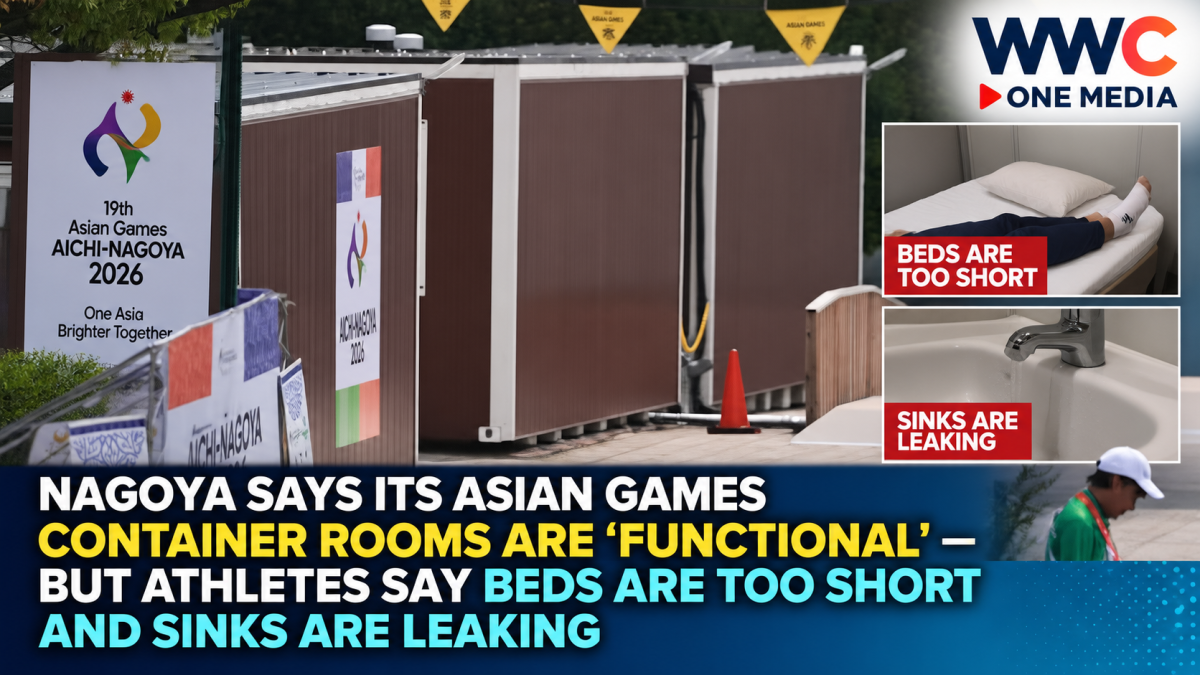
NAGOYA, Japan — September 17, 2026 — Organisers of the 2026 Aichi-Nagoya Asian Games are defending their unconventional athlete accommodation plan after complaints over short beds, leaking plumbing and a wider shortage of rooms threatened to overshadow the opening of Asia’s biggest multi-sport event.
Aichi-Nagoya organising committee president Hideaki Omura said the temporary wooden container-style rooms were considered “functional” after being inspected by a panel that included former athletes and Olympians. He said organisers were responding to complaints individually and making improvements as problems emerged.
But the official reassurance has done little to silence criticism from some visiting delegations.
South Korean basketball officials have described the container accommodation as the “worst ever”, arguing that some beds are too short for players taller than two metres. South Korean guard Byeon Jun-hyeong also posted a social-media video showing water leaking from a sink and spreading across the floor of his room, accompanied by the message: “Please help us.”
CNA, citing AFP, reported that an official from another delegation inspected the temporary facility and decided instead to book a hotel room. About 2,000 athletes and officials are expected to stay in the container-style units near Nagoya Port.
The bigger problem: Nagoya suddenly has thousands more people to house
The accommodation controversy is tied to a major numbers problem.
Organisers originally budgeted and planned for roughly 15,000 athletes and officials, but registrations climbed to about 17,000, according to Reuters. The unexpected increase put additional pressure on hotel availability and the Games’ alternative housing system.
The Korea Times, citing Yonhap and South Korean sports officials, reported that the accommodation plan called for roughly 9,000 people in hotels, 4,000 aboard a cruise ship and 2,000 in the temporary container complex. A Korean Sport and Olympic Committee official claimed that some delegations were receiving fewer container rooms than initially promised and said representatives of all 45 participating national or regional committees had raised concerns with organisers.
That claim comes from the South Korean committee and has not been independently confirmed as a formal complaint from every delegation.
The Associated Press reported that more than 11,000 athletes alone are entered in the Games — more competitors than took part in the 2024 Paris Summer Olympics — while the larger 17,000 figure includes athletes and officials.
A cruise ship has become part of the athletes’ village
Nagoya does not have a conventional, purpose-built athletes’ village for these Games.
Instead, organisers are relying on a combination of hotels, temporary wooden accommodation and the Costa Serena, a 290-metre Italian cruise liner docked at Nagoya Port. Around 4,000 athletes and officials are expected to stay aboard the ship, according to organisers.
AP reported that the Olympic Council of Asia said participants registered by the established deadline would receive accommodation, while people added later could be required to arrange their own lodging.
The Philippines has also been affected by the reshuffling. Philippine Olympic Committee president Abraham Tolentino previously said Filipino athletes had been assigned rooms, although some coaches and other officials were moved to different hotels or Airbnb accommodation.
Organisers say the rooms passed an athlete review
Omura pushed back against suggestions that the temporary units were inherently unsuitable.
He said organisers had shown the accommodation to a committee that included former Olympians and that the group had assessed the facilities positively. He also said officials would continue making adjustments when individual complaints were raised.
That leaves two competing pictures of the same accommodation system: organisers describing it as safe and functional, while some athletes and officials point to practical problems involving bed length, plumbing and available space.
Weather is adding another layer of risk
Accommodation is not Nagoya’s only logistical challenge.
Hundreds of athletes were temporarily evacuated from their lodging after torrential rain hit the region last week, disrupting trains and closing schools.
Now organisers are also preparing for the possibility of another severe-weather disruption. Reuters reported Thursday that Tropical Storm Dujuan was moving toward central Japan and could potentially affect the Aichi-Nagoya area around September 21, shortly after the opening ceremony.
Japan’s chef de mission Kosei Inoue said Games officials were holding meetings to prepare for possible weather-related delays or postponements.
The Games are already under way
The 20th Asian Games officially run from September 19 to October 4, although competitions including basketball began earlier. The programme features 469 medal events across 43 sports, with events spread across Aichi and other parts of Japan.
For Nagoya, however, the immediate contest is happening outside the sporting venues: whether organisers can turn an improvised housing system built around hotels, container-style cabins and a cruise ship into accommodation capable of supporting thousands of elite athletes for more than two weeks.
With the opening ceremony only days away, the controversy is unlikely to be settled simply by calling the rooms “functional.”



Leave a Reply