
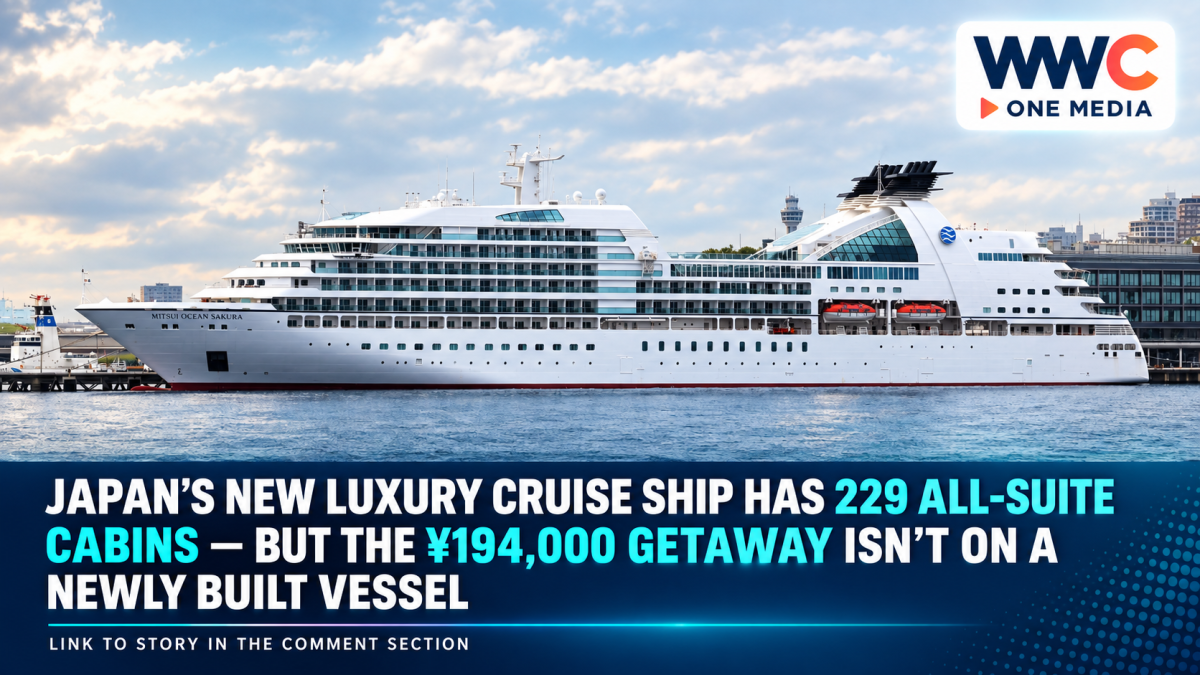
YOKOHAMA — Japan is getting a new luxury cruise ship this weekend — although the vessel itself already has more than a decade of ocean travel behind it.
Mitsui Ocean Sakura is scheduled to begin commercial service on Saturday, September 19, giving Tokyo-based MOL Cruises a 458-passenger, all-suite ship designed primarily for voyages around Japan.
The operator opened the ship to the media in Yokohama ahead of the debut, revealing 229 ocean-facing suites, five restaurants, a poolside footbath and an 87-square-meter premium Signature Suite overlooking the sea.
But Sakura is more than another high-end ship entering the Japanese market.
Its arrival marks the next phase in one of Japan’s oldest passenger-shipping businesses.
The vessel is effectively replacing Nippon Maru, which ended nearly 35 years of service in May, while joining Mitsui Ocean Fuji, which began operating in December 2024. Together, the two ships form the core of MOL Cruises’ attempt to capture growing demand for upscale cruising around Japan.
And there is another twist.
Despite being described as a “new” cruise ship, Sakura was not constructed from scratch.
Mitsui Ocean Sakura used to be Seabourn Sojourn
Before becoming Mitsui Ocean Sakura, the vessel sailed for luxury operator Seabourn as the Seabourn Sojourn.
Mitsui O.S.K. Lines acquired the ship from Seabourn in 2025 after previously purchasing its sister vessel, Seabourn Odyssey, which became Mitsui Ocean Fuji.
The former Sojourn completed its final Seabourn service earlier this year before crossing the Pacific and arriving in Japan.
It then entered dry dock for conversion into the Japanese-focused Sakura.
That distinction is important.
This is not a newly constructed ship entering the global fleet.
It is an established luxury vessel being reflagged, refurbished and repositioned for Japan, with new dining concepts, entertainment and services tailored to MOL Cruises’ Japanese passengers.
The strategy also gives MOL an operational advantage.
Because Fuji and Sakura originated as sister ships with essentially the same underlying design, MOL Cruises can apply much of what it has learned from operating Fuji directly to Sakura.
Every cabin is a suite — and every cabin faces the sea
One of Sakura’s biggest selling points is its accommodation.
The ship has 229 suites and capacity for 458 guests.
All rooms face the ocean, and roughly 90% have private balconies, according to Japanese coverage of the pre-launch ship tour. Rooms also include bathtubs and washlet-equipped toilets.
At the top end is the 87-square-meter Signature Suite, featuring large forward-facing windows, a private veranda, a jet bath and butler service.
That room is only one part of MOL Cruises’ effort to position the vessel above a conventional mass-market cruise.
The entire ship carries only a few hundred passengers despite being almost 200 meters long.
Official specifications currently list Sakura at 198.15 meters in length and 26 meters wide.
That gives it a very different passenger-to-space proposition from mega-ships carrying several thousand holidaymakers.
The ship has five restaurants — including sushi and French fine dining
Food is central to the product.
The ship contains five restaurants, including the main Restaurant Sakura and Sushi Bar Shiosai, serving sushi, smaller Japanese dishes and sake.
Another venue, Hokusai Fine Dining, offers French cuisine supervised by prominent Japanese chef Kiyomi Mikuni.
MOL has deliberately linked the food programme to Nippon Maru’s heritage.
Executive chef Katsutoshi Nakayama previously worked aboard Nippon Maru, Fuji Maru and Mitsui Ocean Fuji. He joined the company as a cook in 1990 — the same year the recently retired Nippon Maru entered service.
That gives MOL Cruises a useful continuity story:
The ship is changing.
The brand is changing.
But the company says the food culture and Japanese hospitality developed aboard its older vessels are being carried forward.
There is even a Japanese-style footbath beside the pool
One of Sakura’s more unusual features sits by its main swimming pool.
Passengers can use a footbath overlooking the sea, part of MOL Cruises’ effort to make the vessel feel more distinctly Japanese rather than simply putting a Japanese name on an imported luxury ship.
The ship also includes lounges, bars, a spa, fitness facilities and entertainment spaces.
MOL Cruises announced this month that Sakura will stage a newly created production show from Belinda King Creative Productions as part of its onboard entertainment programme.
The design philosophy is therefore less about competing with giant resort ships full of water parks and roller coasters.
It is selling something closer to a small luxury hotel that happens to move between Japanese ports.
But the first cruise is not a short three-day getaway
The Japan Times noted that Sakura will focus heavily on one- to three-night itineraries.
That is true of a substantial part of its programme.
But its actual maiden voyage is longer.
The first commercial sailing leaves Yokohama on September 19 for a four-night, five-day round trip, visiting Toba in Mie Prefecture and Hidaka in Wakayama Prefecture before returning to Yokohama on September 23.
The advertised fare for that inaugural cruise ranges from ¥372,000 to ¥1.241 million per passenger, based on two people sharing a cabin and depending on suite category.
That puts the first sailing squarely in premium territory.
After that, however, shorter voyages become a major part of the schedule.
A one-night cruise can still cost ¥69,000
Japanese outlet Impress highlighted how MOL plans to use short cruises to lower the time commitment for customers.
One example is the one-night Santa Cruise between Yokohama and Nagoya, priced from around ¥69,000 per person.
A two-night autumn voyage linked to Ise Jingu starts from around ¥154,000.
That illustrates the business strategy behind the ship.
Luxury cruising has traditionally demanded both substantial money and substantial time.
MOL is trying to reduce the second barrier.
A customer might not have a week available.
But they may be willing to spend heavily for one weekend at sea.
MOL scheduled 29 debut cruises in just over three months
The scale of that short-cruise strategy becomes clearer in Sakura’s inaugural schedule.
MOL Cruises announced 29 debut voyages between September 19 and the end of December 2026, with numerous one-, two- and three-night sailings.
Ports include Yokohama, Tokyo, Kobe, Hakata, Nagoya and other locations around Japan.
Because the ship is less than 200 meters long, MOL says it can access smaller ports, remote islands and locations that can be difficult for larger cruise vessels to visit.
That gives the company another advantage.
Rather than competing only for the same major cruise terminals used by international mega-ships, Sakura can build itineraries around destinations that are harder for very large vessels to reach.
Being Japanese-flagged matters
There is another major difference between MOL Cruises’ two luxury ships.
Mitsui Ocean Fuji operates under the Bahamas flag.
Mitsui Ocean Sakura is being operated as a Japanese-flagged vessel.
That is not merely symbolic.
Its Japanese registration gives MOL Cruises more flexibility to operate purely domestic Japanese itineraries, including cruises that begin and end inside Japan without the foreign-port requirements affecting foreign-flagged vessels.
For a ship designed around short Japanese journeys, that becomes a major commercial advantage.
It helps explain why Sakura, rather than Fuji, is particularly well suited to frequent one- and two-night cruises.
The January Seto Inland Sea cruise starts at ¥194,000
One itinerary highlighted by the Japan Times is a three-day Seto Inland Sea cruise departing Kobe on January 3, 2027.
The lowest published fare is ¥194,000 per person for an Ocean View Suite.
Prices rise steeply by category.
The top Mitsui Ocean Suite costs ¥648,000 per passenger for the same itinerary, again based on double occupancy.
That pricing underscores what Sakura is — and what it is not.
This is not a low-cost cruise attempting to compete with an inexpensive domestic ferry or budget holiday.
MOL is positioning the ship as an all-inclusive luxury experience, with standard meals, drinks, onboard activities and some shore excursions included, although certain restaurants and menu items may require additional payment.
It replaces one of Japan’s most recognizable cruise ships
The transition carries considerable emotional significance for Japan’s cruise sector.
Nippon Maru ended service on May 10, 2026, after almost 35 years.
More than 7,000 people attended its retirement ceremony at Yokohama’s Osanbashi terminal.
The ship had become closely associated with domestic Japanese cruising, particularly smaller ports, food-focused sailings and itineraries around the country’s islands.
MOL Cruises has deliberately framed Sakura as its successor.
Former Nippon Maru captain Satoshi Ninomiya is among the captains selected for Sakura’s debut season, while Nakayama carries over the culinary connection.
So even though the hardware came from Seabourn, MOL wants the service culture to feel distinctly inherited from Nippon Maru.
The company now has two former Seabourn sister ships
MOL Cruises’ modern fleet has undergone an unusually rapid transformation.
In late 2024, it launched Mitsui Ocean Fuji, formerly Seabourn Odyssey.
Now it is adding Sakura, formerly Seabourn Sojourn.
The two were sister ships before MOL ever owned them.
That effectively gives the company a matched pair of small luxury vessels.
MOL says its previous experience operating Fuji helped convince it that the design was well suited to its concept of a high-end Japanese cruise experience.
Buying a proven sister ship also avoids some of the execution risk associated with designing and building an entirely new vessel.
The trade-off is age.
Sakura was originally built in 2010, meaning the ship’s premium credentials now depend heavily on the quality of the conversion, refurbishment and onboard product rather than the novelty of its underlying hull.
Japan’s cruise market is recovering strongly
The timing is favourable.
Japan’s Ministry of Land, Infrastructure, Transport and Tourism said the number of cruise ship port calls in the country reached 3,117 in 2025, about 30% higher than the previous year and above the pre-pandemic peak.
Those included 2,352 calls by foreign cruise ships and 765 by Japanese-operated vessels.
Cruise tourism brought about 1.767 million inbound passengers to Japan during 2025, around 20% more than the previous year.
At the same time, the number of Japanese people taking cruises increased.
Japan’s domestic cruise passenger count rose about 25% to 76,000 in 2025, while the overall Japanese cruise population reached approximately 243,000, up about 8% year on year.
Those numbers remain much smaller than mainstream Japanese tourism, but they show why operators see room to grow.
Japan also wants cruise ships to spread visitors beyond major tourist cities
The government has its own reason to encourage the industry.
Japan welcomed a record 42.68 million international visitors in 2025, intensifying concerns about overcrowding in destinations such as Tokyo and Kyoto.
The transport ministry has specifically identified cruise tourism as one tool for dispersing visitors toward regional destinations.
In 2026, it approved support for 36 projects aimed at sustainable cruise development, including efforts to encourage ships and passengers to use a wider range of ports.
That strategy fits Sakura particularly well.
Its sub-200-meter size gives it access to smaller regional ports that would be difficult for some large international vessels.
For those communities, even a few hundred relatively affluent passengers can create spending for local restaurants, guides, transport operators and attractions.
The ship is part of something bigger inside Mitsui O.S.K. Lines
MOL Cruises is owned by shipping giant Mitsui O.S.K. Lines, better known globally for commercial shipping than holidays.
But the parent company has increasingly classified cruises among the businesses it wants to develop as it diversifies away from purely shipping-market-dependent earnings.
MOL’s broader Blue Action 2035 strategy has entered a new phase covering fiscal 2026 through 2030, with management saying investments made during earlier expansion should increasingly begin producing returns.
Sakura therefore carries expectations beyond whether passengers like its sushi bar.
It is also a test of whether MOL can convert its investment in premium passenger travel into a meaningful long-term business.
The biggest challenge may be convincing Japanese travelers to cruise more often
Japan is surrounded by sea and has some of the world’s largest ports.
But cruising has never reached the level of mass-market penetration seen in places such as the United States.
That gives MOL both a problem and an opportunity.
Rather than asking Japanese customers to immediately commit to a seven-, 10- or 14-night holiday, Sakura can offer a one-night or weekend cruise as an introduction.
If customers like it, the operator can attempt to move them toward longer and more expensive voyages later.
That makes the short-cruise strategy partly an acquisition strategy.
Sell the weekend first. Sell the cruise lifestyle second.
And ¥194,000 is only the beginning
The headline ¥194,000 price from the January Seto Inland Sea sailing represents the entry-level Ocean View Suite.
That same two-night voyage reaches ¥648,000 per person in the largest suite category.
The inaugural September voyage ranges even higher, topping ¥1.241 million per person in its most expensive accommodation category.
Those figures demonstrate the audience MOL is pursuing.
This is not simply transportation between Japanese ports.
It is selling space, service, food, privacy and time.
The ship’s real test starts after the novelty fades
Saturday’s departure will generate attention because Mitsui Ocean Sakura is new to Japan.
It has all-suite accommodation.
It has premium restaurants.
It has a poolside footbath.
And it carries the legacy of a famous Japanese cruise ship that served for nearly 35 years.
But the business test comes later.
MOL Cruises must prove that Japanese passengers will repeatedly pay premium prices for shorter voyages — not simply book once to experience the newest ship.
It also has to convince Nippon Maru loyalists that a former Seabourn vessel can genuinely inherit the personality of a deeply Japanese cruise brand.
MOL Cruises President Tsunemichi Mukai said the company wants passengers to come away with special, unforgettable experiences.
That sounds like a hospitality promise.
It is also a commercial one.
Because MOL already has the ships.
It now has to fill them.
And after retiring a 35-year icon, Japan’s next era of domestic cruising is starting on a vessel that has already lived one luxury life — and is about to begin another under a Japanese flag.


Leave a Reply