
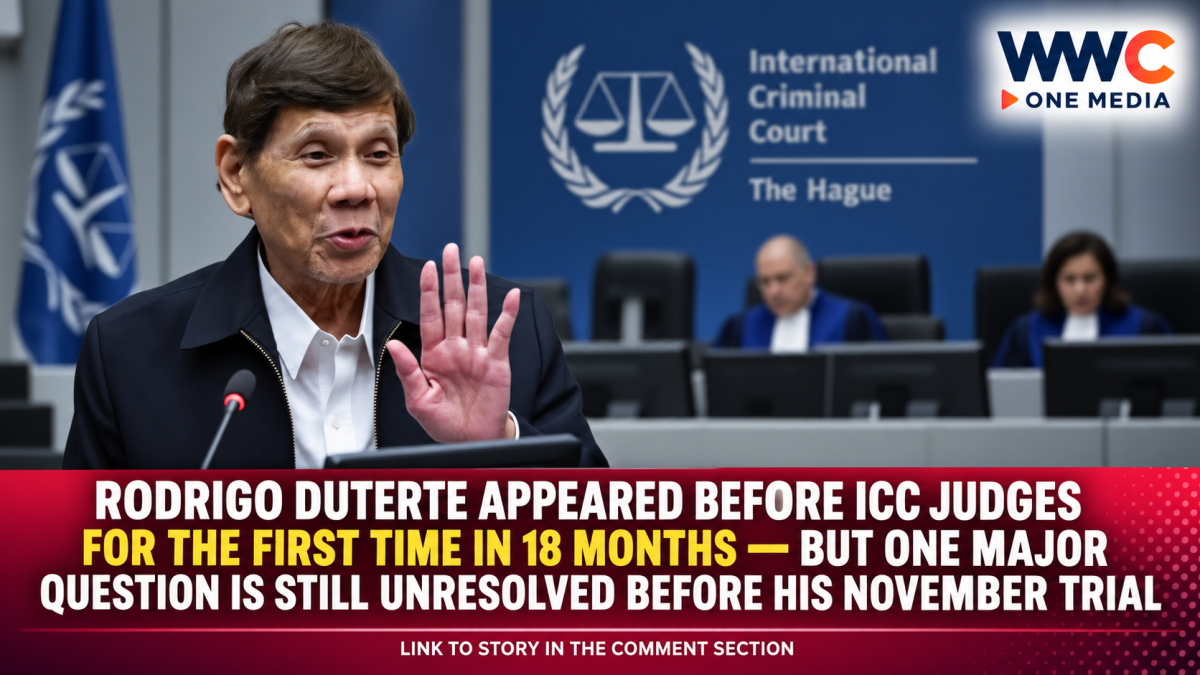
Former Philippine President Rodrigo Duterte made his first courtroom appearance since being transferred to the International Criminal Court 18 months ago, appearing before judges in The Hague on September 16 as preparations intensified for his crimes against humanity trial.
The 81-year-old former president, dressed in a black suit and white shirt, did not address the court during the proceedings. Reuters reported that he sat quietly, drank water and stood to wave toward family members in the public gallery.
The appearance was significant because Duterte had previously participated only remotely or had been absent from several proceedings, including the February confirmation-of-charges hearing after judges allowed him to waive his attendance. The ICC says Duterte’s trial is scheduled to formally open on November 30, 2026.
But despite the highly visible return to court, one of the most closely watched questions surrounding the case remains unresolved:
Will the judges uphold the earlier assessment of his ability to participate as the case moves into the full trial phase?
Duterte’s defense has renewed arguments concerning his health and cognitive condition. The Trial Chamber has not yet issued its latest ruling on that dispute.
What Exactly Is Duterte Accused Of?
Duterte faces three counts of crimes against humanity involving murder and attempted murder.
On April 23, the ICC’s Pre-Trial Chamber unanimously confirmed the charges and sent the case to trial after finding “substantial grounds to believe” he could be responsible for the alleged crimes. That is the evidentiary standard for confirming charges at the ICC; it is not a finding of guilt. Guilt or innocence is determined at trial.
The confirmed allegations cover incidents linked to the anti-drug campaign during Duterte’s periods as Davao City mayor and Philippine president.
According to the ICC, the alleged crimes occurred between November 1, 2011 and March 16, 2019 and were allegedly part of a widespread and systematic attack against a civilian population.
Philippine media reports on the April decision said the confirmed case encompasses 49 incidents involving 76 killings and two attempted murders.
Duterte denies criminal responsibility.
His defense has argued against the prosecution’s characterization of his anti-drug policies and has challenged aspects of the ICC proceedings, including jurisdiction and the evidence presented against him.
The September 16 Hearing Was More About What Happens Next
The latest appearance was a status conference, not the start of testimony on Duterte’s guilt or innocence.
Much of the proceeding dealt with how the upcoming trial will operate, including the enormous quantity of evidence, the number of prosecution witnesses and the amount of courtroom time the parties expect to need.
Presiding Judge Joanna Korner urged prosecutors to consider reducing their witness list and shortening the presentation of their case.
GMA News reported that prosecutors had requested approximately 193 hours to present their evidence. Korner called that a lengthy amount of time and told the prosecution to examine whether multiple witnesses covering similar issues were all necessary.
Reuters reported that Korner emphasized the need for an efficient trial because of Duterte’s age and health circumstances.
The prosecution said it would look for ways to streamline its presentation, while noting that its proposed schedule was already a reduced version of what it originally anticipated.
Duterte’s Lawyers Say the Evidence Disclosure Is Overwhelming
Another major dispute erupted over the amount of material the defense must examine before trial.
Duterte’s lawyer Peter Haynes told the court that roughly 62,000 exhibits had been placed in the court’s evidence system and criticized the way prosecution material had been disclosed.
The prosecution disputed the defense’s characterization of the disclosure process.
Haynes told the court that even with a younger and healthier client he would have considered seeking a substantial delay because of the volume of evidence, Reuters reported.
The argument matters because trial judges must balance two competing requirements: moving the case forward without unnecessary delay while also ensuring that the defense receives enough time and information to prepare its case.
Then Came Another Decision: Duterte Will Stay Detained
Shortly after the status conference, Trial Chamber III issued a separate decision ordering that Duterte remain in ICC detention.
The three judges unanimously concluded that circumstances still justified detention, citing risks that he could abscond or obstruct or endanger the proceedings.
The chamber specifically pointed to the disclosure of witness identities and expected testimony, saying this increased the potential ability to interfere with witnesses either directly or through others.
Duterte’s defense has contested continued detention and has linked the issue to the unresolved question surrounding his fitness to proceed.
The court nevertheless concluded that the defense had not presented a sufficient change in circumstances to justify modifying detention at this stage.
He therefore remains held at the ICC detention facility in Scheveningen, The Hague, ahead of trial.
But What About Duterte’s Health?
This is where the legal situation requires careful distinction.
In January 2026, ICC judges ruled that Duterte was fit to participate in the pre-trial proceedings after considering assessments from three independent medical experts. The chamber rejected the defense’s request for an indefinite adjournment and concluded that he could effectively exercise his procedural rights at that stage.
That decision allowed the confirmation-of-charges proceedings to resume.
The confirmation hearing was eventually held from February 23 to 27. Duterte did not personally attend after the chamber granted his request to waive attendance.
But his lawyers have since renewed concerns about his condition as the full trial approaches.
Reuters reported that the defense says Duterte suffers from cognitive decline affecting his memory and daily functioning. That is a defense claim, not an independent medical conclusion that should be stated as established fact.
GMA News reported after the September 16 proceedings that the Trial Chamber has yet to decide the latest fitness issue, following further submissions concerning medical assessments.
That makes the distinction important:
Duterte was previously found fit for the pre-trial proceedings, but the court is still considering renewed arguments about his condition ahead of trial.
Why Does the ICC Still Claim Jurisdiction When the Philippines Has Withdrawn?
The Philippines formally withdrew from the Rome Statute, the treaty that created the ICC, with the withdrawal taking effect on March 17, 2019.
Duterte’s lawyers have challenged the court’s jurisdiction.
The ICC, however, has ruled that withdrawal does not erase its jurisdiction over alleged crimes committed while the Philippines was still a state party.
The court says its Philippines investigation covers alleged crimes within its jurisdiction committed from November 1, 2011 through March 16, 2019.
That legal question has therefore already been litigated extensively, although Duterte’s defense has continued challenging aspects of the case.
How Many People Were Killed in the Drug War?
This is another area where figures must be presented carefully because estimates differ significantly depending on what is being counted.
Reuters reports that Philippine police acknowledged about 6,200 deaths of suspects during official anti-drug operations under Duterte.
Human rights groups and ICC prosecutors have cited substantially higher estimates when deaths allegedly connected to vigilantes and other actors are included, with figures reaching as high as roughly 30,000.
A 2020 United Nations human-rights report calculated at least 8,663 deaths, while Philippine and international rights organizations have argued that the true number could be considerably higher.
Those broader estimates should not be confused with the specific incidents formally charged in Duterte’s ICC case.
The trial will concern the evidence supporting the confirmed charges, not a judicial determination covering every death attributed publicly to the anti-drug campaign.
Victims’ Families Watched From Manila
Duterte’s courtroom appearance was followed closely thousands of kilometres away in the Philippines.
Associated Press reported that relatives of people killed during anti-drug operations gathered in Manila to watch the proceedings and called for accountability. A smaller gathering also took place outside the ICC in The Hague.
Reuters reported that some relatives of victims reacted to seeing Duterte physically appear before judges for the first time since his transfer.
Duterte also retains a substantial political support base in the Philippines, and members of his family and supporters have repeatedly challenged the legitimacy and handling of the ICC proceedings.
The court itself will ultimately decide the case on the evidence and applicable law rather than political opinion surrounding the former president.
From March 2025 Arrest to a November 2026 Trial
Duterte was arrested by Philippine authorities in March 2025 under an ICC warrant and surrendered to the court in The Hague on March 12.
The ICC arrest warrant initially found reasonable grounds to believe he was responsible as an alleged indirect co-perpetrator for murder as a crime against humanity during the period covered by the investigation.
The case then moved through jurisdictional challenges, medical assessments and confirmation proceedings.
On January 26, 2026, judges found him fit for the pre-trial phase.
From February 23 to 27, prosecutors, victims’ representatives and the defense argued over whether there was enough evidence for the charges to proceed.
On April 23, judges unanimously confirmed all three counts and committed Duterte to trial.
And on November 30, unless the schedule is changed by the Trial Chamber, prosecutors are expected to begin presenting the case that could determine the former Philippine president’s criminal responsibility.
The September courtroom appearance therefore was not the final showdown.
It was the clearest sign yet that the case is moving toward one.
Duterte appeared before the judges.
The charges have been confirmed.
His detention continues.
But before the first trial witness takes the stand, the court still has a critical procedural question to resolve.




Leave a Reply