
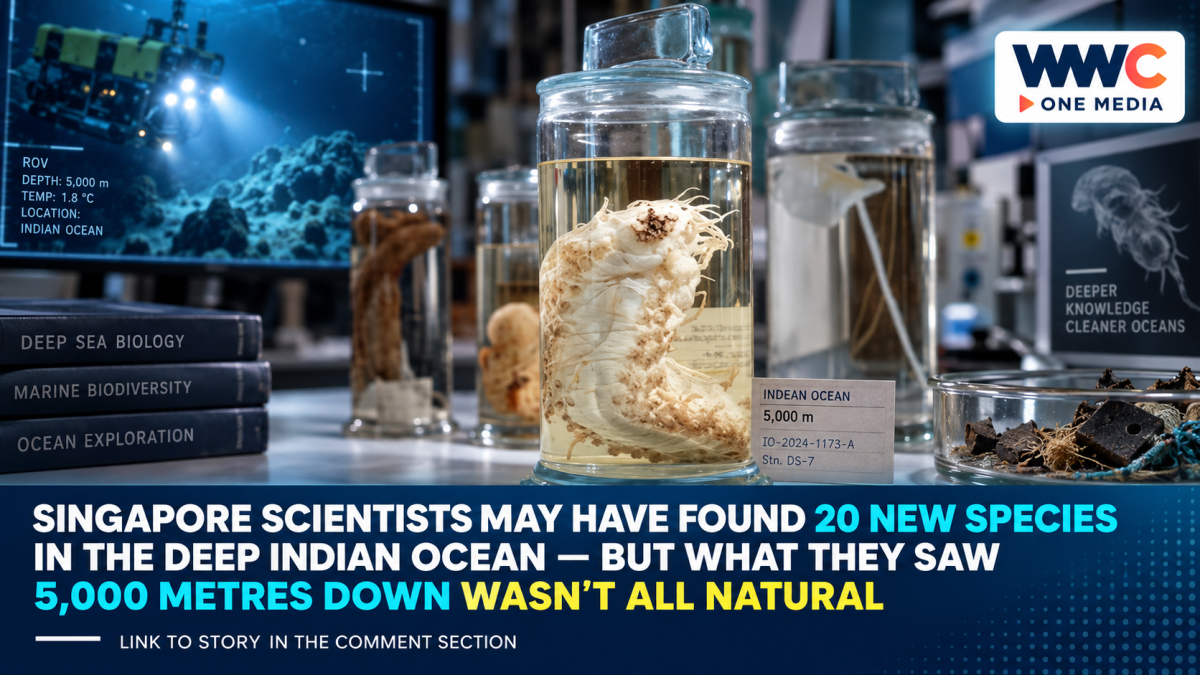
Scientists exploring one of the least-studied stretches of the eastern Indian Ocean may have encountered at least 20 species potentially new to science, opening a rare window into an ecosystem thousands of metres beneath the surface.
The findings come from the NUS-OceanX Into the Deep: Monsoon Rise expedition, conducted in October 2025 by researchers from the National University of Singapore and nonprofit ocean exploration organisation OceanX.
According to new results reported by CNA on September 17, researchers returned with more than 2,000 biological specimens, while an estimated 100 to 200 species were documented during the mission. At least 20 of those could ultimately turn out to be previously undescribed species — although scientists stress that formal identification and taxonomic work are still under way.
That distinction matters: researchers have not yet formally declared 20 new species. Establishing a new species can require detailed anatomical comparisons, genetic sequencing, examination of museum collections and eventual publication in a peer-reviewed scientific paper.
But the early results already suggest that Monsoon Rise is hiding substantially more biodiversity than scientists previously knew.
And that was not the expedition’s only surprise.
Researchers also detected microplastics at depths of around 5,000 metres, showing that even this remote deep-sea environment is not isolated from humanity’s pollution.
The Expedition Went Into a Part of the Ocean We Barely Know
Monsoon Rise is a chain of enormous underwater mountains, or seamounts, in the eastern Indian Ocean near Christmas Island.
Unlike islands, their peaks do not break the ocean surface.
Some rise around 3,000 metres above the surrounding seafloor, and one summit area alone is roughly comparable in size to Singapore, according to expedition researchers.
Seamounts can become biological hotspots because their hard surfaces give corals and sponges somewhere to attach, creating habitat for smaller organisms that can in turn attract larger animals.
Yet thousands of these underwater mountains remain poorly investigated.
When the expedition was launched, NUS said the team aimed to build the first comprehensive biodiversity baseline for Monsoon Rise using remotely operated vehicles, submersibles, environmental DNA sampling, sonar and specially designed deep-sea traps.
That baseline could prove crucial if the area changes in the future because of fishing, pollution, climate change or potential resource extraction.
More Than 6,000 Sq Km Newly Mapped
The scale of the expedition was considerable.
CNA’s latest reporting says researchers newly mapped about 6,050 sq km of deep-sea terrain and collected more than 2,000 specimens.
Earlier post-expedition reporting from NUS and The Straits Times gave a broader total: more than 8,300 sq km of seafloor mapped, with around 70 per cent previously unknown to science. The different reports are therefore referring to somewhat different measures of the mapping work rather than necessarily contradictory discoveries.
Researchers collected samples at depths ranging from roughly 1,000m to 5,000m.
The team originally expected to work to about 4,000m, but ultimately reached areas approximately 5km below sea level.
At those depths, sunlight has completely vanished.
Pressure is extreme.
Temperatures are low.
And the organisms living there have evolved under conditions radically different from those found in coastal waters.
Then Scientists Started Looking at the Sea Cucumbers
Among the creatures brought back were 20 sea cucumber specimens.
Only four could immediately be identified confidently to species level, NUS Reef Ecology Lab research fellow Dr Allison Miller told CNA.
Another 10 appear to be unidentified forms that scientists had encountered during previous expeditions.
But the remaining six specimens may represent animals nobody has documented before.
Scientists are now comparing their structures and genetic information with known species before reaching any formal conclusion.
Sea cucumbers may not look dramatic, but their ecological role is significant.
They consume organic material on the seabed, disturb and mix sediments and recycle nutrients — essentially helping process the material that settles onto the deep-ocean floor.
Researchers also collected and are analysing crustaceans, fishes, sponges, anemones and other organisms from Monsoon Rise.
So the final number of potential new species could still change.
And DNA Is Finding Animals the Cameras Missed
Physical specimens are only part of the story.
Researchers also collected environmental DNA, or eDNA.
Every organism leaves tiny genetic traces behind through skin cells, mucus, waste and other biological material.
Scientists can filter seawater or analyse sediment for these fragments, sequence the DNA and compare the resulting genetic signatures with known organisms.
The expedition’s preliminary eDNA work has already detected organisms that were not represented among the physical specimens collected, according to CNA. For certain groups, the genetic evidence indicates greater species diversity than the specimens alone suggested.
That means some Monsoon Rise animals may have been scientifically detected without ever being caught — or even seen.
OceanXplorer Gave Scientists Something Older Expeditions Couldn’t
The expedition relied heavily on OceanXplorer, OceanX’s advanced research vessel.
It carries onboard laboratories, sonar mapping systems, manned submersibles and remotely operated vehicles.
One of the main machines used was Chimera, an ROV capable of descending beyond 6,000 metres while carrying cameras, sensors and sampling equipment.
That represents a major improvement over some traditional deep-sea research techniques.
Earlier expeditions often relied heavily on dredging or trawling — effectively dragging equipment across the seafloor and examining whatever came back.
Specimens can be damaged during that process.
By contrast, high-definition cameras allowed the Monsoon Rise team to watch animals alive in their natural environment before sampling them.
The Straits Times reported sightings including lantern sharks, chimaeras, sleeper sharks and deep-sea sea cucumbers, while researchers were also able to observe corals and other organisms attached to steep seamount slopes.
That behavioural information can be scientifically valuable because a preserved specimen in a jar cannot reveal how an animal moves, feeds or interacts with its habitat.
But 5,000 Metres Down, Scientists Found Something Much More Familiar: Plastic
Perhaps the most sobering finding came from the same extreme depths.
The expedition detected microplastics thousands of metres below the Indian Ocean surface, with larger pieces of plastic debris also observed on the seabed.
That means researchers encountered signs of human pollution in an ecosystem so remote that many of its animals may still lack scientific names.
The discovery fits a broader body of research showing that plastic fragments can be transported far from their original sources through rivers, currents, sinking organic matter and other ocean processes.
Its presence does not by itself establish how much ecological harm is occurring at Monsoon Rise — that requires further study.
But it destroys any assumption that remote deep-sea environments are untouched simply because people rarely visit them.
Why This Expedition Matters Beyond Discovering Strange Animals
The expedition has wider geopolitical and conservation significance.
It was Singapore’s first major deep-sea scientific expedition following adoption of the United Nations Biodiversity Beyond National Jurisdiction Agreement, commonly known as the BBNJ or High Seas Treaty.
The treaty formally entered into force on January 17, 2026. It creates an international framework covering areas outside national jurisdiction, including provisions for marine protected areas, environmental impact assessments, sharing benefits from marine genetic resources and transferring marine technology.
The Monsoon Rise project involved researchers not just from Singapore but also from Indonesia, Thailand, Vietnam and Fiji, making regional scientific capacity-building part of the mission from the beginning.
Singapore’s National Research Foundation committed up to S$6 million to support the broader research programme and development of deep-sea science capabilities.
The Timing Is Important Because Interest in Mining the Deep Sea Is Growing
There is another reason scientists want detailed biodiversity maps before commercial activity potentially expands.
Deep-sea minerals have become increasingly attractive to governments seeking supplies of metals used in batteries, electronics, defence equipment and clean-energy technologies.
The United States is now pushing to accelerate deep-sea mining permits. Reuters reported this week that U.S. Interior Secretary Doug Burgum said Washington aims to begin issuing permits within months, although environmental groups and scientists have warned that mining could cause biodiversity losses in ecosystems that remain poorly understood.
Monsoon Rise is not automatically a mining site simply because scientists are studying it, and the NUS-OceanX findings should not be read as evidence that mining there is imminent.
But the larger debate illustrates why baseline research matters.
You cannot measure what has been lost if nobody documented what was there beforehand.
During earlier reporting on the expedition, NUS mission lead Professor Peter Ng told The Straits Times that scientists generally preferred avoiding disruption to environments they did not yet understand.
The Monsoon Rise results make that knowledge gap strikingly clear.
Scientists explored only part of the seamount system.
They brought back more than 2,000 specimens.
They estimate 100 to 200 species were encountered.
At least 20 may be new to science.
Genetic material suggests still more organisms were present but never physically collected.
And even after sophisticated robots descended kilometres into darkness, researchers say they have examined only a fraction of what is there.
The remarkable part of the story may therefore not be that scientists potentially found 20 new species.
It may be that 20 is only the beginning.




Leave a Reply