
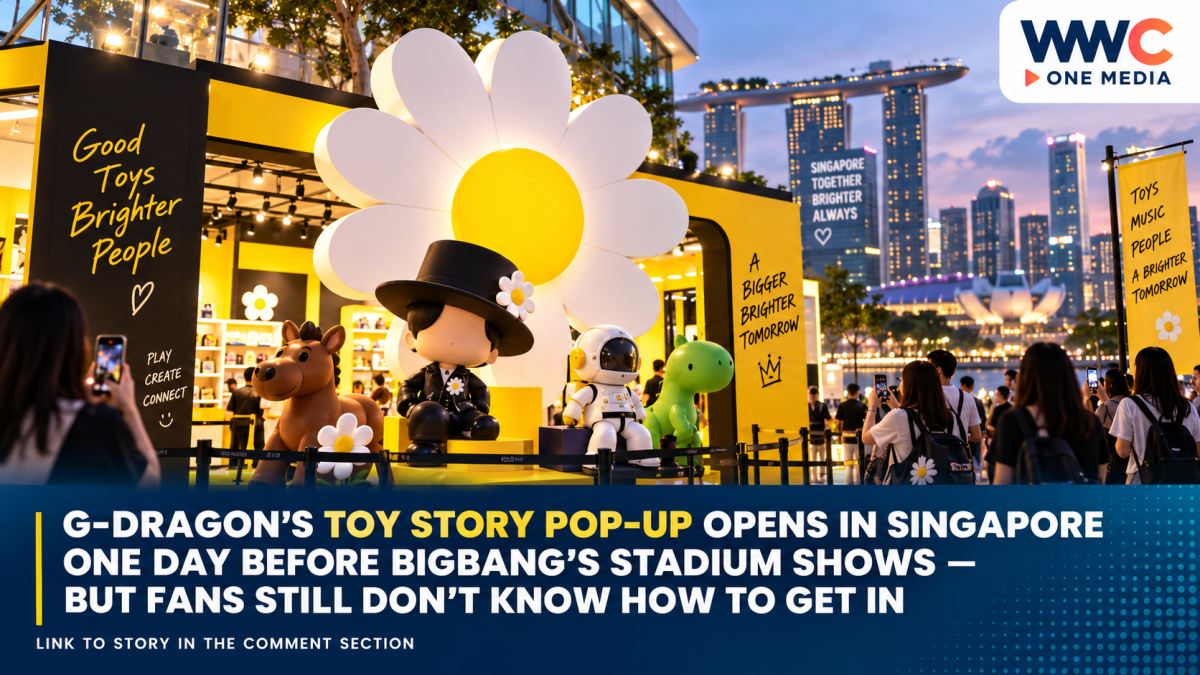
SINGAPORE — G-Dragon is about to have an unusually busy October in Singapore.
On October 16, his fashion and lifestyle label PEACEMINUSONE will bring its Toy Story collaboration to Clarke Quay for the project’s first Southeast Asian pop-up.
One day later, G-Dragon will walk into Singapore’s National Stadium with Taeyang and Daesung for the first of two sold-out BigBang concerts.
For fans, that means Singapore is about to become a concentrated G-Dragon destination: collectibles, fashion and Pixar nostalgia by day, then a stadium-scale K-pop reunion at night.
But there is one major catch.
The pop-up opens in less than a month, and organisers still have not disclosed exactly how fans will enter, what Singapore-exclusive products will be sold, how much they will cost or whether reservations will be required.
That uncertainty could matter because earlier stops of Toy Story | PEACEMINUSONE: The First Fan were far more than ordinary merchandise stalls.
They combined giant Toy Story installations, limited-edition collectibles, apparel, interactive displays and city-exclusive items—with some locations requiring advance reservations.
Singapore gets the Southeast Asian debut
CNA Lifestyle says the Clarke Quay edition will run from October 16 through November 11, giving fans nearly four weeks to visit. It will be the collaboration’s first stop in Southeast Asia after previous editions in Seoul, Tokyo, Hong Kong and Taipei.
Singapore-based collectibles company Mighty Jaxx is collaborating on the local edition.
That pairing makes commercial sense.
Mighty Jaxx has built an international business around designer collectibles and licensed pop-culture properties, including collaborations connected with Disney, Sanrio, One Piece and The Powerpuff Girls.
For The First Fan, the company will be helping translate a collaboration that already mixes three audiences:
Toy Story fans.
G-Dragon fans.
And collectors who follow PEACEMINUSONE.
The overlap could be unusually powerful.
The idea is built around G-Dragon’s childhood
The collaboration is not simply Woody wearing a PEACEMINUSONE logo.
The entire project is built around the idea of childhood toys as the “first fans” of a person’s dreams.
The official project describes the toys children grew up with as companions who were there when their ambitions were still at their biggest and most imaginative.
The Japanese launch material makes the G-Dragon connection even more explicit.
It says The First Fan was conceived around the idea that Pixar toys represented some of the earliest companions that supported G-Dragon’s childhood dreams. Characters including Woody, Buzz Lightyear, Jessie, Rex, the Aliens, Bullseye and Forky are then reinterpreted through PEACEMINUSONE’s design language.
At the centre of that visual language is the fashion label’s instantly recognisable daisy with a missing petal.
The result is Toy Story filtered through G-Dragon rather than simply conventional Disney merchandise.
Woody and Buzz have already been given the PEACEMINUSONE treatment
At earlier stops, Toy Story characters appeared alongside oversized daisy installations, mirrored interiors and PEACEMINUSONE branding.
The Hong Kong edition, held at Harbour City, featured a three-metre illuminated PEACEMINUSONE daisy, a 1.6-metre Woody sculpture, a giant recreation of furniture from Andy’s bedroom and installations featuring Buzz Lightyear, Jessie, Bullseye, the Aliens, Forky and Rex.
There were also more than 20 themed artworks and an interactive message wall where visitors could leave notes connected to their childhood dreams.
Singapore organisers have confirmed interactive elements.
What they have not confirmed is whether the Clarke Quay edition will reproduce those exact installations.
That distinction matters.
Earlier pop-ups offer a preview of the project’s scale, not a guaranteed floor plan for Singapore.
Previous stops carried around 70 products
The merchandise may create even more attention.
Harbour City said its Hong Kong pop-up offered approximately 70 PEACEMINUSONE × Toy Story products, including limited-edition figures, jewel pins, keychains, scarves, baseball caps, stickers and phone cases.
Japan’s range was similarly broad.
Official Baycrews material listed figures, plush toys, apparel, accessories and lifestyle products.
Some were relatively accessible collectibles.
Others were anything but.
A life-size Woody figure in Japan was listed at ¥4.303 million, as was a life-size Buzz Lightyear.
A limited crystal Buzz figure was priced at ¥280,280, while ordinary action figures and blind-box collectibles were positioned at far lower price points.
Those prices are useful only as context.
They are Japanese prices for that market’s product assortment, not confirmed Singapore prices.
Some collectibles were genuinely limited
The collection also uses scarcity as part of its appeal.
Japan’s Baycrews edition offered a Crystal Figure Buzz limited to 888 pieces worldwide, with only part of that allocation made available through its store.
That kind of limited-production merchandise changes the psychology of a pop-up.
Consumers are no longer simply asking:
“Do I like this?”
They are also asking:
“Will it still exist tomorrow?”
That urgency is one reason designer-toy pop-ups can create queues, reservations and resale activity far beyond what an ordinary clothing launch might generate.
Singapore organisers have promised exclusive merchandise but have not yet said whether any products will be exclusive specifically to Singapore or whether globally numbered items will be allocated here.
Hong Kong had its own exclusive products
There is precedent for location-specific merchandise.
Harbour City said its edition included items created specifically for Hong Kong alongside the broader collaboration range.
Japan likewise sold Tokyo-labelled bags and caps among its market-specific products.
That makes a Singapore-exclusive item plausible.
It does not make it confirmed.
Until Mighty Jaxx or PEACEMINUSONE releases the local catalogue, fans should be careful about social-media claims showing merchandise from Seoul, Tokyo or Hong Kong and presenting it as guaranteed Singapore stock.
Singapore entry rules are still the biggest unknown
This may become the practical issue fans care about most.
The Seoul edition required reservations, CNA noted.
Hong Kong also used timed online registration for portions of its pop-up and exhibition.
Japan used reservation or numbered-entry systems during parts of its retail release as well.
Singapore has announced none of that yet.
There is currently no confirmed requirement for:
advance reservations,
paid admission,
timed slots,
purchase limits,
queue numbers,
or membership registration.
That does not mean Singapore will be walk-in.
It means the rules remain to be announced.
For anyone planning around the opening weekend, that is a crucial distinction.
Because opening weekend could be exceptionally busy
The date appears almost custom-built for G-Dragon fans.
The pop-up begins on Friday, October 16.
BigBang performs at Singapore’s National Stadium on Saturday, October 17 and Sunday, October 18.
That creates a massive concentration of fans in Singapore during the pop-up’s first three days.
BigBang’s first Singapore show sold out rapidly, prompting organisers to add the second date.
CNA reported that tickets for the original October 17 concert sold out within two hours of general sales beginning, while the presale queue had exceeded 500,000.
Ticketmaster now lists both Singapore concerts as fully sold.
So even before tourists and ordinary Toy Story fans are counted, there will already be a huge pool of highly motivated G-Dragon supporters in the city.
BigBang has not played Singapore together in a decade
The timing also carries nostalgia beyond Toy Story.
The October concerts mark BigBang’s first performance in Singapore in roughly a decade.
G-Dragon, Taeyang and Daesung are touring as part of the group’s XX: Cosmos world tour, which Ticketmaster describes as part of BigBang’s 20th-anniversary year.
That makes the weekend a double nostalgia event.
Toy Story reaches back toward childhood.
BigBang reaches back toward an earlier generation of K-pop.
PEACEMINUSONE sits between them as G-Dragon’s contemporary design identity.
That combination is unusually suited to fans who grew up with both Pixar movies and second-generation K-pop and now have significantly more spending power than they did as teenagers.
This is Disney’s first Asia-Pacific collaboration of its kind with a K-pop artist
The Straits Times, citing the project’s press materials, reported that The First Fan marks Disney’s first Asia-Pacific collaboration with a K-pop artist spanning joint product development and retail experiences.
That makes the partnership more substantial than simply licensing G-Dragon’s image for a T-shirt.
PEACEMINUSONE is helping reinterpret the Toy Story universe visually.
The collaboration spans products, exhibitions and temporary retail experiences.
The official project site says the global pop-up tour was planned for key cities across 10 countries beginning in July 2026.
Singapore is therefore part of a broader regional strategy rather than a one-off event.
It also shows how G-Dragon has moved beyond music endorsements
G-Dragon’s commercial identity increasingly operates across several categories at once.
PEACEMINUSONE, which he founded with stylist Gee Eun in 2016, has previously collaborated with brands including Nike and Giuseppe Zanotti.
Now Disney and Pixar are entering that ecosystem.
At almost the same time, McDonald’s is using G-Dragon and PEACEMINUSONE in a separate regional Asian campaign built around Korean-developed gochujang-butter products.
And BigBang is filling stadiums.
That matters because many celebrity collaborations function mainly as endorsements.
G-Dragon increasingly operates differently.
He is simultaneously the performer, cultural reference point and brand owner.
The Toy Story collaboration is especially smart because it does not depend on K-pop alone
Toy Story is already one of Pixar’s most recognisable franchises.
Woody and Buzz have decades of cultural recognition independent of G-Dragon.
That gives the partnership multiple entry points.
Someone who has never bought a PEACEMINUSONE product can still recognise Buzz Lightyear.
Someone who does not follow Toy Story collectibles may want a product because it is associated with G-Dragon.
A fashion buyer may care about the design more than either fandom.
That kind of overlap is what makes modern character licensing particularly valuable.
The product does not have to live inside one audience.
It can circulate among several.
“The First Fan” also taps into a powerful adult nostalgia market
Toy Story debuted in 1995.
Many children who grew up with the earliest films are now adults with disposable income.
That gives Disney something unusually valuable: childhood characters that can be marketed simultaneously to children and grown collectors.
The First Fan deliberately leans into the latter.
Its message is not simply that Woody and Buzz are cute.
It asks adult visitors to remember the toys that accompanied them before careers, bills and adult responsibilities arrived.
Hong Kong’s version explicitly framed the project around reconnecting with the dreams and emotional memories of childhood.
PEACEMINUSONE then adds fashion scarcity and designer branding to that nostalgia.
It is a potent retail formula:
memory plus exclusivity.
The Singapore partnership with Mighty Jaxx makes sense for the same reason
Mighty Jaxx has built its business around the idea that character merchandise can function as collectible design.
That means a Toy Story project does not have to look like a conventional Disney Store.
It can be staged as art, fashion and collector culture simultaneously.
That is exactly how The First Fan has been presented in earlier cities.
At Hong Kong’s Harbour City, the project was split between a retail pop-up, art exhibition, outdoor installations and interactive areas.
CNA says Singapore visitors can expect interactive elements, although specifics remain undisclosed.
If Mighty Jaxx follows the visual ambition of previous stops, the attraction could become as much a photo destination as a store.
But again, that is an expectation based on earlier editions—not yet a confirmed Singapore floor plan.
The merchandise could become the bigger story than the installations
Pop-ups live or die partly on their products.
People may photograph the giant Woody.
Collectors queue for what they can actually take home.
Previous ranges suggest organisers understand that distinction.
There were relatively traditional products such as:
T-shirts,
caps,
scarves,
keyrings,
cushions,
phone accessories,
stickers,
plush toys,
and blind-box figures.
At the high end were large-scale art toys and limited collectibles costing hundreds of thousands or even millions of yen.
That price ladder allows the same event to target both a casual visitor buying a small souvenir and a serious collector willing to spend thousands.
Singapore’s exact ladder remains unknown.
And that uncertainty may be deliberate
Pop-up marketing often unfolds in stages.
First announce the concept.
Then reveal the space.
Then show merchandise.
Then publish entry rules.
Each announcement creates another burst of social-media attention.
The Singapore edition is currently at the first stage.
Fans know:
the collaboration,
the dates,
the broad location,
and that merchandise and interactive elements are coming.
They do not yet know the details needed to plan a purchase.
That gap creates anticipation—but it also creates space for misinformation.
Do not assume the Seoul or Hong Kong system applies here
This is the most important practical warning.
Photos circulating online from earlier editions can make it look as though Singapore’s experience is already fully known.
It is not.
A Woody statue from Seoul is not automatically coming to Clarke Quay.
A Hong Kong-exclusive item is not automatically being restocked here.
A Tokyo price is not a Singapore retail price.
A previous reservation system is not proof that Singapore will require reservations.
The organisers may eventually announce some or all of those things.
Until then, the only confirmed Singapore details are those released publicly: October 16 to November 11 at Clarke Quay, with exclusive merchandise and interactive elements.
G-Dragon’s Singapore week is becoming a commercial ecosystem
Put the timing together and the strategy becomes clearer.
October 16:
The First Fan opens.
October 17:
BigBang performs at the National Stadium.
October 18:
BigBang performs again.
The pop-up then remains open until November 11.
A fan flying into Singapore for BigBang therefore has an obvious second G-Dragon-related destination.
That increases the chance that concert tourism spills into retail spending.
For Clarke Quay, that could mean additional foot traffic.
For Mighty Jaxx, an unusually concentrated collector audience.
For Disney, access to one of Asia’s most recognizable K-pop fan communities.
And for PEACEMINUSONE, another example of G-Dragon turning cultural visibility into physical consumer experiences.
There may be even more Disney and G-Dragon ahead
The relationship may not end with Toy Story merchandise.
Industry reporting has said a G-Dragon documentary intended for Disney+ is in production for a possible 2027 release, covering his solo career, role in BigBang and influence on K-pop.
However, Disney+ Korea told The Korea Herald that it had no official statement to provide at that time, so the reported 2027 project should be treated as industry reporting rather than a fully dated Disney release announcement.
That distinction is useful because it shows how quickly G-Dragon’s commercial relationship with Disney may be expanding while also preserving what is and is not formally confirmed.
For now, the one thing Singapore fans need most is still missing
The collaboration itself is no longer a mystery.
It has already appeared across major Asian cities.
We know the visual language.
We know previous editions sold roughly 70 products.
We know some locations required bookings.
We know there have been enormous installations, limited figures and city-specific merchandise.
And we know Singapore’s edition opens at almost the exact moment thousands of BigBang fans arrive for two stadium concerts.
What Singapore does not yet know is arguably the part that determines whether a fan actually gets inside with the item they want.
The reservation rules.
The stock list.
The buying limits.
The prices.
And the exact Clarke Quay location.
Those details will decide whether The First Fan becomes a relaxed month-long pop-up—or one of Singapore’s most competitive fandom queues of the year.
G-Dragon, Woody and Buzz are definitely coming.
The question now is how many fans will be able to get their hands on what comes with them.



Leave a Reply