
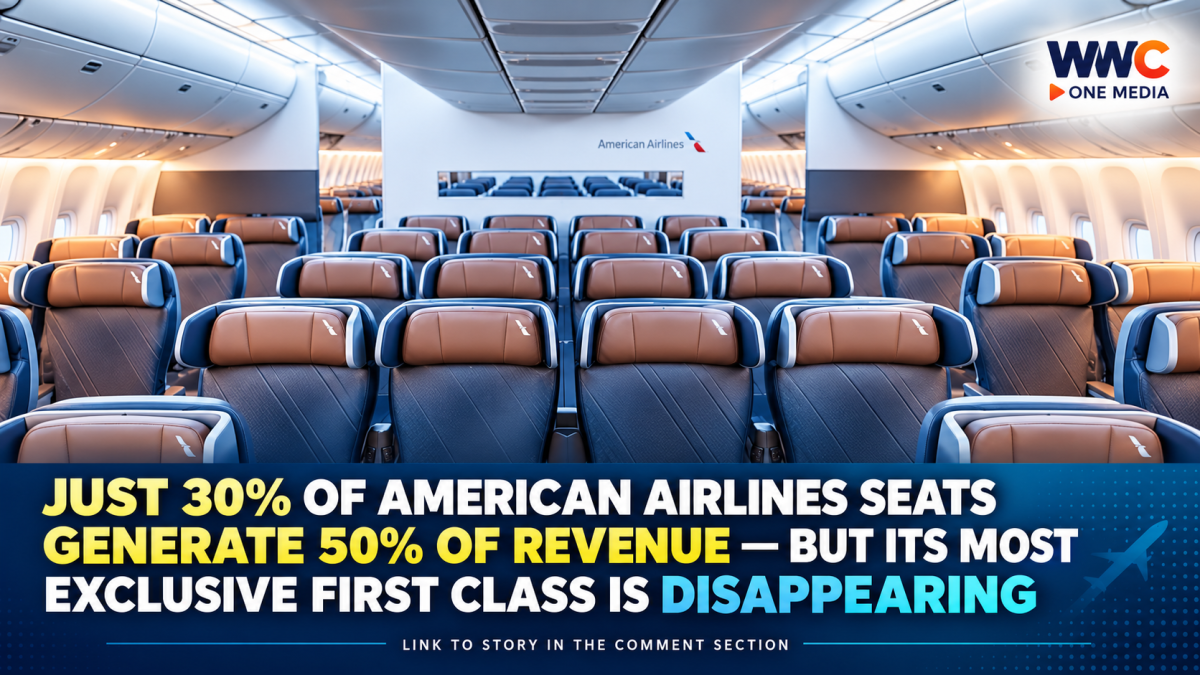
FORT WORTH — American Airlines has found the seats it wants more of.
They are not necessarily the most numerous seats on the airplane.
They are the ones passengers pay much more to occupy.
CEO Robert Isom says roughly 30% of American Airlines’ seats now generate 50% of the carrier’s revenue, an imbalance so lucrative that the company is redesigning aircraft, adding more premium seating and using incoming jets to increase the amount of space devoted to higher-paying passengers.
Speaking at Morgan Stanley’s aviation conference on September 16, Isom said that 30% share will grow as aircraft reconfigurations and new deliveries arrive.
And American is not thinking small.
By the end of the decade, Isom said, the carrier expects its premium seating to have expanded by roughly 50% from current levels.
But there is an apparent contradiction.
At the same time American is chasing premium travelers harder than ever, it is eliminating the separate international first-class cabin that once sat at the very top of its product hierarchy.
That is not evidence that luxury flying is weakening.
It may be evidence of exactly the opposite.
Airlines have learned that the most profitable premium product may no longer be traditional first class at all.
Thirty percent of the seats, half the revenue
Isom’s figure explains much of what is happening inside American’s aircraft.
Premium customers occupy only around three out of every 10 seats, but according to the CEO they are producing approximately half of revenue.
That means, very roughly, each premium seat is producing substantially more revenue than the average economy seat.
It does not mean every first-class ticket costs the same multiple of every economy fare, nor does it mean half of American’s total corporate revenue comes from one cabin.
The figure groups American’s premium seating and premium-revenue strategy more broadly.
But commercially, the signal is unmistakable.
The front and upgraded sections of the airplane are punching far above their physical size.
That is why American wants more of them.
The new 777 shows exactly what American is doing
Earlier this month, American put its first extensively retrofitted Boeing 777-300ER into commercial service.
The new configuration dramatically expands the aircraft’s premium footprint.
American says the remodeled jet contains:
70 Flagship Suite business-class seats,
44 Premium Economy seats, and
30 Main Cabin Extra extra-legroom seats.
American groups those together as 144 premium seats, up from 116 in the previous configuration.
Premium seating therefore rises to roughly 44% of the aircraft from about 38% previously.
The 70-seat Flagship Suite cabin is especially significant.
Every suite offers direct aisle access and a privacy door, with a lie-flat seat and additional personal storage.
American says the reconfigured 777 offers more premium seating than any aircraft operated by a U.S. airline.
But American is removing international first class
Here is the paradox.
The old 777-300ER contained:
eight Flagship First seats and
52 business-class seats.
Those eight first-class seats are disappearing.
American will stop selling Flagship First on its 777-300ERs for travel beginning November 19, as the carrier converts the fleet toward its new Flagship Suite business-class product.
So American is becoming more premium while offering less traditional first class.
That sounds contradictory only if “premium” and “first class” are treated as the same thing.
They are not.
Business class has swallowed much of what first class used to offer
Modern international business class has changed dramatically.
Lie-flat beds have become standard among leading carriers on long-haul routes.
Privacy doors are increasingly common.
Premium lounges, elaborate meals, bedding, amenity kits and priority airport services now accompany top-tier business products.
American’s Flagship Suite follows that trend.
Passengers receive lie-flat seating with privacy doors, multicourse meals, upgraded bedding and lounge access on qualifying itineraries.
The gap between business class and traditional international first class has therefore narrowed.
For airlines, that creates a mathematical question.
Is it better to dedicate a large amount of cabin floor space to a tiny number of first-class passengers?
Or fit more high-priced business-class suites into that space?
American has chosen the second option.
American made that decision years ago
The elimination of international first class is not a sudden response to this month’s numbers.
American announced back in 2022 that it intended to phase out Flagship First as it introduced its new suites.
The reason was unusually straightforward.
Reuters reported that American said customers were not buying the separate first-class product in sufficient numbers, while demand for business class made adding more business seats more attractive.
Delta had already combined international first and business class decades earlier.
United stopped selling a separate international first class in 2018 while moving its long-haul fleet toward Polaris business class.
That leaves the U.S. airline industry increasingly centered on premium business class rather than the old three-tier international model of economy, business and first.
Domestic first class is not disappearing
This distinction is important.
American is not eliminating first class everywhere.
On domestic narrowbody aircraft, the airline is doing almost the opposite.
American announced in August that it plans to increase the proportion of premium seating on narrowbody departures from roughly 25% today to about 40% in coming years.
That expansion includes additional domestic first-class seats and more Main Cabin seats offering extra legroom.
So two things are happening simultaneously:
American is adding first class on many domestic aircraft while eliminating the separate Flagship First product on international long-haul aircraft.
The common strategy is not about preserving a particular cabin name.
It is about maximizing the number of seats customers will pay significantly more to occupy.
More than 800 smaller aircraft are being changed too
The premium push extends deep into American’s narrowbody fleet.
More than 800 aircraft are eventually expected to receive updated interiors.
American also plans to bring back seatback entertainment screens, reversing a strategy adopted nearly a decade ago when the airline believed passengers would increasingly watch entertainment on their own phones, tablets and laptops.
Those retrofits are scheduled to begin in 2028, with completion stretching into the early 2030s.
New Airbus and Boeing aircraft featuring seatback displays are also expected to begin arriving from 2028.
The reversal is revealing.
Premiumization is no longer simply about making the first two rows nicer.
American is trying to reshape the overall perception of its product.
The airline is also adding free high-speed connectivity
Isom highlighted high-speed Wi-Fi, Starlink, seatback entertainment and new lounges as parts of the same broader strategy.
American sees the aircraft seat, airport experience, loyalty programme and digital experience as connected pieces of one commercial product.
That matters because the battle for premium passengers often begins long before boarding.
Corporate travelers care about schedule and reliability.
Frequent flyers care about loyalty benefits.
Long-haul travelers may care about lounges, Wi-Fi, privacy and bedding.
And premium leisure passengers may be willing to spend considerably more for comfort on a once-a-year international trip.
American wants to capture all of them.
Why airlines suddenly love premium passengers
American is not acting alone.
The most powerful trend in major U.S. aviation over the past several years has been the resilience of higher-spending travelers.
Even when price-sensitive passengers become cautious, wealthier leisure travelers and corporate passengers have frequently continued purchasing premium products.
At Delta, premium-ticket revenue reached $6.92 billion in the second quarter of 2026, actually edging above the $6.85 billion generated by main-cabin tickets.
Delta’s premium revenue increased 17% year on year.
That is an extraordinary milestone.
For one of the world’s biggest airlines, premium ticket products generated slightly more revenue during the quarter than ordinary main-cabin tickets.
United is seeing the same thing
United Airlines reported 16% year-on-year premium revenue growth in the second quarter.
Its contracted corporate revenue jumped 27%, while basic-economy revenue also increased 11%.
That last number is important.
The industry is not simply abandoning economy passengers.
United is demonstrating that airlines can simultaneously sell:
basic economy to highly price-sensitive passengers,
standard economy,
extra-legroom products,
premium economy,
and lie-flat premium cabins.
The objective is segmentation.
Instead of giving everyone roughly the same seat and charging slightly different fares, airlines increasingly want a product at almost every willingness-to-pay level.
Even low-cost airlines are moving upmarket
The trend has become so powerful that it is spreading beyond traditional network carriers.
Allegiant, known for an ultra-low-cost leisure model, has announced Allegiant First, an eight-seat premium cabin scheduled to appear on select aircraft beginning in spring 2027.
JetBlue has long operated its Mint premium product.
Southwest has been moving toward assigned seating and more differentiated seat products.
The result is increasingly difficult to miss:
America’s airlines are competing upward.
At the Morgan Stanley conference, Isom explicitly welcomed what the analyst described as an industry “race to the top.”
Isom replied that a race to the top was preferable and said American was ready for the competition.
There is a reason American needs the strategy to work
For American, this is not merely about copying an industry trend.
It is also a turnaround strategy.
The airline has lagged Delta and United in profitability.
Reuters reported in August that American expected results around breakeven for 2026, while Delta and United were forecasting solid profits.
That performance gap has increased pressure on Isom and his management team.
American has been rebuilding corporate sales relationships, strengthening its Citi credit-card partnership, improving lounges and investing in premium aircraft interiors.
The bet is that higher revenue per passenger can close part of the earnings gap.
Corporate travelers are especially valuable
Isom offered another revealing figure at the Morgan Stanley conference.
He said corporate yields are almost twice those produced through some other sales channels.
American’s managed corporate business has also been recovering after earlier distribution changes damaged relationships with travel agencies and corporate customers.
This makes premium seating and corporate sales mutually reinforcing.
A company might be willing to send an employee on American because of its network.
But if another airline offers a substantially better business-class seat, lounge and onboard experience, that passenger—and eventually the corporate contract—can move.
Premium cabins are therefore not simply expensive seats.
They can help defend an airline’s broader corporate business.
The new A321XLR is part of that plan
American is also receiving Airbus A321XLRs, long-range single-aisle aircraft equipped with its Flagship Suite product.
Isom said those aircraft will increasingly become the backbone of American’s premium transcontinental flying and will also enable service to secondary European cities.
American’s new premium-configured Boeing 787-9s also feature Flagship Suites.
The 787-9 layout includes 51 suites and 32 Premium Economy seats, while the A321XLR features 20 Flagship Suites and 12 Premium Economy seats.
That means the strategy is not limited to remodeling old aircraft.
It is being designed directly into incoming ones.
Even the old 777-200 and 787-8 fleets are next
Isom has said American is planning additional interior work on its older Boeing 787-8s and 777-200s.
At the Morgan Stanley conference he said 777-200 changes would be moving forward before long, while the broader premium expansion continues through the end of the decade.
The message is increasingly consistent across the fleet.
More privacy.
More premium seating.
More extra-legroom choices.
Better connectivity.
And fewer rows devoted exclusively to the cheapest possible seat.
But premium seats take up more space
There is a physical limit to the strategy.
A lie-flat suite can occupy the floor area of several economy seats.
Premium economy requires more pitch.
Domestic first class means wider seats and fewer passengers per row.
So airlines cannot simply keep adding premium seats without giving something up.
The economics work only if the extra fare paid by premium passengers more than compensates for the reduced seat density.
American’s 30%-of-seats, 50%-of-revenue figure suggests that—at least today—the calculation is working.
That does not mean there is unlimited demand.
The risk is that every airline is chasing the same passenger
American.
Delta.
United.
JetBlue.
Allegiant.
And other carriers are all adding or upgrading premium products.
That raises a basic economic question:
How many premium passengers are there?
If every airline increases premium capacity faster than the number of travelers willing to pay for it, pricing could eventually weaken.
Isom dismissed that concern at the Morgan Stanley conference, pointing to American’s hub network, loyalty programme, partnerships and international presence as competitive advantages.
For now, industry data support his optimism.
Premium demand remains strong.
But airlines are building aircraft configurations that will remain in fleets for years.
Today’s successful cabin mix therefore has to survive future economic cycles too.
Fuel has made high-paying passengers even more valuable
There is another reason American wants more revenue from each available seat.
Fuel.
American told investors this week that fuel prices had risen sharply over the previous month, forcing the carrier to consider further capacity adjustments late in the fourth quarter.
Chief Financial Officer Devon May said the move in fuel amounted to roughly $1 per gallon compared with earlier expectations for the fourth quarter, while Reuters estimated the change could add around $1 billion to American’s costs.
Fuel is generally the airline industry’s second-biggest expense after labor.
An airline cannot control the global oil market.
It can try to charge more for the seats it sells.
That makes premium revenue an increasingly important shock absorber.
American says demand is still strong
Despite fuel pressure, Isom told investors that demand remained strong across international and domestic markets, both in the front cabin and coach.
He also said American remained comfortable with its revenue outlook and described current year-on-year revenue improvement as unusually strong by the standards of his career.
That does not mean every passenger is trading up.
Basic economy remains important.
Standard economy remains the largest physical section on most aircraft.
But the airline increasingly wants to persuade customers to buy something above the cheapest fare:
a better seat,
more legroom,
premium economy,
domestic first class,
or a Flagship Suite.
Each step upward can increase revenue without adding another flight.
That matters when adding flights becomes expensive
The airline industry traditionally grew revenue partly by adding aircraft and flights.
But aircraft shortages, delivery delays, congested airports, expensive fuel and operational constraints make pure capacity growth more difficult.
Premiumization offers another strategy.
Instead of carrying dramatically more people, generate dramatically more revenue from the same aircraft.
American’s 777 transformation is almost a physical representation of that strategy.
The plane is still a Boeing 777.
It still flies one trip at a time.
But more of its floor space is being devoted to products that can command higher fares.
American is not betting only on rich travelers
It is tempting to frame the strategy solely as airlines abandoning ordinary passengers for wealthy customers.
The reality is more complicated.
American continues selling huge numbers of Main Cabin and Basic Economy tickets.
Isom said both front-cabin and coach demand remain strong.
United’s results similarly show basic economy growing alongside premium travel.
What is changing is the internal economics of the airplane.
An airline can carry hundreds of economy passengers and still find that a much smaller group at the front produces a disproportionate share of revenue.
That smaller group therefore has outsized influence on how the next generation of cabins is designed.
And the numbers explain why
American’s strategy can be reduced to one statistic:
30% of seats.
50% of revenue.
Once that relationship exists, the incentive becomes obvious.
American wants that 30% to become larger.
Isom says it will.
But the airline’s most interesting move is what it is not doing.
It is not rebuilding an enormous traditional international first-class cabin.
It is eliminating it.
Because the airline’s future version of luxury is increasingly a larger number of private business-class suites, premium-economy seats and extra-legroom products rather than a tiny cabin designed for a handful of passengers.
American Airlines is not simply putting more first-class seats on planes.
It is redesigning the aircraft around a different lesson:
the most valuable passenger may be the one willing to pay more—but not necessarily the one buying traditional first class.




Leave a Reply