
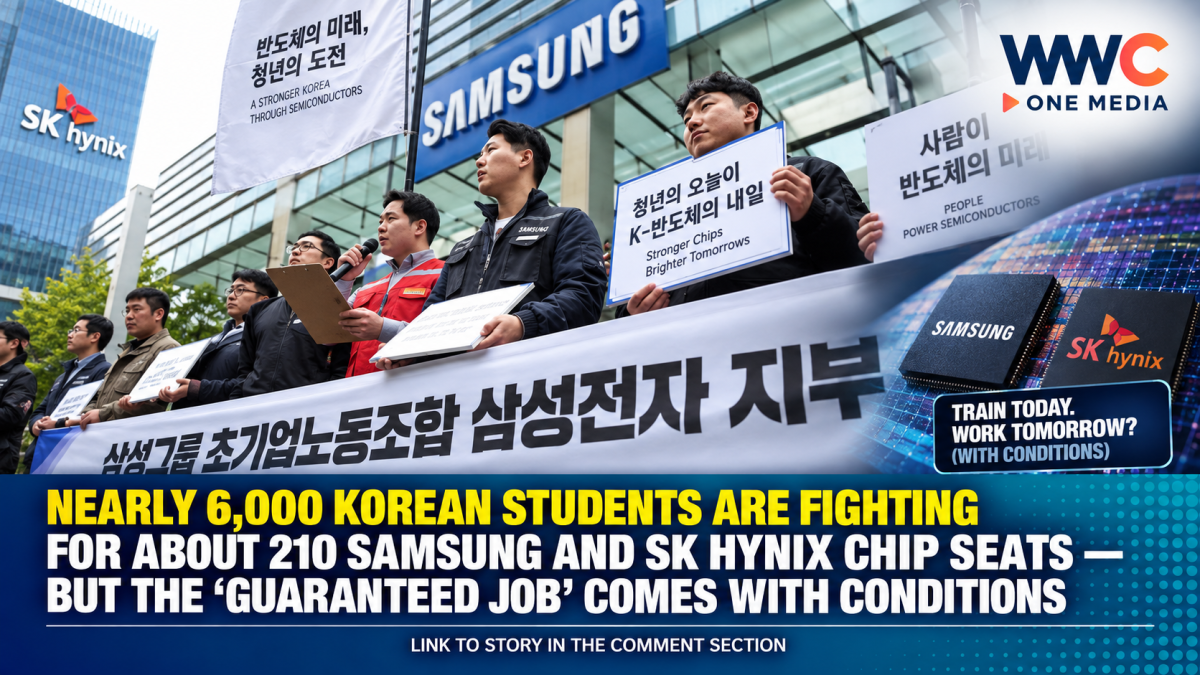
SEOUL — For a growing number of South Korean teenagers, getting into university is no longer only about choosing the right school. It can also mean choosing an employer years before graduation.
Samsung Electronics and SK hynix are embedding themselves directly inside some of South Korea’s most competitive university programmes, helping shape curricula, paying tuition and creating hiring pipelines into the semiconductor and artificial-intelligence industries.
And students are lining up.
CNBC reported that applications to Samsung-linked university contract departments rose 6.5% for the 2026 academic year, while applications to SK hynix-linked courses increased 12.7%.
Samsung programmes averaged 13.44 applicants for every available place.
SK hynix programmes averaged 9.14 applicants per place.
But those figures are already being overtaken.
Fresh data from South Korea’s 2027 early-admissions cycle show 5,992 applicants chasing semiconductor contract-department seats at Yonsei, Korea, Sogang, Sungkyunkwan and Hanyang universities.
Applications rose 19.4% in a single year, pushing average competition to a record 28.53 applicants per seat.
For some admissions tracks, the competition is even more extreme.
An essay-based admissions route for Sogang University’s SK hynix-linked System Semiconductor Engineering department attracted almost 298 applicants for each available place, while a comparable Hanyang University route exceeded 200-to-one.
Why?
Because admission can come with something unusually valuable in an uncertain economy:
a pathway into Samsung or SK hynix before the student has even finished university.
This is not a normal university major
South Korea calls these programmes contract departments.
A company and university cooperate to train students for a specific area of industry.
The company can:
help develop the curriculum,
provide scholarships,
bring executives and engineers into seminars,
give students access to corporate facilities,
and create a preferred—or sometimes conditional guaranteed—route into employment.
For semiconductor companies, the logic is straightforward.
Instead of waiting four years for engineering graduates to enter the labour market and then competing to recruit them, the company begins building its talent pipeline while those workers are still university students.
CNBC described it as recruitment effectively starting inside the classroom rather than after graduation.
At Sogang, SK hynix can effectively recruit freshmen
One of the clearest examples is Sogang University’s Department of System Semiconductor Engineering, created through a strategic partnership with SK hynix.
The four-year department welcomed its first undergraduate cohort in 2023.
Sogang says the curriculum integrates semiconductor:
process technology,
devices,
circuit design,
systems,
and software.
The university describes the programme as explicitly designed to cultivate engineers for advanced semiconductor work in collaboration with SK hynix.
CNBC profiled second-year student Jung Chae-rin, who said her tuition is covered through an SK hynix scholarship and that she receives an additional monthly study allowance of about ₩300,000.
For a university student, that sounds close to an ideal bargain.
Free tuition.
Financial support.
A specialised engineering degree.
And potentially a major-company job at the end.
But there are conditions.
The “guaranteed job” is conditional
At Sogang, students still have to maintain their academic performance.
Jung told CNBC that students need approximately a 2.3 GPA to retain the scholarship and 2.7 to remain eligible for SK hynix employment.
Students who withdraw can be required to repay financial support.
SK hynix also told CNBC that graduates receiving company funding must work for SK hynix for a period equivalent to the duration of their support.
So the arrangement is not simply:
Get accepted and receive a no-strings-attached job.
It is closer to an early career contract.
The company invests in the student.
The student completes the required academic work.
And qualifying graduates commit part of their early careers back to the company that funded them.
That structure makes sense for SK hynix.
Training semiconductor engineers is expensive.
Losing them immediately to a rival would undermine much of the reason for financing their education in the first place.
Samsung’s route works differently
Samsung Electronics’ partnership with Sungkyunkwan University, or SKKU, illustrates why headlines should not describe every contract department as offering exactly the same guarantee.
Its Department of Intelligent Software is a five-year integrated bachelor’s-and-master’s programme focused on artificial-intelligence software, developed with Samsung Electronics’ Device eXperience division.
Students spend roughly 3½ years on undergraduate study and another 1½ years on the master’s component.
Samsung supports the programme financially and offers students access to company-related experiences.
But employment is not automatic from the moment a student is admitted.
Students must later pass a separate Samsung hiring procedure.
Those who clear that process can continue receiving full tuition support and move toward employment with the company.
That distinction matters.
SK hynix-linked and Samsung-linked programmes can both dramatically improve the route into a major technology company, but the hiring conditions are not identical.
Students are increasingly choosing chips over prestige alone
The latest admissions data suggest those conditions are not discouraging applicants.
Quite the opposite.
For the 2027 early-admissions cycle, the five major semiconductor contract programmes received 5,992 applications, compared with 5,020 a year earlier.
The average competition ratio climbed from 23.90-to-one to 28.53-to-one.
Sogang saw applications climb 36.5%.
Hanyang rose 21.3%.
Korea University increased 21.1%.
Sungkyunkwan gained 18%.
Only Yonsei recorded a slight decline.
Broken down by corporate partner, the difference was even clearer.
SK hynix-linked departments attracted 3,152 applicants, up 27.3%.
Samsung-linked departments received 2,840, up 11.7%.
The popularity is now high enough that admissions analysts are comparing some semiconductor departments with elite medical-school pathways.
Some contract departments are beating Seoul National University science cutoffs
That comparison would have sounded unlikely only a few years ago.
In South Korea, medicine has historically represented one of the most sought-after educational routes because of its prestige, job security and earning potential.
But semiconductor majors tied directly to major corporations have become increasingly competitive.
An analysis of 2026 admissions results found that the five major Samsung- and SK hynix-linked semiconductor programmes averaged an admission cutoff score of 96.2, putting some of them above ordinary natural-science departments at Seoul National University.
Hanyang University’s semiconductor engineering programme was reported at a level approaching some Seoul-area medical programmes.
That does not mean semiconductor engineering has replaced medicine as South Korea’s dominant elite career choice.
But it shows how dramatically perceptions have shifted.
A decade ago, a teenager might have viewed semiconductor engineering simply as another difficult engineering major.
Today, it can look like an admission ticket into one of the world’s most important industries.
And AI changed the economics
The surge would probably not be happening at this scale without artificial intelligence.
Generative AI requires enormous amounts of computing infrastructure.
Those servers need processors.
They need advanced memory.
And increasingly, they need high-bandwidth memory, or HBM, capable of moving extraordinary quantities of data quickly enough to keep AI accelerators operating efficiently.
That has placed South Korean memory manufacturers at the centre of the AI investment boom.
SK hynix became an early leader in HBM supply.
Samsung has been investing aggressively to strengthen its position.
Across the industry, demand for advanced chips has transformed semiconductor engineers from a specialist labour category into a strategic resource.
The companies are therefore competing not only for customers.
They are competing for the people who can design and manufacture the next generation of chips.
Korea is planning chip factories on an enormous scale
The demand for workers becomes clearer when Korea’s physical investment plans are considered.
The government announced in June that Samsung and SK Group intend to pursue enormous long-term domestic semiconductor and AI investments as part of three national “mega projects.”
Reuters reported that Samsung plans trillions of won in long-term domestic investment across semiconductor clusters including Pyeongtaek and Yongin, while SK Group intends to invest more than ₩100 trillion annually over the coming decade in semiconductors and AI infrastructure.
SK hynix is also accelerating construction of additional fabrication capacity.
The government is simultaneously expanding semiconductor development beyond the existing Seoul metropolitan-area clusters, including major investment plans for southwestern Korea.
Factories can be built with concrete, steel and multibillion-dollar lithography machines.
They still need people.
Korea could be short 54,000 chip workers
That may be the most important number behind the entire university race.
The Korea Semiconductor Industry Association has projected that the country’s semiconductor workforce could need to grow from roughly 180,000 in 2021 to about 304,000 by 2031.
On current trajectories, the industry could face a shortage of around 54,000 workers.
That is why corporate-linked degrees are more than recruitment marketing.
They are one response to a national industrial bottleneck.
South Korea can subsidise fabs.
Provide electricity.
Build industrial parks.
Offer tax incentives.
But if companies cannot find enough engineers and technicians, physical capacity alone does not guarantee technological leadership.
The government wants 150,000 semiconductor specialists by 2031
South Korea recognised the problem years ago.
The Education Ministry launched a plan to cultivate at least 150,000 semiconductor specialists by 2031, ranging from master’s and doctoral researchers to bachelor’s graduates, technicians and vocational workers.
The target included roughly:
30,000 master’s- and doctorate-level specialists,
61,000 bachelor’s-level workers,
and 59,000 people at associate-degree level or below.
The government loosened rules governing university enrolment in advanced-technology fields and expanded support for semiconductor graduate schools, specialised universities, boot camps and contract departments.
Companies such as Samsung and SK hynix are essentially adding a private-sector layer to that strategy.
Why companies want influence over the curriculum
A shortage of engineering graduates is one problem.
A shortage of graduates with exactly the right skills is another.
Semiconductor manufacturing is highly specialised.
A student may understand electrical engineering without knowing the specific process-control, device physics, circuit-design or software tools needed in a modern fab.
Contract departments allow the employer to reduce that gap.
CNBC reported that Samsung provides universities with input on course content and curricula.
SK hynix said it participates partly in curriculum design and review.
At Sogang, Jung described a first-year course in which SK hynix executives, employees and instructors from the company’s internal university regularly discussed technology and real industry problems with students.
She said students could propose solutions directly and receive immediate feedback from company specialists.
For an employer, that could reduce the amount of retraining required after recruitment.
For the student, it narrows the distance between classroom theory and the job they expect to perform.
But companies are not literally running the universities
There is another useful distinction.
Samsung and SK hynix influence these programmes.
They do not completely replace the universities.
CNBC reported that SK hynix staff provide seminars and special lectures but do not formally teach the regular courses.
Academic programmes remain within university structures, even when the employer helps shape what is taught.
That separation matters because corporate relevance and university independence can pull in different directions.
Companies naturally want graduates trained for technologies they need today.
Universities also need to teach fundamental knowledge that remains useful even after today’s particular chip architecture becomes obsolete.
The best contract programme therefore has to accomplish both.
Students are trading some flexibility for certainty
The economic bargain has another side.
A teenager entering a normal engineering degree can wait several years before choosing an employer.
A contract-department student may be making that choice much earlier.
The advantages are obvious:
financial support,
less tuition debt,
industry access,
higher employment certainty,
and a direct route into an elite Korean company.
But an employment-linked scholarship can reduce flexibility.
A student who discovers halfway through university that they prefer another industry may have repayment obligations.
A graduate may be required to stay with the sponsoring company for an agreed period.
And the semiconductor cycle can look very different four or five years after admission.
Today’s AI boom does not guarantee that chip-industry conditions will remain exactly as strong when the class of 2031 enters full-time employment.
Chip cycles still exist
That is especially important in semiconductors.
The industry has always been cyclical.
Periods of shortage and exceptional profits encourage companies to increase production.
Eventually, capacity can catch up with demand.
Prices fall.
Hiring slows.
Then the cycle begins again.
AI may have changed the scale of demand, particularly for HBM and advanced memory.
It has not repealed basic semiconductor economics.
Even in 2026, Samsung and SK hynix rejected a proposal from Korea Electric Power Corp. asking them to prepay about ₩25 trillion for electricity infrastructure serving future semiconductor clusters. Reuters reported that the companies questioned elements of the long-term arrangement amid uncertainty surrounding future industry conditions.
That is a useful reminder.
The companies themselves are planning for enormous growth.
They are still aware that forecasts can change.
The students know exactly why the programmes are attractive
For many applicants, however, the calculation is simpler.
South Korea’s broader youth employment market is difficult.
A degree no longer guarantees an easy transition into a good corporate job.
Contract departments reduce that uncertainty.
Admissions analyst Lim Sung-ho of Jongro Academy said the rising popularity appears to reflect a combination of:
a tough job market,
optimism about the semiconductor cycle,
and the attraction of employment at major corporations.
That makes these degrees something unusual.
They sell education and employment certainty at the same time.
The AI boom is even reshaping competition with medical school
Another indicator comes from where applicants are applying simultaneously.
A July analysis found that among students seeking admission to five major semiconductor contract departments, the proportion also applying to medical or pharmaceutical schools had fallen from 45.5% to 39.3%.
At the same time, more students were applying across multiple semiconductor contract programmes.
That suggests some top science students are no longer treating semiconductor departments merely as backups for medicine.
For at least part of the applicant pool, chips are becoming the primary objective.
And SK hynix currently has another recruitment advantage: momentum
Among the current contract programmes, SK hynix-linked departments are seeing the faster application growth.
For 2027 admissions, SK hynix programmes recorded a 27.3% increase in applications, compared with 11.7% for Samsung-linked semiconductor departments.
That coincides with SK hynix’s unusually strong position in the current AI-memory cycle and expectations around employee compensation.
Students deciding where they want to work years from now are inevitably influenced by what companies look attractive today.
That creates an unusual feedback loop.
AI demand lifts the chipmaker.
The chipmaker’s compensation and reputation improve.
More elite students want its sponsored university programme.
The company gains access to a stronger future recruitment pool.
Yet 6,000 applicants do not solve a 54,000-worker shortage
This is where the headline numbers need perspective.
Nearly 6,000 applicants sound enormous.
The programmes themselves contain only a few hundred places.
That selectivity is beneficial for Samsung and SK hynix because they can choose from elite candidates.
It does not by itself create enough engineers for the wider Korean semiconductor ecosystem.
A modern chip industry also needs:
equipment engineers,
materials experts,
software developers,
fab technicians,
chemists,
construction specialists,
power engineers,
packaging specialists,
and thousands of workers across small and midsized suppliers.
The contract departments are therefore the visible top of a much larger talent problem.
Smaller chip companies face the harder recruitment battle
Samsung and SK hynix have obvious advantages when competing for talent.
Their brands are famous.
Their salaries are attractive.
Their career paths are established.
And now they can reach students before those students graduate.
Smaller semiconductor suppliers cannot necessarily offer the same combination of prestige, scholarships and long-term financial support.
That creates a potential unintended consequence.
Contract departments may help solve the talent problem for Korea’s largest corporations while making competition for engineers even more difficult elsewhere in the supply chain.
Yet Korea’s semiconductor strength depends on that wider ecosystem too.
A giant memory-chip company cannot manufacture advanced products without hundreds of suppliers providing materials, components, equipment and specialised engineering services.
Korea is now trying to widen the pipeline beyond Seoul
That is partly why government policy is expanding semiconductor workforce programmes regionally.
In July, the Employment Ministry announced additional training cooperation involving companies, universities and local authorities in southwestern Korea, where new semiconductor fab investments are planned.
The measures include expanding joint training centres, K-Digital Training and practical programmes aimed at technicians needed on manufacturing floors.
That approach acknowledges that four-year elite engineering degrees are not enough.
A semiconductor cluster needs every level of the workforce.
The university degree is not dying in Korea’s AI economy
There is also a broader irony behind CNBC’s story.
Around the world, AI executives and technology entrepreneurs increasingly debate whether traditional university education remains worth its cost.
Some argue rapidly changing AI tools make skills and demonstrated ability more important than degrees.
Samsung and SK hynix are effectively making the opposite bet.
They are not abandoning universities.
They are integrating themselves more deeply into them.
Instead of waiting for higher education to produce the workers they need, the companies are helping shape higher education itself.
That may be the most significant lesson from Korea’s contract departments.
The AI boom is not eliminating the university route.
At least in semiconductors, it is making certain university seats more valuable than ever.
The competition has already doubled in six years
The trend is remarkably clear.
Applications to the five major Samsung- and SK hynix-linked semiconductor programmes totaled:
2,234 for 2021.
2,971 for 2022.
3,663 for 2023.
4,121 for 2024.
4,829 for 2025.
5,020 for 2026.
And now:
5,992 for 2027.
In six admissions cycles, applicant volume has risen by roughly 168%.
That is not simply interest in engineering.
It is a vote by thousands of Korean students on where they believe economic opportunity is moving.
The real AI talent war begins before graduation
Samsung and SK hynix are spending extraordinary sums to build the factories needed for the AI era.
But a chip fab worth tens of billions of dollars is useless without engineers who know how to operate, improve and reinvent what happens inside it.
That changes the meaning of recruitment.
The old model was:
graduate from university,
send applications,
interview,
then join the company.
The new Korean model can begin four or five years earlier:
get into the right department, receive company-funded training and start building a relationship with the employer before graduation.
For students, that can mean financial security and an unusually clear career path.
For Samsung and SK hynix, it means competing for human talent before competitors ever see the résumé.
And for South Korea, it reveals just how serious the semiconductor labour challenge has become.
Almost 6,000 applicants are now fighting for a few hundred of the most coveted chip-industry university seats.
Yet by 2031, Korea could still be short tens of thousands of semiconductor workers.
The AI boom has made the courses more popular.
It has also made the talent shortage much more expensive to ignore.




Leave a Reply