
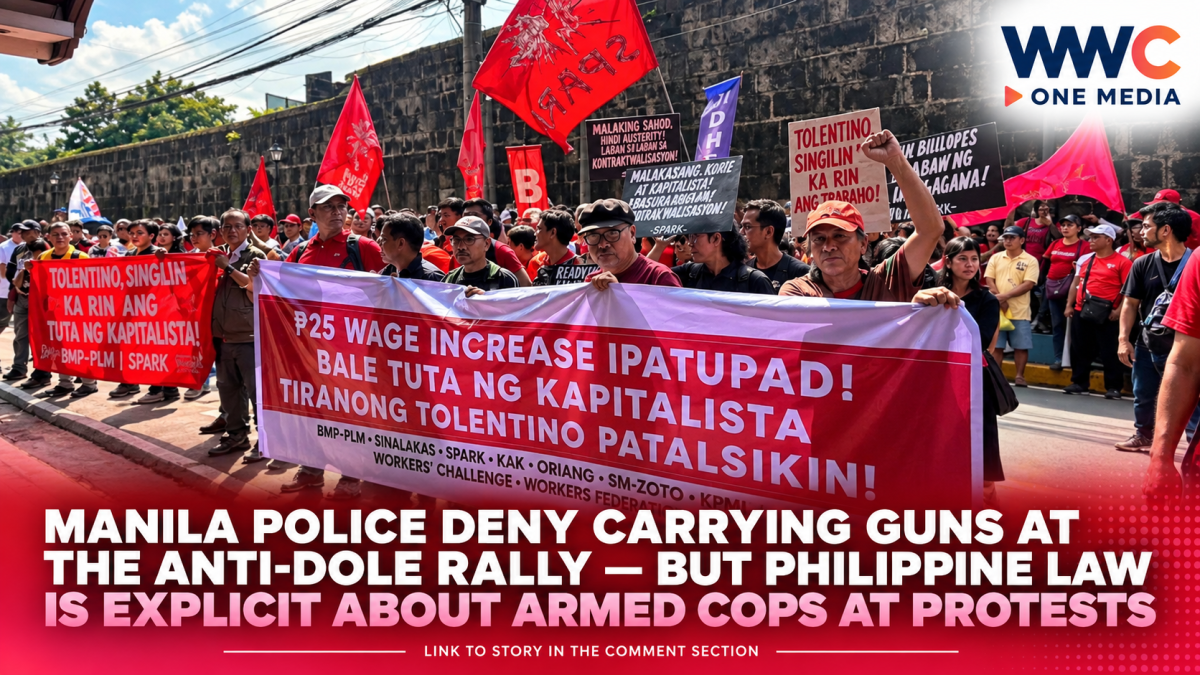
MANILA — The Manila Police District has denied allegations that police officers carried firearms while securing a tense labor protest outside the Department of Labor and Employment, turning what began as another demonstration over Metro Manila wages into a fresh dispute over how police should operate around public assemblies.
The MPD, through its Ermita Police Station, rejected claims that officers deployed during the anti-DOLE demonstration were carrying guns, according to the Manila Standard. The allegation and the police denial come under particular scrutiny because Philippine law expressly restricts firearms among officers assigned to deal directly with demonstrators.
What has not been independently established in the available reporting is that MPD personnel assigned to the rally were in fact armed. For that reason, any publication should describe the firearms issue as a disputed allegation, not as a confirmed violation by police.
But the law itself leaves little ambiguity about what the standard is supposed to be.
Philippine law says police dealing with demonstrators should be unarmed
Under Batas Pambansa Blg. 880, or the Public Assembly Act of 1985, members of a law-enforcement contingent who deal with demonstrators must observe “maximum tolerance” and “shall not carry any kind of firearms.”
Police may instead be equipped with crowd-control equipment including batons, shields, helmets, gas masks and protective footwear.
The same law separately lists “the carrying of firearms by members of the law enforcement unit” within 100 metres of a public assembly or on the occasion of the assembly as a prohibited act.
It also prohibits the unnecessary firing of firearms to disperse a public gathering.
That makes the distinction crucial.
The issue is not whether Philippine police officers normally possess service weapons. They do.
The question is whether members of the law-enforcement contingent assigned to deal with demonstrators were carrying those weapons in circumstances covered by the Public Assembly Act.
MPD says they were not.
The rally was really about an ₱85 wage increase caught in court
The firearms controversy emerged from a much larger dispute over how much Metro Manila’s lowest-paid private-sector workers should earn.
Labor groups staged a protest outside DOLE’s headquarters in Intramuros on September 14, demanding implementation of an earlier ₱85 daily minimum-wage increase and criticising Labor Secretary Francis Tolentino.
DZRH and RMN reported that tension developed when protesters placed material over DOLE signage and attempted to display their own banner, prompting security personnel and police to intervene. The situation was eventually brought under control.
The protesters’ main complaint traces back to Wage Order No. NCR-27, which was designed to increase Metro Manila’s minimum wage by ₱85 in two stages.
The first ₱60 was supposed to raise the daily minimum for non-agricultural workers from ₱695 to ₱755, followed by another ₱25 increase in January 2027 that would take the rate to ₱780.
But the order became tied up in litigation after court challenges by employers.
The National Wages and Productivity Commission currently states that implementation of Wage Order NCR-27 remains subject to continuing litigation before courts in Pasig and Navotas.
That legal fight is the reason workers were back outside DOLE.
A new wage order guarantees ₱60 — but the missing ₱25 remains contested
While Wage Order NCR-27 remains before the courts, the NCR wage board issued a second measure, Wage Order No. NCR-28.
That order grants a ₱60 daily increase effective September 26, 2026, bringing the minimum wage to ₱755 for non-agricultural workers and ₱718 for agricultural workers and other covered smaller establishments.
DOLE says approximately 1.1 million daily wage earners in Metro Manila are expected to benefit.
But that does not completely resolve the earlier controversy.
Wage Order NCR-27 provided another ₱25 increase in January 2027, while NCR-28 guarantees only the ₱60 adjustment for now.
That difference has drawn objections from labor organisations, which argue that the second wage order should not replace the full benefit previously approved under NCR-27.
DOLE, for its part, says it has continued pursuing legal remedies to defend the original ₱85 adjustment while the litigation remains unresolved. The department said the Office of the Solicitor General had filed motions seeking action in the court cases.
So the dispute is not simply “workers versus DOLE.”
The department itself publicly supports the earlier wage increase, while labor organisations have criticised the government’s handling of its implementation and the issuance of a replacement order while NCR-27 remains in court.
Why workers say ₱60 is not the same thing as ₱85
The original Wage Order NCR-27 was announced in June as the largest single daily minimum-wage adjustment approved for Metro Manila.
When fully implemented, it would have taken non-agricultural minimum pay from ₱695 to ₱780 a day.
Employers raised concerns even before the court fight.
The Employers Confederation of the Philippines said the ₱85 adjustment was too steep and warned of possible consequences for hiring, prices and smaller businesses, although employers said they would comply with a valid wage order.
Labor organisations argued in the opposite direction, saying even ₱85 remained insufficient to restore workers’ purchasing power and meet the cost of living.
Those competing economic arguments remain unresolved by the police controversy outside DOLE.
But the September 14 confrontation shows how a wage case that began in a tripartite wage board has spilled into the streets.
Why the firearms allegation is particularly sensitive in Manila
Police conduct at demonstrations has been under heightened attention after several recent confrontations.
During the May 1, 2026 Labor Day protest in Manila, seven police personnel were reported injured. NAPOLCOM said officers exercised maximum tolerance and condemned assaults against police, while labor representatives disputed aspects of the police account and accused officers of obstructing a peaceful march.
A separate protest in Taguig on September 10 over the U.S.-backed Pax Silica initiative also resulted in clashes. Police and protesters were injured, and several demonstrators or paralegals were arrested, according to GMA, Philstar and Bulatlat.
Those incidents do not prove anything about the September 14 DOLE rally.
But they help explain why images or accusations involving weapons at demonstrations receive immediate attention.
The law requires “maximum tolerance”
The Public Assembly Act defines maximum tolerance as the highest degree of restraint that military, police and other peacekeeping authorities must observe during a public assembly or its dispersal.
The Supreme Court reinforced that standard in its 2006 Bayan v. Ermita decision.
The Court held that maximum tolerance under BP 880 — rather than a more aggressive “calibrated preemptive response” policy — is the controlling legal standard for public assemblies.
The law also says law-enforcement agencies should generally not interfere with a lawful public assembly, although police may be stationed nearby to protect public safety and maintain order.
Those protections operate alongside responsibilities imposed on protest organisers and participants to keep assemblies peaceful.
In other words, the legal framework places duties on both sides: demonstrators must not commit violence or use prohibited weapons, while police must exercise restraint and comply with specific restrictions on crowd-control operations.
The firearms question should be investigated with evidence, not assumptions
For news organisations, the safest formulation is straightforward:
MPD has denied that its officers carried firearms during the anti-DOLE protest.
That is confirmed as the police position.
What the currently available reporting does not establish conclusively is whether any officer assigned to the rally possessed a firearm, whether any image circulating publicly depicts the September 14 event accurately, or whether an officer shown near protesters was part of the specific law-enforcement contingent covered by BP 880’s restrictions.
Those questions require authenticated photographs or video, deployment records, body-camera footage where available, or a formal investigation.
The distinction is particularly important because the statutory consequences are not trivial.
BP 880 expressly identifies carrying firearms by members of the law-enforcement unit in connection with a public assembly as a prohibited act and sets penalties upon conviction.
Another major protest is only days away
The controversy is unfolding as police prepare for much larger demonstrations scheduled for September 21, marking the anniversary of the declaration of martial law.
The National Capital Region Police Office has said more than 15,000 police personnel will be deployed around Metro Manila for the planned protests. Authorities have said they will respect peaceful expression while preparing for possible security threats.
Police preparations have been intensified partly because violence erupted during September 21 demonstrations in Manila last year.
That makes the handling of even a smaller labor rally consequential.
How officers are equipped, where they are positioned and how they interact with protesters will be under closer scrutiny as much larger crowds prepare to gather.
The bigger story is no longer just about whether one officer had a gun
The September 14 rally began with workers demanding money they believed should already have appeared in their paychecks.
The underlying numbers are straightforward.
The original wage order promised ₱85.
Court action stalled it.
A replacement order now guarantees ₱60 beginning September 26.
The remaining ₱25 from the earlier order is still bound up in the unresolved legal dispute.
Then the protest itself generated another dispute — whether the police securing it followed rules that explicitly say officers dealing with demonstrators should not carry firearms.
MPD says its officers did.
More precisely, it says they did not carry guns.
Until evidence establishes otherwise, that claim and the allegation against the police must remain clearly separated.
But one thing does not depend on either side’s version:
Philippine law already says what the standard is.
When police are dealing with demonstrators at a public assembly, their job is not only to keep order.
They are expected to do it under maximum tolerance — and without firearms.


Leave a Reply