
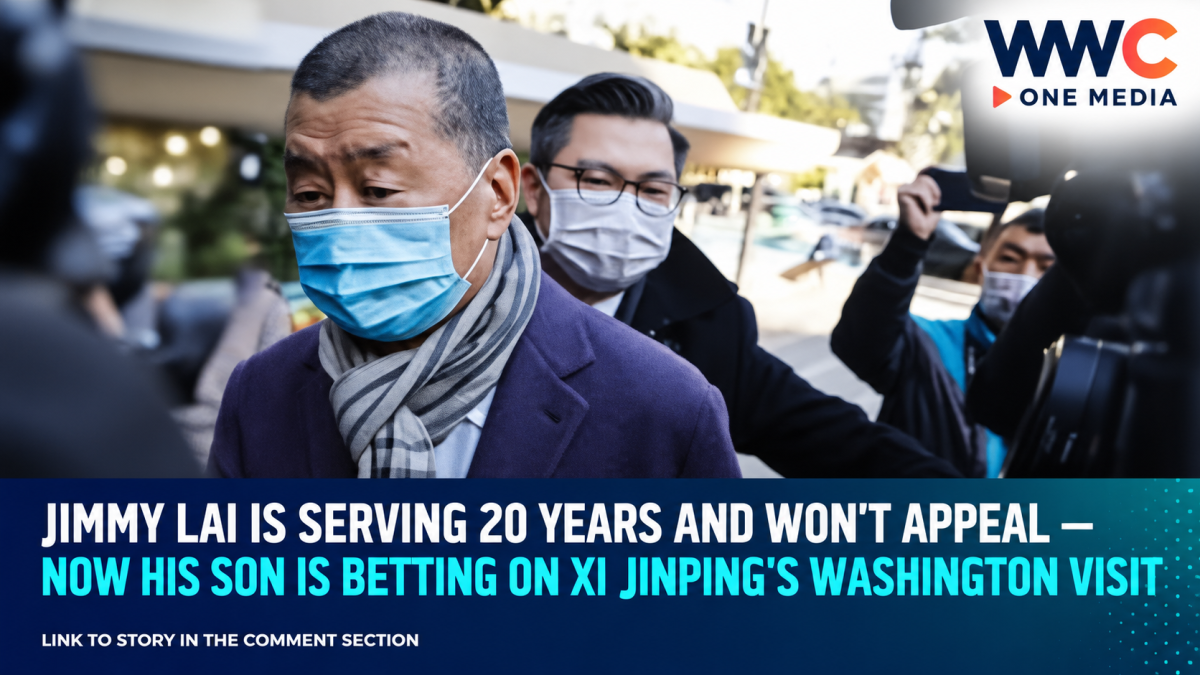
WASHINGTON — With Chinese President Xi Jinping expected in Washington next week, the family of imprisoned Hong Kong media founder Jimmy Lai is making a renewed push for his release — this time framing the case as an urgent humanitarian appeal at the highest level of U.S.-China diplomacy.
Sebastien Lai, Jimmy Lai’s son, appeared on Capitol Hill on Wednesday, September 16, urging Xi to allow his 78-year-old father to return to his family after years behind bars and a 20-year national security sentence.
Speaking before the U.S. Congressional-Executive Commission on China, Sebastien said his appeal was simple: his father should be allowed to go home. The family is particularly concerned about Lai’s age and health, while Sebastien also told lawmakers that his sister Claire recently began chemotherapy in London after being diagnosed with cancer.
The plea comes at a potentially important diplomatic moment.
President Donald Trump has said Xi will visit the United States on September 24, following Trump’s trip to Beijing in May. The coming talks are expected to range across trade, artificial intelligence, Taiwan and other points of tension between the world’s two largest economies.
But for the Lai family, the summit represents something more personal:
another chance to put Jimmy Lai directly in front of Xi and Trump.
Trump already raised Jimmy Lai with Xi — and the answer was not encouraging
This will not be the first time Trump has discussed Lai’s imprisonment with the Chinese leader.
Ahead of his May visit to Beijing, Trump said publicly that he planned to raise Lai’s case with Xi. After the talks, Trump confirmed that he had done so — but described it as a difficult issue. Reuters reported that Trump said Xi characterized Lai’s release as “a tough one,” and Trump later said Beijing’s response had not been positive.
That previous exchange is important because it tempers expectations surrounding the Washington meeting.
There is no public indication that Beijing or Hong Kong authorities have agreed to release Lai, and neither Trump nor Xi has announced any deal involving him.
Still, Lai’s family has some reason to believe high-level diplomacy can affect individual detention cases.
During the same May discussions, Trump also raised the case of Chinese pastor Ezra Jin Mingri. Beijing released Jin in July after more than eight months in detention, according to AP. That does not mean Lai’s circumstances will follow the same path; his conviction and sentence involve Hong Kong’s national security system and have attracted far greater political attention.
Jimmy Lai is no longer waiting for an appeal
One of the most significant developments since Lai was sentenced is that he has chosen not to challenge the outcome through an appeal.
Hong Kong’s High Court sentenced him in February to a total of 20 years in prison after his December 2025 conviction on two counts of conspiracy to collude with foreign forces and one count involving seditious publications.
Lai denied the charges throughout the trial.
But on March 6, a member of his Hong Kong legal team confirmed that Lai had given “clear and definitive instructions” not to appeal either his conviction or sentence. His lawyers did not publicly explain why.
That decision effectively shifted the centre of gravity in the campaign for his freedom.
Rather than waiting for a higher Hong Kong court to reverse the national security convictions, his family, foreign governments and supporters are increasingly asking for humanitarian or political intervention.
Why Lai received 20 years
Lai founded Apple Daily, once one of Hong Kong’s best-known newspapers and a vocal supporter of the city’s pro-democracy movement.
The paper shut down in 2021 after authorities froze assets and arrested senior executives under the national security crackdown that followed the huge 2019 anti-government protests.
In Lai’s case, Hong Kong judges found him to have been the driving force behind conspiracies aimed at obtaining foreign sanctions and other measures against China and Hong Kong.
When sentencing him, the judges said his conduct fell within the most serious category of national security offences and described him as the “mastermind” of the conspiracies.
Hong Kong Chief Executive John Lee strongly defended the sentence, arguing that Lai had endangered national security and that the punishment demonstrated that the city’s national security laws would be enforced.
The Hong Kong government maintains that Lai was prosecuted because of specific criminal conduct rather than because of his journalism or political beliefs. It says the proceedings were conducted according to law and that foreign criticism amounts to interference in Hong Kong’s judicial affairs.
The other side says the prosecution criminalised journalism and dissent
That interpretation is sharply disputed outside Hong Kong and mainland China.
The United States, Britain, the European Union and several other governments have criticised Lai’s prosecution and called for his release.
After the February sentence, U.S. Secretary of State Marco Rubio called for humanitarian parole, while the British government — Lai is a British citizen — said it would continue pressing his case.
Britain repeated that position as recently as September 16, one day before Xi’s expected Washington visit moved back into the spotlight.
In a statement to the UN Human Rights Council, the UK said Lai had been imprisoned for more than 2,000 days and again called for his release. Britain also cited a previous finding by the UN Working Group on Arbitrary Detention concerning his case.
Hong Kong and Beijing reject those criticisms, maintaining that national security cases are judicial matters and that no person is above the law.
His health has become a major part of the argument
Sebastien Lai’s latest appeal placed humanitarian concerns at the centre of the family’s case.
Family members and supporters say Lai’s health has deteriorated during years in custody. Reuters reported that he has diabetes and that his family has cited problems including high blood pressure and heart palpitations.
Sebastien warned lawmakers that, given his father’s age and the length of the sentence, the family fears he could spend the rest of his life in prison. AP reported that he described Lai as a 78-year-old who had already suffered enough and urged authorities to let him reunite with his daughter while she undergoes cancer treatment.
Hong Kong authorities strongly dispute claims that Lai has been mistreated or denied adequate medical care.
The government says the Correctional Services Department has provided appropriate medical treatment and humane conditions. It has also said Lai’s separation from other prisoners — frequently described by his family and supporters as solitary confinement — has been maintained at his own request after consideration by prison officials.
Those competing accounts should be presented separately: the family says prolonged isolation and imprisonment are damaging Lai’s health; Hong Kong authorities say he receives adequate treatment and dispute allegations of mistreatment.
Lai also won one legal victory this year — but it did not change the 20-year sentence
There has been one notable courtroom development in Lai’s favour.
In February, Hong Kong’s Court of Appeal overturned a separate fraud conviction against him and quashed a 69-month prison sentence in that case.
That ruling, however, did not overturn his national security convictions.
The 20-year sentence handed down on February 9 remains in force, and Lai subsequently chose not to appeal it.
That distinction matters because reports about the overturned fraud case can otherwise create the misleading impression that his main conviction was reversed.
It was not.
Apple Daily made Lai one of Hong Kong’s most prominent political figures
Lai’s case carries unusual international weight because he was not simply a newspaper proprietor.
A self-made businessman who became a vocal critic of China’s Communist Party leadership, he built Apple Daily into an influential mass-market publication known for tabloid-style reporting and strongly pro-democracy editorials.
His extensive foreign contacts later became central to prosecutors’ case.
At the height of Hong Kong’s 2019 protests, Lai met then-U.S. Vice President Mike Pence and Secretary of State Mike Pompeo in Washington. Prosecutors cited his contacts with U.S. politicians and international advocacy networks as part of their evidence concerning efforts to obtain foreign pressure and sanctions.
Lai and his defenders argued that such activities were political advocacy and protected expression.
The judges disagreed, finding that his conduct crossed into criminal conspiracies under Hong Kong’s national security legislation.
The case sits at the centre of a much bigger argument about Hong Kong
Beijing imposed Hong Kong’s National Security Law in June 2020, following months of sometimes violent protests and political unrest during 2019.
Chinese and Hong Kong authorities say the law was necessary to restore stability and protect the city from secession, subversion, terrorism and foreign interference.
Critics contend that the law has sharply narrowed political opposition, press freedom and civil society.
That dispute has only intensified as courts have sentenced prominent opposition figures and activists in major national security cases.
Just days before Sebastien Lai’s Washington appearance, Hong Kong courts handed prison sentences to former leaders of the group that once organised the city’s annual Tiananmen Square vigils. Hong Kong authorities said those defendants had engaged in conduct intended to subvert state power; critics and some foreign governments said peaceful political expression was being criminalised.
Lai’s case is therefore being watched far beyond his immediate family.
For Beijing and the Hong Kong government, it demonstrates that the national security system applies even to wealthy, internationally connected defendants.
For his supporters and foreign critics, it has become a test of how much space remains for dissent and independent media in Hong Kong.
Xi’s Washington trip will have a crowded agenda
Lai’s family is competing for attention with some of the most consequential issues in U.S.-China relations.
Trump has said Xi is due in Washington on September 24, following their meetings in Beijing earlier this year.
Artificial intelligence is expected to feature prominently, including U.S. restrictions on advanced semiconductors and concerns on both sides about technological competition.
Taiwan is another major issue. Reuters reported that U.S. allies are closely watching whether Washington changes its language or policy as Trump and Xi discuss arms sales and regional security.
Trade will also loom over the visit. China has recently stepped up purchases of U.S. soybeans, while officials from both governments have continued economic negotiations ahead of the summit.
Against that backdrop, the Lai family is trying to ensure an individual prisoner does not disappear beneath the larger strategic agenda.
Other detained families are making the same calculation
Sebastien Lai was not the only relative on Capitol Hill this week hoping Xi’s visit could create leverage.
Sylvia Zin, wife of U.S. academic Min Zin, separately asked Trump to seek her husband’s release.
Min Zin, a scholar of Myanmar politics affiliated with the University of California, Berkeley, has been detained in China since June on suspicion of endangering national security. The U.S. State Department considers him wrongfully detained, according to AP.
Another American, seismologist Youlin Chen, is also classified by Washington as wrongfully detained in China.
The cases highlight a recurring feature of major diplomatic summits: families often see leader-to-leader meetings as rare opportunities to elevate detention cases that may otherwise remain stalled for years.
But summit diplomacy does not guarantee an agreement.
Why September 24 could still matter
There is no public evidence that Xi plans to announce a change in Jimmy Lai’s status during his U.S. trip.
China has consistently resisted foreign pressure over the case, and Trump’s account of his May conversation with Xi suggested Beijing was reluctant to move.
Yet the situation has changed in one important respect since then.
Lai is now serving a 20-year term, has decided not to appeal, and his family is increasingly emphasizing his age, health and family circumstances rather than expecting another judicial proceeding to deliver his freedom.
That leaves diplomacy as one of the few visible avenues being publicly pursued.
For Sebastien Lai, the message in Washington was deliberately personal rather than geopolitical.
His father is 78.
His sentence could keep him imprisoned well into his 90s.
His daughter is undergoing cancer treatment.
And the Chinese leader who could potentially influence what happens next is expected to be sitting across from the U.S. president within days.
The question is no longer whether Jimmy Lai’s case will be mentioned at the highest levels — Trump has already raised it once.
The unanswered question is whether Xi’s Washington visit changes anything the second time around.

Leave a Reply