
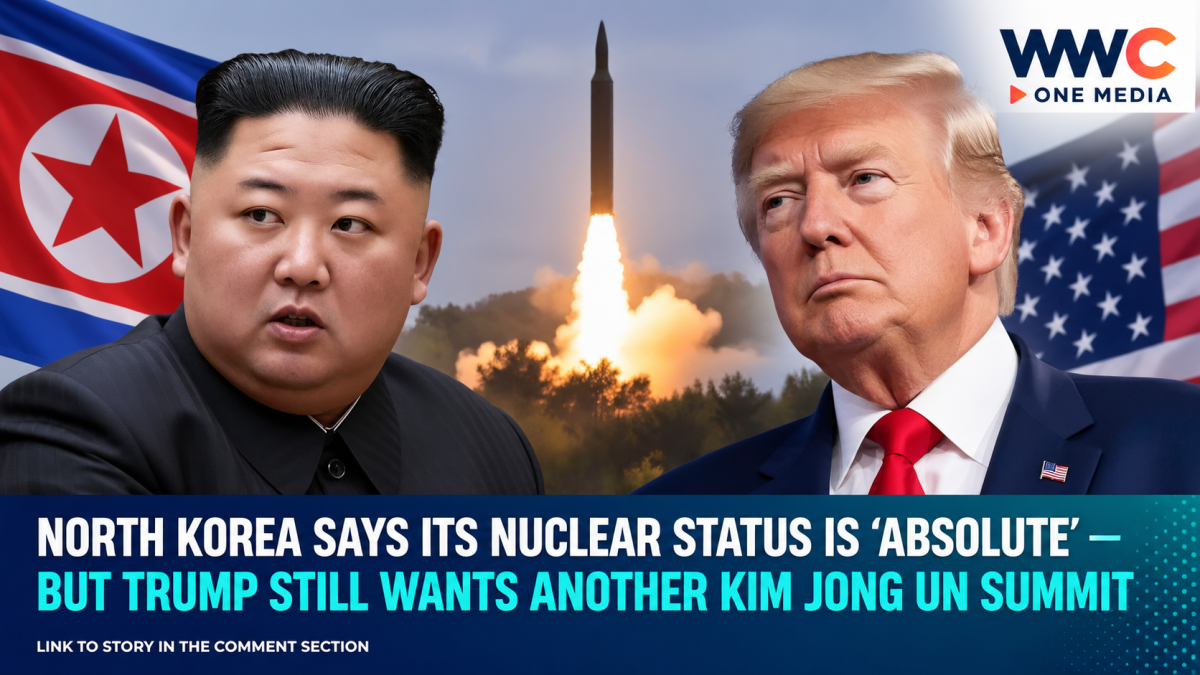
SEOUL — North Korea has delivered one of its clearest warnings yet to governments hoping to revive nuclear negotiations: Pyongyang does not consider its atomic arsenal a temporary bargaining chip.
Kim Yo Jong, the influential sister of North Korean leader Kim Jong Un, declared that North Korea’s position as a nuclear-armed state is “absolute” and said international efforts aimed at reversing it would not change Pyongyang’s policy. Her statement, carried by state news agency KCNA, came as the International Atomic Energy Agency’s General Conference met in Vienna and renewed concerns about North Korea’s expanding nuclear activities.
Her language was deliberately dismissive. Kim characterized international denuclearisation discussions as repetitive and futile and said those expecting North Korea to surrender its arsenal were ignoring what Pyongyang regards as a permanently changed security reality.
But the statement lands at an unusual diplomatic moment.
U.S. President Donald Trump says he wants to meet Kim Jong Un again before the end of 2026.
That leaves Washington and Pyongyang potentially interested in dialogue while fundamentally disagreeing over what any new talks would actually be about.
Kim Yo Jong was responding directly to the IAEA
The immediate trigger was the IAEA’s 70th General Conference in Vienna.
According to Yonhap, participants again expressed concern over North Korea’s expanding nuclear capabilities and called on Pyongyang to abandon its nuclear-weapons programme in a complete, verifiable and irreversible manner and comply with international obligations.
The IAEA’s latest reporting has also pointed to increased uranium-enrichment activity and expansion at key North Korean nuclear facilities. The agency has had no inspectors inside North Korea since 2009, meaning much of its monitoring now depends on satellite imagery and other remote information.
Kim’s answer was effectively that the premise of those demands is obsolete.
She said North Korea’s nuclear position had been established both physically and legally and could not be undone by repeated resolutions or international meetings.
That phrase matters because Pyongyang has spent several years building its nuclear programme into domestic law rather than treating it merely as a military project.
North Korea wrote nuclear weapons into its laws
In September 2022, North Korea adopted legislation laying out circumstances under which nuclear weapons could be used, including provisions allowing pre-emptive nuclear action under certain conditions. Kim Jong Un described the legislation at the time as making the country’s nuclear status irreversible.
A year later, North Korea went further.
In September 2023, its Supreme People’s Assembly amended the constitution to enshrine the policy of strengthening the country’s nuclear forces. Kim said the nuclear-force policy had been made a permanent part of the state’s basic law.
That provides the background to Kim Yo Jong’s latest reference to nuclear status being legally settled.
From Pyongyang’s perspective, giving up nuclear weapons would therefore require not simply dismantling missiles and warheads but reversing a central element of state policy.
Internationally, however, that constitutional change does not automatically confer recognised nuclear-weapon-state status.
Being nuclear-armed is not the same as being recognised under the NPT
This distinction is crucial.
North Korea is widely assessed to possess operational nuclear weapons and has conducted six nuclear tests.
But the international non-proliferation system does not accept its argument that domestic legislation makes it a recognised nuclear-weapon state.
At an April 2026 UN Security Council meeting, South Korea reiterated that North Korea cannot receive nuclear-weapon-state status under the NPT framework, while multiple UN members continued to call for the dismantling of its nuclear and ballistic-missile programmes.
So two different realities coexist.
North Korea has nuclear weapons in practice.
Most of the international community does not recognise North Korea as a legitimate nuclear-weapon state under the existing non-proliferation system.
That gap is no longer semantic. It has become one of the biggest obstacles to restarting diplomacy.
How many nuclear weapons does North Korea actually have?
Nobody outside North Korea knows the exact number.
Pyongyang does not publish a verified inventory, and outside estimates vary depending on assumptions about how much weapons-grade plutonium and highly enriched uranium North Korea has produced and converted into warheads.
The Stockholm International Peace Research Institute estimated in its 2026 Yearbook that North Korea may have assembled around 60 nuclear warheads and possesses enough fissile material to produce at least 30 more. SIPRI also said North Korea continued expanding production of fissile material.
Trump recently offered his own figure, saying North Korea possesses 57 “very powerful” nuclear weapons, although that was a presidential statement rather than a publicly released U.S. intelligence inventory.
The exact figure is therefore uncertain.
The direction of the programme is less disputed.
North Korea is trying to make it larger.
Kim Jong Un ordered an ‘exponential’ expansion
In June, Kim Jong Un visited a newly operational nuclear-material production facility and ordered further expansion of the country’s arsenal.
KCNA said production capacity for weapons-grade nuclear material had more than doubled over five years, a North Korean claim that cannot be independently verified in full.
Kim instructed officials to accelerate both the quantitative and qualitative development of nuclear forces.
SIPRI independently concluded that North Korea was accelerating fissile-material production and developing new delivery systems, including longer-range and more manoeuvrable missiles intended to complicate missile defence.
North Korea is also widening the number of military platforms potentially connected to its nuclear strategy.
Its naval programme, for example, now includes large destroyers that Pyongyang says will form part of a nuclear retaliatory system.
That makes future negotiations considerably more complicated than they were when Trump and Kim first met in 2018.
The Trump-Kim diplomacy began in Singapore
Trump and Kim held their first summit in Singapore in June 2018, producing a broadly worded agreement covering new relations, security guarantees and work toward denuclearisation of the Korean Peninsula.
They met again in Hanoi in February 2019.
That summit ended without an agreement after the sides failed to bridge differences over how much nuclear infrastructure North Korea would dismantle and how much sanctions relief Washington would provide.
The two leaders met briefly again at the inter-Korean border later in 2019.
After that, substantive nuclear talks largely stalled.
North Korea did not freeze its nuclear programme during the diplomatic deadlock.
Instead, the arsenal and missile systems continued developing.
That means any new Trump-Kim negotiation would begin from a markedly different military balance than the negotiations of 2018 and 2019.
Trump says he wants another meeting in 2026
Despite the expanding arsenal, Trump has again expressed interest in direct diplomacy.
In August, he said he expected to meet Kim Jong Un before the end of the year and cited what he described as their good personal relationship.
Trump also ordered a significant reduction in U.S.–South Korea military exercises, arguing that scaling back could reduce what Pyongyang perceives as a hostile signal and help create conditions for renewed engagement.
North Korea did not respond by softening its nuclear position.
Instead, its Foreign Ministry said at the end of August that U.S. policy remained hostile and vowed that the North’s nuclear forces would continue growing.
That is the central contradiction facing a potential summit.
Trump wants renewed talks.
Pyongyang has not entirely rejected the possibility of talking.
But it rejects the objective around which previous negotiations were built.
North Korea has left one diplomatic door slightly open
Pyongyang’s message is not simply “no talks.”
It is closer to: no talks about surrendering nuclear weapons.
Kim Jong Un said in 2025 that North Korea would have no reason to avoid negotiations with Washington if the United States abandoned its insistence on denuclearisation and accepted what he called the current reality.
Kim Yo Jong separately acknowledged that the personal relationship between Trump and her brother was “not bad”, while warning that using that relationship to pursue denuclearisation would lead nowhere.
That suggests Pyongyang could conceivably discuss issues such as arms limitations, sanctions, diplomatic relations or military tensions while refusing negotiations premised on eliminating its arsenal.
Whether Washington would accept such a framework is unresolved.
Formal recognition of North Korea as a nuclear state would carry major implications for the global non-proliferation system and for U.S. allies South Korea and Japan.
Seoul is proposing a phased approach instead
South Korean President Lee Jae Myung has tried to bridge that gap with a step-by-step model.
Lee said in June that he had proposed initially seeking to halt or freeze further North Korean nuclear and missile development, followed by reductions in nuclear material and eventually broader denuclearisation as trust increases. He said Trump was open to considering that approach.
This is significantly different from expecting North Korea to surrender its entire arsenal at the beginning of negotiations.
But it does not mean Seoul has abandoned denuclearisation as the eventual objective.
South Korea told the UN Security Council in April that its approach would begin with stopping the nuclear and missile programmes, move toward reductions and ultimately seek complete dismantlement.
Kim Yo Jong’s latest statement indicates Pyongyang rejects even that final destination.
Military activity is continuing at the same time
Diplomatic signals are also arriving alongside continued military activity.
North Korea launched multiple short-range ballistic missiles on September 11 after a U.S.–South Korea–Japan exercise known as Freedom Edge. The missiles travelled about 250km before landing in waters off North Korea’s east coast, according to South Korean assessments reported by AP.
North Korea described the trilateral exercise as threatening.
The United States and its allies say such exercises are defensive and intended to improve readiness against North Korean missile and nuclear threats.
On September 17, North Korean Vice Defence Minister Kim Kang Il separately argued at a security forum in China that continued U.S. military deployments justified expanding Pyongyang’s nuclear deterrent.
Those competing security narratives have persisted for years.
North Korea says nuclear weapons are necessary because of U.S. military pressure.
Washington, Seoul and Tokyo say stronger deterrence is necessary because North Korea is expanding its nuclear and missile arsenal.
Each side therefore presents the other’s military actions as justification for its own.
Russia and China have also changed North Korea’s strategic environment
Another major difference from 2019 is North Korea’s external position.
Pyongyang has developed much closer relations with Russia and strengthened high-level relations with China.
Reuters reported in June that Kim entered talks with Chinese President Xi Jinping from a stronger position than during earlier periods of diplomatic isolation, supported by closer military and economic cooperation with Moscow and an expanded nuclear arsenal.
Russia and China have also resisted attempts to impose significant new UN sanctions on North Korea.
The Security Council sanctions regime remains in force, but the panel of experts that once independently monitored its implementation ceased operating in 2024 after Russia vetoed renewal of its mandate. The sanctions committee itself continues to exist.
That has weakened one of the international community’s monitoring mechanisms even as North Korea’s nuclear programme has expanded.
Sanctions have not produced denuclearisation
North Korea has been subject to UN sanctions related to its nuclear and missile activities since 2006.
Over the years, restrictions have targeted weapons materials, financing, exports, overseas workers and other sources of foreign currency.
Yet North Korea has continued building nuclear weapons.
At the April Security Council meeting, supporters of the sanctions argued that they had constrained North Korea’s access to financing and sensitive technology even though they had not stopped the programme altogether. Other governments, including China and Russia, have argued that pressure alone will not resolve the nuclear dispute and have supported sanctions relief as part of diplomacy.
That debate is unlikely to disappear if Trump and Kim meet again.
Pyongyang has historically sought meaningful economic concessions.
Washington has historically demanded meaningful nuclear steps in return.
The latest statement makes the bargaining gap unusually clear
Kim Yo Jong’s remarks do not reveal a new nuclear doctrine.
They reinforce a position North Korea has been developing for years.
Nuclear weapons have been embedded in law.
Nuclear expansion has been ordered by Kim Jong Un.
New enrichment capacity is being built.
New missiles and delivery systems continue to appear.
And North Korean officials increasingly frame denuclearisation not as an unacceptable concession but as something that is simply no longer available for negotiation.
Washington, Seoul, the IAEA and much of the wider international community have not accepted that premise.
They continue to maintain that North Korea should ultimately dismantle its nuclear-weapons programme.
That leaves a potentially historic diplomatic paradox.
Trump and Kim may have a path back to the same negotiating table.
But before anyone gets there, they still disagree over what is supposed to be negotiated.
The next summit, if it happens, would be very different from Singapore
In 2018, the possibility that North Korea might eventually trade significant parts of its nuclear programme for sanctions relief and security guarantees remained central to diplomacy.
In 2026, Pyongyang is telling the world to abandon that assumption.
North Korea may now seek talks from the premise that its nuclear arsenal is permanent and that negotiations should instead focus on coexistence, sanctions and risk reduction.
The United States and South Korea have not formally accepted that position.
So Kim Yo Jong’s latest statement is significant not because North Korea suddenly announced that it possesses nuclear weapons.
Everyone involved already knows that.
The important message is what Pyongyang says those weapons now mean.
North Korea does not want its arsenal treated as the opening bid in a negotiation.
It wants it treated as the starting reality.
Whether Washington ever accepts that premise may determine whether another Trump-Kim summit produces a new agreement—or simply reveals how much wider the negotiating gap has become.



Leave a Reply