
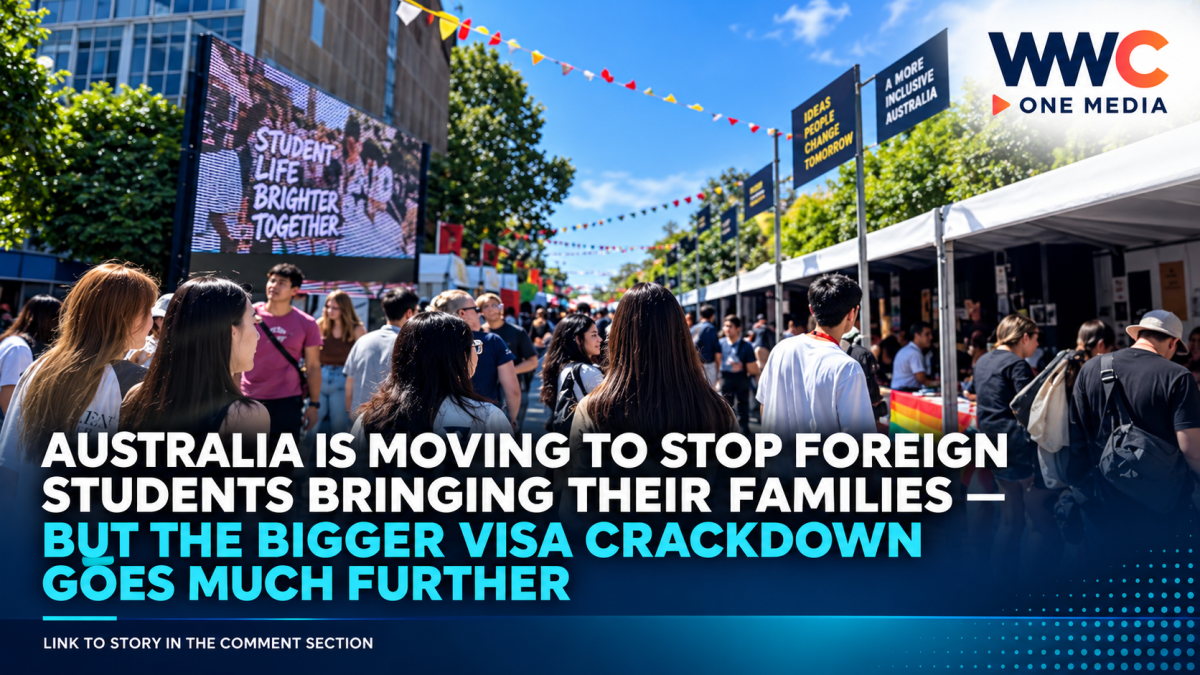
CANBERRA — Australia is preparing one of its most consequential changes to international student migration in years, with the Albanese government moving to sharply restrict the ability of foreign students to bring spouses, partners and dependent children while studying in the country.
But the family restrictions appear to be only one part of a much broader attempt to regain control of a temporary migration system that swelled after Australia reopened its borders following the COVID-19 pandemic.
Home Affairs Minister Tony Burke is using a National Press Club address on Thursday, September 17, to outline changes aimed at reducing net overseas migration from roughly 300,000 a year to 225,000 by 2028, according to ABC News, Reuters and other Australian outlets.
The proposed measures target not just dependants of international students but also visa switching, overstayers, bridging visas and other pathways that allow temporary migrants to remain in Australia longer.
The biggest change could hit international students with families
Under Australia’s current Student visa system, overseas students can include a spouse or de facto partner and dependent children under 18 in their application.
Australia’s official Study Australia website still states that partners, children and a partner’s dependent children may be included in a Student visa application. Family members can also, under existing rules, apply later as subsequent entrants if they were properly declared in the original application.
That makes the proposed change significant.
ABC News reported that international students would effectively lose the ability to bring family members with them, even though the government was not expected to announce an equivalent wholesale cut to the number of primary international students themselves.
In the last financial year, Australia granted 337,427 student visas, of which 45,991 went to secondary applicants, including dependants and other family members, according to figures reported by ABC.
Reuters similarly reported that Australia plans to prevent foreign students from bringing partners and children with them while studying. Under the existing system, spouses and partners may have work rights, although their specific conditions can depend on the primary student’s course and visa conditions.
One detail students should not assume yet
The headline change is substantial, but several practical details remain crucial.
At the time the initial Reuters and CNA reports were published, the government had not yet released complete implementing rules spelling out when the restrictions would take effect, whether existing visa holders would be grandfathered in, or what exemptions might apply to particular categories of students. Reuters reported the plan ahead of Burke’s National Press Club speech, while official Study Australia guidance was still displaying the existing family rules.
That means prospective students should distinguish between the government’s announced policy direction and the exact visa regulations that will determine individual applications.
Why Australia is tightening migration again
The immediate objective is numerical.
Australia’s net overseas migration climbed sharply after the country reopened its borders in February 2022. Reuters reported net migration reaching 518,000 in 2023, before falling to 429,000 in 2024 and 306,000 in the year to June 30, 2025.
International students accounted for more than half of the latest net migration figure cited by Reuters. Temporary skilled workers and working holidaymakers have also contributed to Australia’s post-pandemic migration rebound.
The government now wants net overseas migration to fall to about 225,000 by 2027-28, with Burke arguing that migration needs to be reduced in a targeted way while limiting disruption to the economy.
Net overseas migration is not simply a count of permanent immigrants. It measures people entering and leaving Australia who satisfy the statistical residence test, including many temporary visa holders. The Guardian reported that Australia’s net overseas migration figure has already declined for seven consecutive quarters since September 2023.
This is bigger than student dependants
The government’s broader migration package is also expected to make it harder for some temporary migrants to keep moving from one visa category to another simply to extend their time in Australia.
ABC reported that the overhaul would target temporary migrants seeking to bring family members, switch visas or extend their stay, with Labor relying heavily on regulatory changes after negotiations with the Coalition over immigration legislation failed to produce an agreement.
The government has also been looking at bridging visas, rejected protection claims and people who remain in Australia after losing their legal right to stay.
ABC reported that about 1,580 onshore protection claims were being lodged each month, with roughly 90% rejected. Appeals can keep some applicants in Australia for years on bridging visas while their cases move through administrative and judicial review.
The Guardian separately reported that Home Affairs data showed 110,898 people who had not been granted protection visas were yet to be deported as of July, a figure that included people on bridging visas or pursuing administrative or judicial review.
Australia has already been making student visas more expensive
The family restrictions would come after several other changes affecting overseas students.
From July 1, 2026, Australia’s main Student visa application charge rose from A$2,000 to A$2,500, according to Study Australia.
There is an important exception for Southeast Asian applicants: primary Student visa applicants holding passports from ASEAN member states — including the Philippines, Singapore, Indonesia, Malaysia, Thailand and Vietnam — receive a concession under the revised fee arrangements rather than paying the full A$2,500 rate.
Australia has also strengthened scrutiny of the international education system. Earlier in 2026, the government imposed a 12-month pause on new private colleges and training organisations seeking approval to offer courses to overseas students as regulators focused on misuse and integrity concerns.
But foreign students are also a huge business for Australia
The migration debate has another side: international education is one of Australia’s biggest export industries.
Australian government figures show international education generated almost A$55 billion in export income in calendar year 2025, up from about A$51.5 billion in 2024.
Higher education alone accounted for about A$40.8 billion of the 2025 total.
That explains why universities have repeatedly warned Canberra against changes they believe could make Australia less attractive to overseas students.
Universities Australia chief executive Luke Sheehy has argued that international student fees support university teaching and research and warned against large-scale cuts to student numbers. Universities and other education groups have made similar arguments as migration policy has tightened.
Those concerns do not resolve the government’s migration objective, but they illustrate the trade-off policymakers face: reducing temporary migration while protecting an export industry worth tens of billions of Australian dollars.
Migration has become a major political dividing line
The announcement also comes amid competing proposals over how far Australia should cut migration.
One Nation this week proposed reducing temporary migrant visas by more than 750,000 over three years, with international students and some migrant family categories among its principal targets. It has proposed an eventual net overseas migration level of about 130,000 a year after that initial adjustment.
The Albanese government has not adopted those figures. Its stated trajectory is toward approximately 225,000 net overseas migrants by 2028, while the Coalition has been developing its own migration policy and has criticised aspects of the government’s management of the system.
Business groups have also pushed back against an exclusive focus on headline migration numbers, arguing that Australia still relies on overseas labour in areas experiencing skills shortages.
What prospective international students should watch next
For anyone planning to study in Australia with a spouse or children, the most important information will now come from the final regulations and updated Department of Home Affairs visa guidance.
Until those rules are published, three questions remain particularly important: exactly which Student visa applicants will lose access to dependant visas, whether postgraduate research students or other categories will receive exemptions, and how Australia will treat applications or visas already lodged or granted.
Current government guidance still lists the ability to include partners and dependent children under the Student visa program.
That guidance is now likely to become one of the most closely watched pages in Australia’s international education system.
Because while the headline is about foreign students bringing their families, Canberra’s bigger objective is unmistakable:
Australia wants fewer people remaining in the country through its temporary migration system — and the rules governing who can come, who can stay and who must leave are being rewritten to make that target easier to enforce.




Leave a Reply