
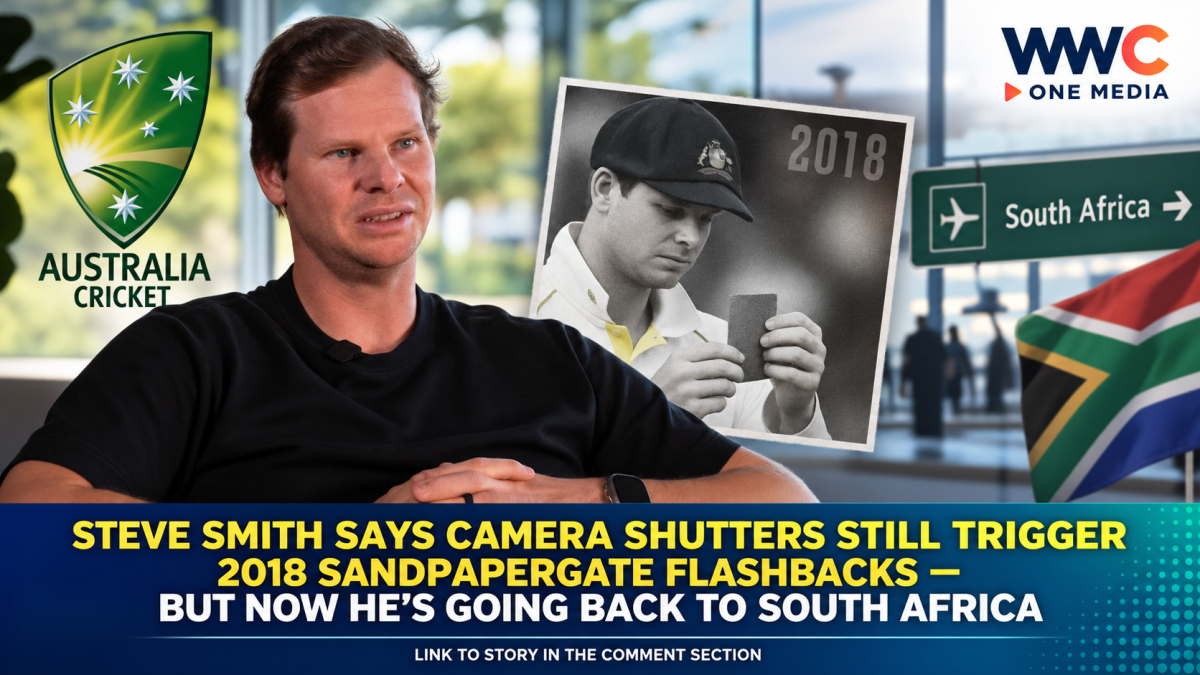
SYDNEY — Eight years after one of cricket’s most explosive scandals cost Steve Smith the Australian captaincy and a year of elite cricket, the former skipper says part of the fallout still follows him.
The trigger is surprisingly ordinary: the sound of a camera shutter.
Smith, now 37, has revealed that cameras can bring back memories of the chaotic days after the 2018 Cape Town ball-tampering scandal, when he was removed as captain, sent home from South Africa and faced a tearful press conference in Sydney under intense global scrutiny.
The admission comes at a striking moment. Smith is preparing to return to South Africa for a three-Test series beginning October 9 in Durban — his first Test tour of the country since the scandal that dramatically altered his career.
The moment Smith says he still relives
Speaking in an interview originally published by CODE Sports and reported by Reuters and Australian media, Smith described the period surrounding his departure from South Africa as one of the hardest experiences of his life.
He recalled feeling effectively “thrown to the wolves” while passing through Johannesburg airport amid an intense media presence and said he had little support around him at the time.
Smith also described his emotional Sydney airport press conference as traumatic. He said camera flashes and shutters can still revive memories of that period. Fox Sports, reporting from the same CODE Sports interview, said Smith acknowledged feeling anxious around cameras because of their association with the 2018 fallout.
That distinction matters: Smith is describing his own continuing emotional response to the episode. It would go beyond the available reporting to attach a medical diagnosis to those experiences.
What actually happened in the 2018 scandal?
The episode erupted during the third Test between Australia and South Africa at Newlands in Cape Town.
Cameron Bancroft was caught using sandpaper in an attempt to alter the condition of the ball. Cricket Australia’s subsequent investigation concluded that then vice-captain David Warner had developed the plan and instructed Bancroft, while Smith knew there was a potential plan and failed to intervene to prevent it.
That is more precise than simply saying Smith personally used the sandpaper.
Cricket Australia suspended Smith and Warner for 12 months, while Bancroft received a nine-month suspension. Smith was also barred from Australian national-team leadership for a further 12 months following his playing ban.
Smith decided not to appeal the sanction, saying at the time that he accepted responsibility as captain. Cricket Australia later rejected an Australian Cricketers’ Association push to have the bans lifted early.
Smith still believes the punishment was severe
Eight years later, Smith has not completely changed his view of the penalty.
Reuters reported that he still considers the punishment harsh, though he accepted it and ultimately found some benefit in being removed temporarily from the relentless demands of international cricket.
The scandal nevertheless created a sharp dividing line in his career.
Before Cape Town, Smith was Australia’s Test captain and one of world cricket’s dominant batsmen. Afterward, he had to rebuild not only his place in the national team but also his standing with supporters.
His comeback became one of the defining chapters of his career.
Edgbaston changed the story
Smith returned to Australia’s international side for the 2019 ODI World Cup before making his Test comeback in the Ashes in England.
At Edgbaston, amid a hostile reception, he scored 144 in his first Test innings back and followed it with another century in the second innings.
Cricket Australia has subsequently ranked that 144 among the defining innings of his Test career, given the pressure surrounding his return.
Smith told Reuters that reaching his first century after the ban brought an enormous emotional release because he had questioned whether he remained good enough — and whether he still belonged at Test level.
The answer from his bat proved emphatic.
Eight years later, the numbers tell a different story
Smith has since returned to Australian leadership duties, serving as Test vice-captain and repeatedly standing in for Pat Cummins when the regular skipper has been unavailable.
His playing record has continued to grow as well.
Cricket Australia currently lists Smith with 10,920 Test runs from 125 matches, 37 centuries and a batting average of 53.97.
He produced his 37th Test century at the Sydney Cricket Ground in January 2026 during the Ashes against England, another major milestone in a career that once appeared at risk of being permanently defined by Cape Town.
Smith is also taking his long-term future series by series. The ICC reported this week that he has not committed to playing the 2027 Ashes in England, even as his immediate Test attention turns to South Africa.
South Africa brings the story back to where it changed
Australia’s three-match Test series against South Africa will begin at Kingsmead in Durban from October 9 to 13, followed by the second Test in Gqeberha from October 18 to 22 and the finale at Newlands in Cape Town from October 27 to 31.
That final stop gives Smith’s return an unavoidable historical connection.
Newlands is where the sandpaper incident erupted in March 2018.
This time, however, Smith says he is approaching South Africa differently. Rather than expressing reluctance about returning, he told Reuters: “I’m actually excited to go back.”
He says the intervening eight years have changed him — as a player, a leader and a person — and that he has become calmer on the field.
That may ultimately be the larger story behind his South African return.
Sandpapergate cannot be erased from Smith’s career record. Cricket Australia’s findings, the bans and the images of his emotional return home remain part of cricket history.
But when Smith walks out in South Africa again this October, the question will no longer simply be what happened in 2018.
It will be what eight years of rebuilding look like when he finally returns to the country where everything changed.




Leave a Reply