
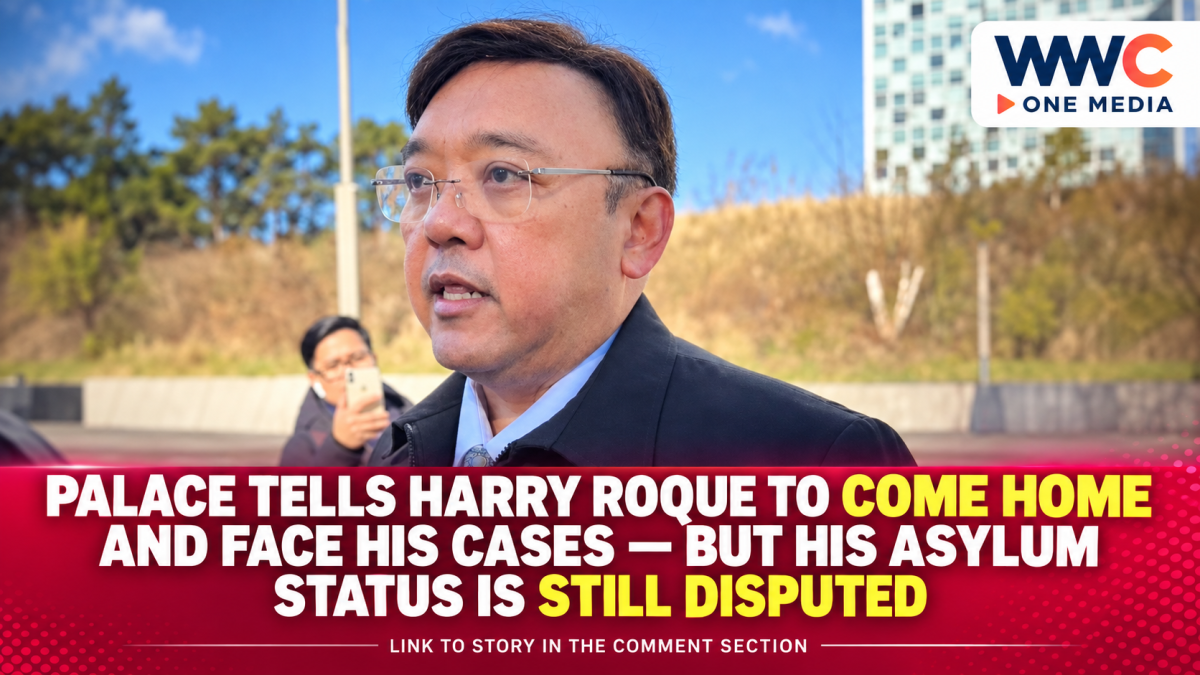
MANILA, Philippines — Malacañang is urging former presidential spokesperson Harry Roque to return to the Philippines and answer the allegations against him, escalating a dispute that now stretches from a Pampanga trafficking case to an unresolved fight over his asylum application in Europe.
Palace Press Officer Claire Castro said Wednesday that Roque should face the legal proceedings and present evidence in his defense if he believes the allegations against him are unfounded.
The Palace statement came after Interior Secretary Jonvic Remulla announced that Roque’s asylum application had been rejected.
Roque immediately disputed that claim.
Speaking from Europe, the former Duterte administration spokesperson called Remulla’s statement “fake news” and said his application had already been submitted for resolution but remained pending with Austrian authorities.
That creates an important factual distinction.
The Philippine government says Roque’s asylum bid has been denied. Roque says it has not. No publicly cited decision from Austrian authorities has yet independently settled the dispute.
Palace: Face the accusations and present your evidence
Castro said Roque should return and use the legal process to clear his name.
The Palace has also rejected Roque’s argument that the cases against him amount to political persecution, describing the proceedings as based on evidence rather than his political affiliation. That is the Marcos administration’s position; Roque has repeatedly denied wrongdoing and maintained that the actions against him are politically motivated.
The disagreement matters because claimed political persecution sits at the heart of Roque’s attempt to obtain asylum in Europe.
But asylum proceedings and the Philippine criminal cases are separate legal processes.
Even if an asylum authority reaches a decision, it does not determine whether Roque is guilty or innocent of the allegations filed in Philippine courts.
The most serious case is qualified human trafficking
Roque faces qualified human trafficking charges connected with Lucky South 99, the Philippine offshore gaming operator hub in Porac, Pampanga that authorities raided in 2024.
On May 8, 2025, the Regional Trial Court in Angeles City issued arrest warrants against Roque, businesswoman Cassandra Ong and other defendants after finding probable cause to proceed with the cases. The warrants covered alleged violations of the Expanded Anti-Trafficking in Persons Act.
The court said the offenses charged were non-bailable.
That is legally significant because the case has progressed beyond an investigation or preliminary complaint: criminal charges have been filed in court and an arrest warrant exists.
It is equally important to state what that does not mean.
An arrest warrant is not a conviction.
Roque has denied involvement in human trafficking and is entitled to the presumption of innocence unless guilt is established through the judicial process.
What investigators say happened at Lucky South 99
Lucky South 99 became one of the highest-profile POGO investigations after authorities raided its compound in Porac.
Law-enforcement agencies alleged that illegal activities including trafficking and other abuses occurred inside the facility. The criminal cases later expanded to multiple defendants allegedly connected to its operations.
Roque’s connections to individuals and companies associated with the compound became a subject of congressional and law-enforcement scrutiny.
He has maintained that his professional relationships were legitimate legal work and has denied being part of illegal operations.
Those competing claims are ultimately matters for courts to resolve.
There is also a tax complaint—but the amount is ₱3.35 million, not billion
Roque’s legal problems widened in April 2026, when the Bureau of Internal Revenue filed a criminal complaint with the Department of Justice against Roque, his wife Mylah Reyes Roque, and associate Percival Sazon Ortega.
The complaint concerns transactions involving Biancham Holdings and Trading Inc.
The BIR alleged that the respondents failed to file required returns and pay taxes associated with share transfers and an increase in authorized capital stock.
The bureau placed the estimated deficiency at more than ₱3.35 million, including surcharges and interest.
That number is worth emphasizing because at least one current report has misstated it as billions.
The BIR figure is ₱3.35 million—not ₱3.35 billion.
The BIR accused the respondents of attempted tax evasion and failure to file tax returns under the National Internal Revenue Code.
Roque has called the complaints baseless and said he would contest them through legal remedies.
A complaint filed with the DOJ is also legally different from a conviction.
Farmers separately brought land-transfer allegations to the NBI
A third issue surfaced in March.
Farmers from Mariveles, Bataan submitted sworn statements and documents to the National Bureau of Investigation alleging that agricultural land covered by Certificates of Land Ownership Award had been improperly transferred to a private corporation.
The complainants linked Roque and other individuals to the transactions.
The NBI said preliminary information raised questions about possible falsification in the processing and transfer of titles and that it was conducting a case build-up to determine whether probable cause existed and who, if anyone, should face criminal liability.
That distinction is crucial.
The Bataan matter is an allegation under NBI investigation; it should not be described as though Roque has already been convicted—or necessarily formally charged in court—over land grabbing.
The asylum fight began in the Netherlands
Roque announced in March 2025 that he was applying for asylum in the Netherlands, saying he feared political persecution if returned to the Philippines. Dutch authorities received the application, according to Roque.
The case later became more complicated because of European asylum rules.
Roque said Dutch authorities determined that Austria should handle his application because Austria had issued the visa he used, invoking the European system that determines which participating state is responsible for processing an asylum claim.
By 2026, Roque was reporting that the Austrian process remained underway.
That is why the latest statements have produced such a direct factual conflict.
Remulla argues that the permissible processing period has passed and maintains that the application was denied. Roque says the case remains pending and challenges Remulla to produce proof of a rejection.
There is still no publicly confirmed Interpol Red Notice
Remulla has also said Philippine authorities intend to move against Roque once an Interpol Red Notice is issued.
That wording itself indicates an important fact:
the latest government statements do not establish that a Red Notice has already been issued.
Earlier this year, Remulla explicitly confirmed that Roque did not yet have one.
A Red Notice is also frequently misunderstood.
It is a request circulated through Interpol asking law-enforcement agencies to locate and provisionally arrest a wanted person pending extradition, surrender or another legal process.
It is not itself an international arrest warrant, and whether a person can be detained abroad depends on the law and procedures of the country where that person is located.
That means Philippine officials could not simply travel to Austria and arrest Roque themselves.
Any action would involve Austrian authorities and applicable European and domestic legal procedures.
Roque’s passport has already been canceled
The government has pursued other measures.
Roque’s Philippine passport was canceled in November 2025 following a court order, according to GMA News. Roque said at the time that he had already surrendered the physical passport to Dutch authorities when he applied for asylum.
The cancellation increases the legal complexity surrounding his stay abroad but does not by itself resolve his asylum application.
International protection proceedings are governed by the host country’s laws and applicable European rules.
Palace and Roque are making competing political-persecution claims
The dispute now has two parallel narratives.
Malacañang says Roque is facing ordinary criminal and administrative processes supported by evidence and should return to defend himself.
Roque says the cases form part of political persecution against figures associated with former President Rodrigo Duterte.
Those are opposing claims, not established facts.
Whether the criminal allegations are proven must be determined through Philippine legal proceedings.
Whether Roque qualifies for asylum is for the relevant European authorities to decide under their own legal standards.
Neither side’s public statements settle the other process.
What happens next
Several moving pieces now determine what comes next.
The Angeles City court warrant remains outstanding.
The qualified trafficking case remains pending.
The BIR complaint must proceed through the appropriate prosecutorial process.
The NBI continues handling the Bataan land allegations according to its case-building process.
Philippine authorities are still seeking international assistance that could facilitate Roque’s return.
And the actual status of his Austrian asylum application remains publicly disputed.
That last point may be the most immediate.
A formal Austrian decision could clarify whether Roque can remain under an international-protection process or face further proceedings concerning his status and possible return.
Until that happens, there are two things that can be stated with confidence.
A Philippine court has issued a warrant for Harry Roque in the qualified human trafficking case.
But the claim that his Austrian asylum application has already been denied remains disputed and has not been independently confirmed through a publicly available Austrian ruling.




Leave a Reply