
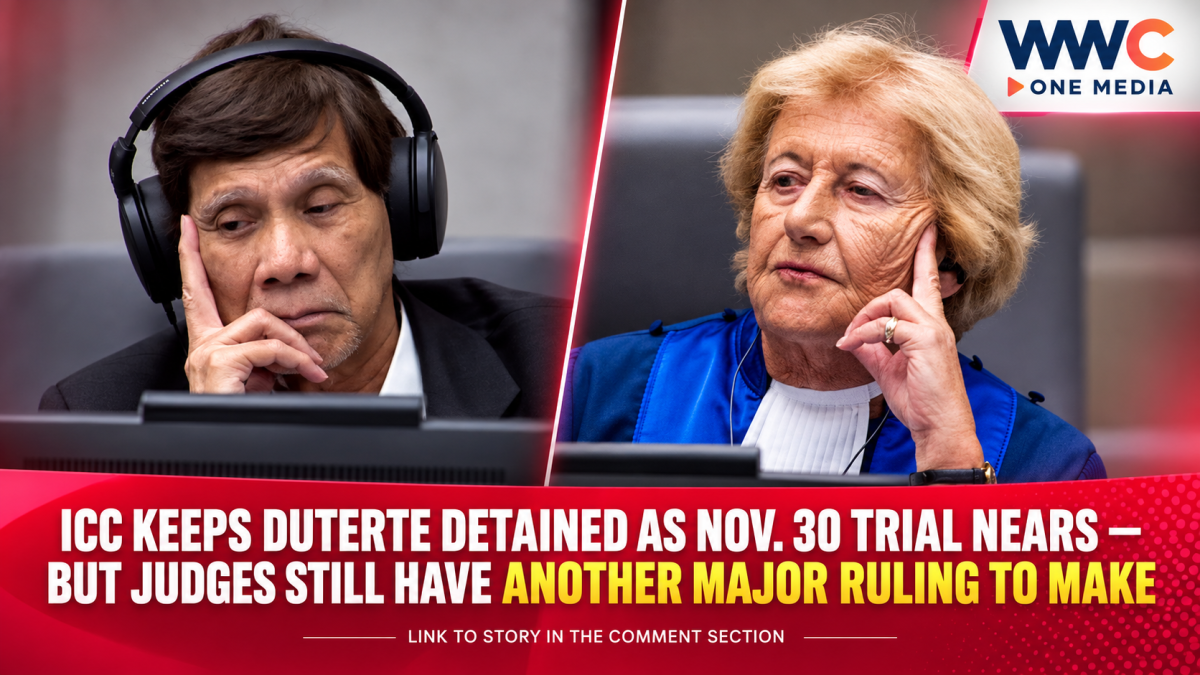
THE HAGUE/MANILA — Former Philippine President Rodrigo Duterte will remain in International Criminal Court detention as his November 30 trial approaches, after judges concluded that circumstances have not changed enough to justify releasing him—with or without conditions.
The unanimous ruling by ICC Trial Chamber III came on September 16, shortly after Duterte personally attended a status conference in The Hague for the first time.
Judges said they continue to see risks that Duterte could abscond or obstruct or endanger the proceedings if released, particularly now that the prosecution has submitted lists identifying witnesses and describing their expected evidence.
But the ruling settles only one major question.
A separate issue—whether Duterte is currently fit to participate effectively in the upcoming trial following a renewed challenge by his defense—is still awaiting a decision from the Trial Chamber.
That distinction matters as the case moves toward its most consequential stage yet.
Why the ICC says Duterte must remain detained
Under the Rome Statute, ICC judges periodically review whether the legal grounds supporting an accused person’s detention still exist.
Article 60 allows judges to change a detention ruling when circumstances change. Among the considerations under Article 58 are whether detention remains necessary to ensure an accused appears for trial or does not obstruct or endanger court proceedings.
In Duterte’s latest review, Trial Chamber III found no development favoring release.
Instead, judges said the prospect of an actual trial—and the possibility of a lengthy sentence in the event of a conviction—had increased the incentive to flee.
The Chamber also pointed to a newer development: prosecutors have disclosed their witness and evidence lists.
Judges reasoned that disclosure of witnesses’ identities and expected testimony could increase the possibility of interference, either personally or through other people.
The Chamber consequently ordered Duterte’s continued detention.
The ruling does not decide whether Duterte is guilty of the charges against him.
That question can be determined only through the trial process.
This was the second major detention ruling in four months
The September decision reinforces an earlier ruling issued on May 22, 2026.
At that time, Trial Chamber III also concluded that there had been no notable change supporting Duterte’s release.
The judges said the confirmation of charges against him actually strengthened concerns over possible flight because his case had moved closer to trial.
The May ruling also considered health-related arguments raised by Duterte’s lawyers but found that information then available from medical experts did not warrant modifying his detention.
His defense subsequently raised a renewed fitness issue before the Trial Chamber.
That question remains legally separate from whether the requirements for detention continue to be satisfied.
Fitness is still a live issue
Duterte’s defense has argued that the Court should resolve his current fitness to stand trial before fully assessing the implications for detention.
Lead defense counsel Peter Haynes told the Court that fitness and detention are connected, arguing that a finding that Duterte could not participate effectively in trial—and any resulting adjournment—could potentially constitute a changed circumstance relevant to a later detention review.
Prosecutors have taken the opposing position and have asked Trial Chamber III to find Duterte fit to proceed.
The Chamber has not yet issued its latest determination on that dispute.
There is also an important piece of procedural history.
In January 2026, Pre-Trial Chamber I found Duterte fit to participate in the then-pre-trial proceedings after considering reports from three independent medical experts. That ruling allowed the confirmation-of-charges process to resume.
The current dispute is a later fitness question being considered by the Trial Chamber as the actual trial approaches.
It would therefore be inaccurate to say that the September 16 detention ruling itself resolved Duterte’s present fitness-to-stand-trial challenge.
It did not.
Duterte made his first in-person appearance
The September 16 status conference was also notable because Duterte attended personally.
He had previously appeared before the ICC by video link during his initial appearance in March 2025 and had waived attendance at the first two status conferences.
His September 16 appearance was therefore his first in-person attendance at an ICC status conference.
The hearing was primarily procedural.
Trial Chamber III discussed how prosecutors intend to present their case, the number of witnesses, documentary evidence, disclosure to the defense and the sitting schedule once proceedings begin.
Presiding Judge Joanna Korner also urged prosecutors to consider reducing their witness list.
The prosecution had requested about 193 hours to present its case. Korner described that as lengthy and asked whether witnesses—including several experts dealing with similar subjects—could be reduced to make the proceedings more efficient.
Prosecutors responded that they would examine ways of streamlining their presentation.
Trial is scheduled for November 30
The ICC currently lists November 30, 2026 as the opening date for Duterte’s trial.
Trial Chamber III is composed of Presiding Judge Joanna Korner, Judge Keebong Paek and Judge Nicolas Guillou.
The Chamber has also indicated that it wants proceedings to move expeditiously once trial begins.
During the September status conference, Korner questioned a proposal that would have divided trial hearings into shorter blocks separated by breaks and indicated that the judges instead intended to sit through longer periods when practicable.
That does not mean the November timetable is immune from future procedural decisions.
The unresolved fitness issue, disputes over evidence and disclosure, and other pretrial matters still have to be managed by the Chamber.
But as of the ICC’s latest publicly available case information, November 30 remains the scheduled opening date.
What Duterte is accused of
On April 23, 2026, ICC Pre-Trial Chamber I unanimously confirmed all charges brought by prosecutors against Duterte and committed the case to trial.
The charges consist of three counts of crimes against humanity involving murder and attempted murder.
The Chamber concluded that there were substantial grounds to believe the alleged crimes formed part of a widespread and systematic attack against civilians in the Philippines between November 1, 2011 and March 16, 2019, in connection with the anti-drug campaign.
The confirmation standard is not the same as the standard required for conviction at trial.
Confirmation means judges found sufficient grounds for the charges to proceed to trial; prosecutors must still prove their case through the trial process.
Duterte has disputed the allegations and has challenged the ICC’s jurisdiction and proceedings. Reuters reported in April that his defense argued, among other things, that statements attributed to him were rhetoric rather than orders to commit killings.
Why the case covers events before and during Duterte’s presidency
The ICC’s confirmed case does not concern only Duterte’s six years as president.
According to the Court, the relevant period begins in November 2011, when Duterte was serving in local government in Davao City, and runs through March 16, 2019.
The ICC says it has jurisdiction over alleged crimes committed while the Philippines was a State Party to the Rome Statute, including conduct within the relevant period before the country’s withdrawal became effective.
Duterte’s defense has challenged the Court’s jurisdiction during the proceedings.
Those jurisdictional arguments are distinct from the latest detention review.
Detention and guilt are two different questions
The latest order could easily be misread as a judgment on the underlying crimes.
Legally, it is not.
The detention review addresses a narrower question: whether the circumstances that justify keeping an accused person in ICC custody continue to exist while proceedings are underway.
The Rome Statute specifically requires periodic review and permits release—with or without conditions—when those circumstances no longer justify detention.
Trial Chamber III concluded that Duterte’s circumstances currently support continued detention.
His criminal responsibility remains for the trial to determine.
That distinction will become increasingly important as the November 30 date approaches and arguments over evidence, witnesses and Duterte’s ability to participate move into sharper focus.
The next major ruling may not be about detention
For now, one question has been answered.
Rodrigo Duterte will remain at the ICC detention facility in The Hague.
But another significant procedural issue is still unresolved.
The Trial Chamber must decide the latest dispute over his fitness to stand trial—a ruling that could influence how the November proceedings are conducted and whether further defense applications follow.
The detention review therefore did not close the legal battle ahead of November 30.
It clarified where Duterte will be while that battle continues.




Leave a Reply