
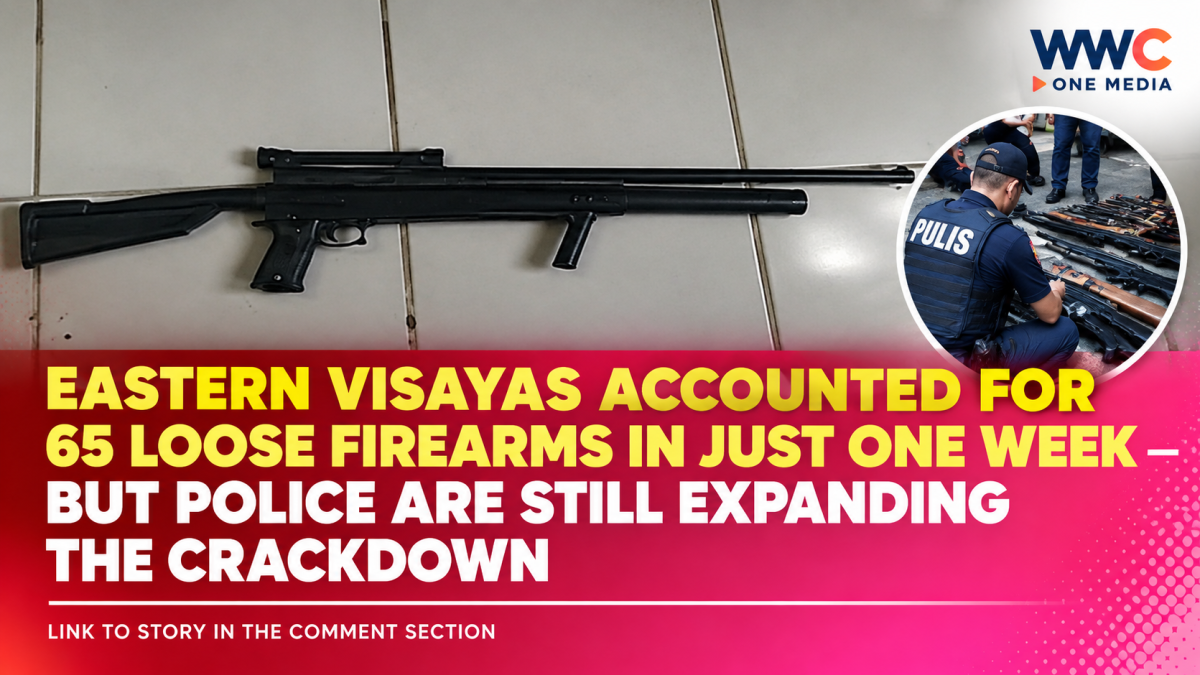
TACLOBAN CITY — Police in Eastern Visayas accounted for 65 loose firearms in just one week, extending an intensified campaign against undocumented and illegally held weapons at a time when authorities across the Philippines are trying to pull thousands of guns out of circulation.
The latest figure, reported by ABS-CBN News on September 16, adds to a much larger firearms drive already underway across Leyte, Samar and the rest of Eastern Visayas.
Only weeks earlier, the Police Regional Office 8 reported accounting for 191 firearms and two explosives during August alone, through 203 operations involving confiscations, surrenders and recoveries.
That means the 65 firearms recorded in the latest week are not an isolated haul.
They are part of a continuing effort to locate weapons whose ownership, licensing or possession falls outside legal requirements—and prevent those firearms from eventually being used in violence.
But there is an important distinction behind the headline:
Not every gun police call a “loose firearm” is necessarily a weapon seized from a criminal suspect.
What exactly is a ‘loose firearm’?
Under the implementing rules of Republic Act No. 10591, or the Comprehensive Firearms and Ammunition Regulation Act, the definition of a loose firearm is broader than the ordinary idea of an “illegal gun.”
It can include firearms that are unregistered, weapons with altered or erased registration details, registered guns that have been reported lost or stolen, or registered firearms found in the possession of someone other than the licensed owner.
That is why police reports often use the wording “accounted for” rather than simply “confiscated.”
Some weapons are seized during search-warrant operations.
Others are surrendered voluntarily.
Some are turned over to police for safekeeping when licenses or registrations have expired.
And others may be recovered during criminal investigations.
Those categories should not be treated as identical.
Eastern Visayas already accounted for 191 guns in August
The scale of PRO-8’s ongoing campaign becomes clearer when the latest week is compared with August.
Police conducted 203 operations involving loose firearms and explosives across Eastern Visayas during that month, resulting in 191 firearms and two explosives being confiscated, surrendered or recovered.
The gun campaign was only one part of a much broader regional anti-crime drive.
During August, PRO-8 said it conducted 1,012 law-enforcement operations, arrested 1,145 alleged law violators and recovered illegal or prohibited items valued at about ₱18.96 million.
That included anti-drug operations, actions against wanted persons, illegal logging, illegal fishing, gambling, smuggling and firearms offenses.
Police also said 105 drug operations resulted in the arrest of 126 people and the recovery of more than 1.1 kilograms of suspected shabu valued at approximately ₱7.79 million.
The latest 65-firearm count therefore continues an enforcement tempo that had already accelerated before September.
PRO-8 also has a new police chief
The latest crackdown comes during a leadership transition inside Eastern Visayas police.
Police Brig. Gen. Romano Cardiño formally took command of PRO-8 on September 8, replacing Brig. Gen. Jason Capoy, who was reassigned to head the PNP Human Rights Affairs Office.
Cardiño previously led the newly established Negros Island Region police.
During his roughly four-month tenure there, PRO-NIR reported conducting 545 loose-firearm operations, confiscating 272 firearms, receiving 286 unlicensed firearms through surrender and arresting 107 people in connection with firearms cases.
He has since brought his community-policing strategy to Eastern Visayas, including a push for faster response through the national 911 system.
The 65-firearm result therefore comes during his first days heading the Eastern Visayas command.
One recent Samar operation shows how seizure cases differ from surrenders
Recent PRO-8 operations illustrate why firearm numbers need context.
On September 1, police implementing a search warrant in Sta. Margarita, Samar, arrested a barangay chairman and reported recovering a .45-caliber pistol, magazines and ammunition as well as an M16 rifle with a defaced serial number.
Police said the suspect was unable to present documents authorizing possession of the .45-caliber firearm and was placed under investigation for a potential violation of RA 10591.
That is different from a weapon voluntarily brought to a police station.
Both may appear under the broader loose-firearm campaign, but one involves a law-enforcement operation and possible prosecution, while the other can involve owners voluntarily attempting to regularize or surrender a firearm.
The crackdown is nationwide
Eastern Visayas is not operating in isolation.
PNP figures published by the Philippine Information Agency show that police across the country accounted for 3,724 firearms in July 2026 through confiscations, surrenders, recoveries and other lawful police actions.
Another 1,106 firearms were voluntarily turned over for safekeeping during the same period, while 965 people were arrested for alleged violations of RA 10591.
Western Visayas has been particularly aggressive.
Its police force launched a community-based Restrict, Track and Turn-In campaign, seeking voluntary firearm turnovers throughout the region.
By September 14, police there said 1,735 firearms had been turned over from 1,639 barangays since the campaign began in August.
In one extraordinary 24-hour period in September, Western Visayas police accounted for 733 firearms, 728 of which were voluntarily surrendered rather than seized from suspects.
That example shows why large gun totals should not automatically be interpreted as hundreds of violent criminals being disarmed.
The method matters.
Central Visayas also reported 65 firearms in a week
Coincidentally, neighboring Central Visayas reported the same number—65 firearms—during its own weeklong anti-crime campaign in September.
Police Regional Office 7 said those operations also resulted in 23 arrests related to loose-firearm enforcement.
Sixteen firearms were recovered through Oplan Katok, the PNP program under which police contact firearm owners and encourage the surrender or proper processing of weapons with expired or otherwise problematic documentation.
That reinforces the nationwide character of the current push.
Police are using both conventional enforcement and voluntary-compliance campaigns to reduce the number of firearms outside proper regulatory control.
Why police are focusing on firearms
The PNP argues that accounting for loose firearms is preventive policing.
A firearm that is stolen, unregistered, improperly transferred or held by someone who is not its licensed owner becomes significantly more difficult for authorities to trace if it later appears at a crime scene.
Ballistic testing can also help investigators determine whether surrendered or seized guns have links to previous incidents.
Western Visayas police, for example, have said surrendered firearms are subjected to ballistic examination before disposal procedures are completed.
There is recent context for that concern in Eastern Visayas itself.
After a school shooting in Tacloban earlier this year, authorities investigated allegations that a firearm licensed to a police officer had been accessed and used without authorization by a minor.
NAPOLCOM opened a separate administrative investigation into the officer’s possible liability.
Under RA 10591, even a legally registered firearm can fall within the definition of a loose firearm when it is possessed by someone other than its licensed owner.
That case highlighted why safe storage and control matter even when the gun itself was originally legally registered.
But counting guns is only the first step
The latest Eastern Visayas figure gives police a measurable result:
65 firearms accounted for in one week.
But the number alone does not tell the entire story.
The more important questions are how many were voluntarily surrendered, how many were confiscated during criminal operations, whether any are linked through ballistics to previous crimes and whether owners who violated firearms laws are successfully prosecuted.
Police also have to determine whether campaigns continue producing results after the easiest-to-locate or most willing firearm owners have already surrendered their weapons.
That challenge can already be seen in Western Visayas, where police reported that more than half of the region’s barangays had still not turned over a firearm despite its aggressive campaign.
65 guns in seven days—but a much larger inventory remains
Eastern Visayas’ latest weeklong result is significant when viewed against the region’s recent numbers.
PRO-8 accounted for 191 firearms during August.
Another 65 were reported in the latest weeklong crackdown.
And similar campaigns are underway throughout the Philippines.
For police, every successfully traced, surrendered or lawfully confiscated firearm means one more weapon brought back under regulatory control.
But the figures also reveal the scale of the challenge.
Sixty-five loose firearms were accounted for in Eastern Visayas in just one week—and if the previous month’s 191-gun tally is any indication, police believe there are still many more weapons left to find.




Leave a Reply