
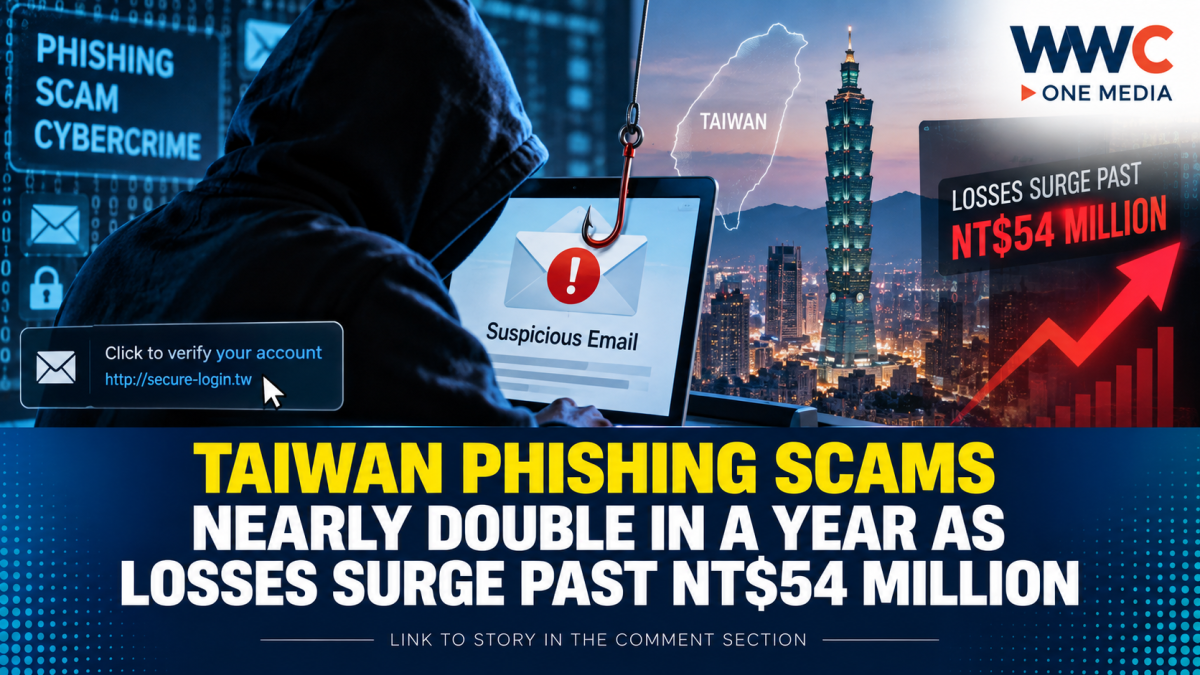
TAIPEI — Taiwan is confronting a sharp rise in phishing-link scams, with reported cases nearly doubling in August from a year earlier and financial losses soaring more than fourfold, according to the latest figures from the Criminal Investigation Bureau (CIB).
The CIB reported 505 phishing-link scam cases in August 2026, compared with 253 cases during the same month last year — an increase of 99.6%.
Even more striking was the financial damage: reported losses reached about NT$54.51 million (US$1.7 million), up from roughly NT$13.05 million a year earlier — a 317.7% increase.
Overall Scam Cases Actually Fell
Despite the surge in phishing, Taiwan’s overall reported telecom and internet fraud numbers moved in the opposite direction.
The CIB said it received 10,652 fraud reports in August, with total reported losses of approximately NT$4.11 billion.
Compared with August 2025, the number of cases fell 22.3%, while total financial losses declined 35.1%.
That makes the phishing figures particularly notable: while overall scam activity declined, phishing-link fraud emerged as a rapidly growing category.
How the Phishing Trap Works
Police are warning people to be especially cautious about messages containing unfamiliar links.
Scammers can disguise malicious links as notifications involving parcel deliveries, online shopping, banking, account verification or other everyday services.
One example highlighted by Taiwanese media involved entertainer Hugh Chiu (張懷秋), who described nearly falling victim to a so-called “ghost package” scam.
He received a message connected to an apparent online-shopping delivery. A closer check raised suspicions before he completed the transaction, allowing him to avoid the loss.
The case illustrates why police are emphasizing caution even when a message appears to involve a familiar service.
CIB’s Three-Step Warning
The Criminal Investigation Bureau is urging the public to adopt a simple approach when receiving suspicious messages:
Pause. Check. Then act.
Police specifically advise people not to click unfamiliar links and to independently verify requests before providing information or making payments. The CIB has also warned that even messages appearing to come from friends or acquaintances can require verification if an unusual request is made.
Taiwan’s Larger Fight Against Online Fraud
The latest numbers come amid a broader effort by Taiwanese authorities to tackle increasingly sophisticated fraud networks.
Earlier this year, Taiwan’s CIB announced the dismantling of what authorities described as the country’s largest phishing syndicate, with 24 people indicted in a case involving a large-scale operation.
Authorities have also expanded cooperation among police, financial institutions, telecommunications companies and technology platforms to disrupt fraudulent advertising, communications and money flows.
The continuing challenge is that scammers can quickly change their methods, making public awareness an important part of Taiwan’s anti-fraud strategy.
Why the Latest Numbers Matter
The August figures show that success against fraud cannot be measured simply by looking at the total number of cases.
Overall reported fraud declined, but phishing-link cases almost doubled and the associated losses increased dramatically.
That shift suggests scammers may be adapting their methods even as authorities intensify enforcement.
For ordinary users, the warning is straightforward: a message that looks routine can still be the beginning of a scam.
And with phishing losses climbing so sharply, the next dangerous link may not look suspicious at all.
WWC ONE MEDIA G.A




Leave a Reply