
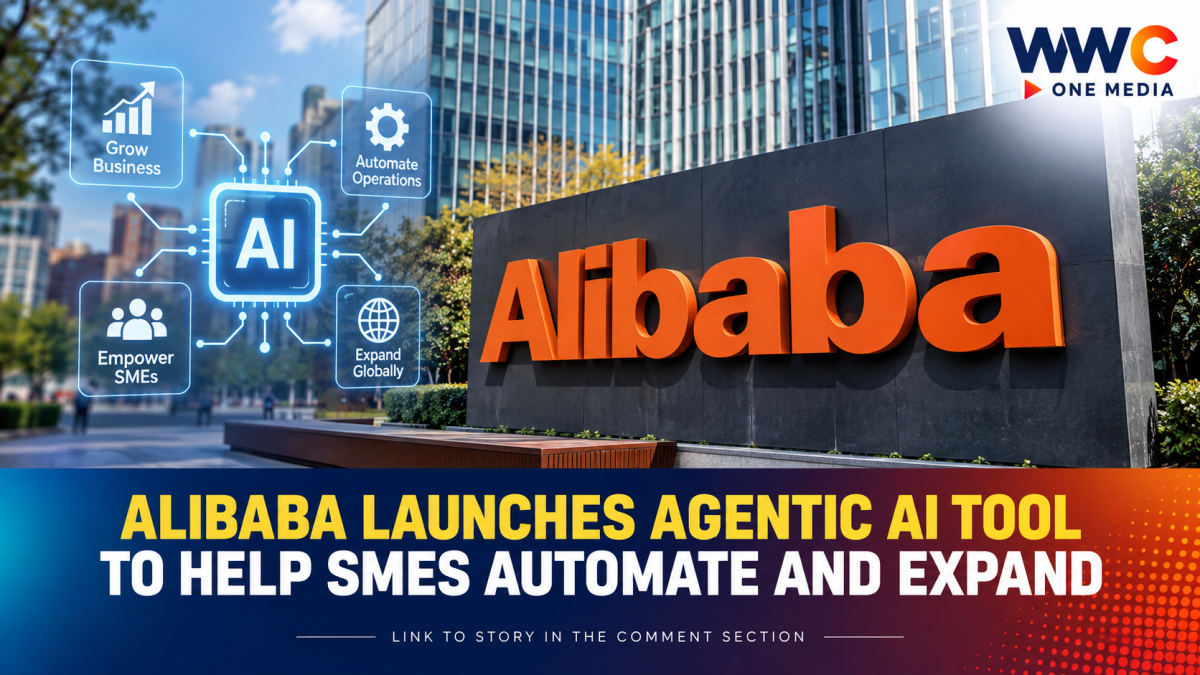
HONG KONG — Alibaba is pushing deeper into the small-business market with an agentic AI tool designed to help small and medium-sized enterprises automate complex business tasks, research opportunities and expand into new markets.
The initiative centers on Accio Work, an AI-powered business system from Alibaba.com that goes beyond traditional chatbots by using multiple AI agents to handle different stages of a business workflow.
Instead of simply answering questions, the system is designed to carry out multi-step tasks, potentially giving smaller companies access to capabilities that would otherwise require larger teams.
From chatbot to AI business team
Alibaba describes Accio Work as a plug-and-play agentic AI business team capable of automating end-to-end business operations.
The system is designed around specialized AI agents that can work on tasks such as product creation, supplier research, business analysis and other operational activities.
That distinction is important.
Traditional generative AI tools generally respond to prompts and produce information. Agentic AI is designed to take a more active role by breaking a broader objective into multiple tasks and executing steps toward a desired outcome.
For an SME, that could mean using AI not merely to draft an email or summarize a document, but to support an entire workflow involving research, sourcing and decision-making.
Alibaba sees SMEs as a major AI opportunity
Small businesses represent a huge potential market for AI companies because many operate with limited staff and resources.
Alibaba’s strategy is to make AI-powered capabilities available without requiring an SME to build its own large technology or data-science team.
The company’s broader AI strategy has increasingly focused on agentic AI, with Alibaba saying it wants AI systems to move from generating content toward executing actions and completing tasks.
The move also puts Alibaba into a rapidly expanding field where technology companies are competing to turn AI agents into practical business tools.
Southeast Asia becomes an important testing ground
Alibaba has also been expanding Accio Work beyond its core Chinese market.
FutureCIO reported that Alibaba.com launched Accio Work for SMEs in Malaysia, with registration opening for businesses interested in using the platform.
That regional expansion is significant because Southeast Asia has millions of SMEs involved in manufacturing, retail, services and cross-border trade.
For businesses seeking international customers, AI tools that can help with product research, sourcing and market expansion could potentially reduce some of the time and manpower traditionally required for those activities.
AI could change how smaller companies compete
The bigger idea behind Alibaba’s strategy is that AI agents could narrow some of the operational gap between small companies and much larger corporations.
A company with a small staff could potentially use AI to conduct research, organize information, identify suppliers and support other repetitive processes without hiring separate specialists for every task.
But that does not eliminate the need for human oversight.
Business decisions involving contracts, finances, suppliers, legal requirements and sensitive company information still require people to verify AI-generated work before acting on it.
Alibaba’s AI push comes amid intensifying competition
Alibaba is not alone in targeting SMEs with agentic AI.
Anthropic, for example, has been expanding its Claude for Small Business initiative, while other major AI companies are developing tools designed to automate increasingly complex business workflows. Recent reporting shows that small-business adoption of generative AI has been rising, although concerns about accuracy, security and customer acceptance remain.
That makes the SME market an increasingly important battleground for AI companies.
Alibaba’s advantage is its existing position in global e-commerce and business-to-business trade, potentially allowing it to connect AI assistance directly with sourcing and commerce workflows.
The bigger question: how autonomous will SMEs let AI become?
Accio Work represents a shift in how businesses may use artificial intelligence — from asking AI for answers to assigning AI tasks.
For smaller companies, that could eventually mean using AI agents as digital assistants across research, sourcing, operations and international expansion.
But the technology’s real impact will depend on how reliably those agents perform in real-world business environments — and how much control companies are willing to give them.
Alibaba is betting that the next generation of SME growth won’t just be AI-assisted. It could be AI-executed.
WWC ONE MEDIA G.A


Leave a Reply