
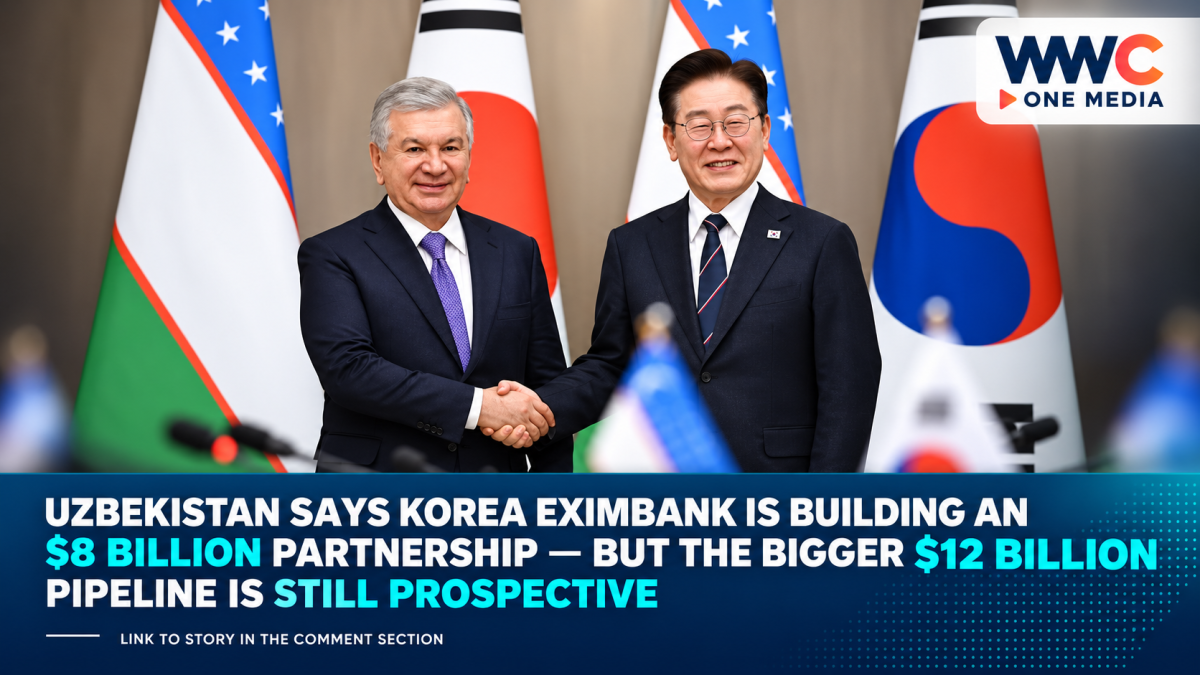
SEOUL — South Korea’s state-run Export-Import Bank is positioning itself at the center of a much larger economic push into Uzbekistan, with potential projects ranging from critical minerals and artificial intelligence to high-speed rail, biotechnology, smart cities and semiconductors.
Korea Eximbank Chairman and CEO Hwang Ki-yeon met Uzbek President Shavkat Mirziyoyev in Seoul on September 15, a day after the two countries exchanged a broad package of agreements during Mirziyoyev’s state visit to South Korea. Korea Eximbank said it wants to turn those agreements into concrete projects and expand financial support for bilateral investment.
The potential scale is striking.
Uzbekistan’s presidential office says Mirziyoyev backed a new $8 billion partnership program with Korea Eximbank, while broader bilateral talks produced a pipeline of approximately $12 billion in prospective projects.
But those figures need careful interpretation.
The $12 billion does not represent $12 billion in finalized Korean investment, and publicly available Korean government documents show that many of the latest arrangements are memorandums of understanding, feasibility-study commitments or frameworks for identifying future projects rather than fully funded construction contracts.
That distinction may ultimately determine how significant the announcements become.
Korea Eximbank Has Moved Beyond Simply Lending Money
The most important agreement involving Korea Eximbank may not be a single loan.
The bank and Uzbekistan’s Ministry of Investment, Industry and Trade signed an MOU establishing a system for jointly identifying strategic projects in six priority industries.
Those sectors are:
- critical minerals
- AI and data centers
- smart cities
- an industrial complex for Korean companies
- pharmaceuticals and biotechnology
- food, beauty and cultural content
Korea and Uzbekistan plan to identify commercially viable projects in those areas and then explore financing through tools including project finance and commercial finance.
That gives Korea Eximbank a role much earlier in the investment process.
Instead of waiting for a Korean company to arrive with an already developed proposal and then deciding whether to finance it, the bank can help identify sectors, structure projects and connect Korean companies with opportunities from the beginning.
For Seoul, that could make Uzbekistan a testing ground for a more coordinated model of overseas industrial expansion.
First, Don’t Confuse the Three Billion-Dollar Numbers
The announcements surrounding Mirziyoyev’s visit contain several large numbers that can easily be mixed together.
More than $8 billion: Uzbekistan says this is the amount of Korean investment that has accumulated in its economy over time.
$8 billion: Uzbek officials separately describe this as a new strategic partnership program involving Korea Eximbank. Mirziyoyev’s office said on September 15 that he supported the signing of the program.
About $12 billion: this is the estimated value of a wider portfolio of prospective projects prepared around the current Korea-Uzbekistan economic push.
They are not interchangeable.
Most importantly, the $12 billion figure should not be rewritten as “South Korea invests $12 billion in Uzbekistan.”
Independent regional reporting reviewing the announcements noted that much of that pipeline still consists of prospective projects and MOUs rather than contracts carrying firm budgets, construction schedules and final financing commitments.
Even the $8 billion Korea Eximbank program should not be interpreted as an immediate $8 billion cash transfer.
Public materials reviewed so far do not show that the entire amount has already been allocated to specific projects or disbursed.
Eight More Korean High-Speed Trains Could Be One of the First Big Tests
Transport is among the most concrete areas where the expanded financing relationship could produce business for Korean companies.
South Korea and Uzbekistan signed an MOU covering the possible introduction of eight additional high-speed trainsets.
Rather than immediately placing an order, however, the two governments agreed to start an Economic Development Cooperation Fund feasibility study to evaluate the project’s scale, economic viability and implementation structure.
That distinction again matters.
The eight trains have not yet been announced as a finalized purchase contract.
If the feasibility process leads to an order, however, it could expand South Korea’s growing role in Uzbekistan’s rail system.
Uzbek authorities said during the latest talks that the first Hyundai Rotem high-speed trains were already operating on the Tashkent-Khiva route, substantially reducing travel time, and the two sides discussed additional deliveries as well as establishing a Hyundai Rotem service center and localizing component production.
Uzbekistan also wants Korean financial institutions and companies involved in the planned Tashkent-Samarkand railway project, another potentially large infrastructure opportunity highlighted during Mirziyoyev’s meeting with Korea Eximbank.
Korea Is Also Looking at Uzbekistan’s Critical Minerals
The relationship is increasingly about what lies beneath Uzbekistan’s soil as much as what runs on its railways.
Critical minerals featured prominently throughout Mirziyoyev’s Seoul visit.
The Uzbek president’s office said the two sides had launched a joint fund intended to finance critical-mineral projects and were discussing stronger participation by Korean research institutions, including the Korea Institute of Geoscience and Mineral Resources.
This fits South Korea’s wider Central Asian strategy.
President Lee Jae Myung’s government has made critical-mineral supply-chain diversification one of the main themes of the inaugural Korea-Central Asia Summit, which brought together South Korea and Kazakhstan, Uzbekistan, Turkmenistan, Tajikistan and Kyrgyzstan in Seoul on September 16.
For an economy heavily dependent on imported industrial raw materials, closer ties with resource-rich Central Asia offer an opportunity to diversify supply chains used by sectors such as batteries, semiconductors, electronics and advanced manufacturing.
Uzbekistan, meanwhile, wants more than simply exporting raw materials.
Its government is seeking foreign capital and technology to process more resources domestically and move further into higher-value manufacturing.
That creates an obvious potential exchange:
Uzbek resources and industrial sites paired with Korean technology, companies and financing.
Semiconductors Have Quietly Entered the Conversation Too
One of the more ambitious proposals discussed with Korea Eximbank involves establishing a design and testing center for semiconductors and advanced materials in Uzbekistan.
No final investment amount or timetable has been announced.
But its inclusion is revealing.
Uzbekistan is trying to move its relationship with South Korea beyond the traditional model of infrastructure loans and factory construction toward cooperation in higher-technology industries.
Mirziyoyev has described the next phase of bilateral cooperation as an innovation and technology alliance, combining Korean technological expertise with Uzbekistan’s industrial and resource base.
The proposed areas include IT, cybersecurity, digital technologies, healthcare, pharmaceuticals and advanced materials.
For Korean businesses, meanwhile, those sectors offer opportunities to participate in a rapidly industrializing Central Asian economy before some markets become more crowded.
A National Biobank Is Another Project on the List
Healthcare is another area where Korea’s development financing could expand.
Alongside the high-speed rail MOU, the two governments agreed to examine creation of a national genome and biobank facility known as the Biome Center.
Like the additional trains, the Biome Center is headed first for an EDCF feasibility study, rather than immediately moving into full construction.
The governments say they will decide the detailed scope of cooperation after evaluating the results.
That makes the project a good example of how Korea Eximbank and the EDCF actually operate.
Announcements made during presidential summits can identify strategic ambitions.
Feasibility studies then have to determine whether those ambitions are technically, financially and economically viable.
Only after that process do many projects progress toward financing and implementation.
What Exactly Is the EDCF?
The Economic Development Cooperation Fund is one of Seoul’s most important overseas development-financing tools.
Established in 1987, it provides long-term, concessional financing for development projects in partner economies.
The South Korean government owns the fund, while Korea Eximbank manages its operations.
Uzbekistan is already its most important partner in Central Asia.
According to Korea Eximbank figures cited by Aju Press, Uzbekistan accounts for approximately 86 percent of all EDCF approvals in Central Asia.
A framework agreement reached in 2024 allows for as much as $2 billion in EDCF financing for Uzbekistan through 2027.
That existing relationship is one reason the latest announcements are more credible than a completely new partnership would be.
Seoul and Tashkent already have a mechanism through which projects can move from government agreements into feasibility studies and eventually financing.
The Existing Korea-Uzbekistan Portfolio Is Already Worth Billions
The two countries are not starting from zero.
Mirziyoyev said this week that the combined portfolio of projects involving KOICA, Korea Eximbank and the EDCF exceeds $3.5 billion.
Those programs cover areas including:
healthcare,
industry,
information technology,
agriculture and water management,
energy,
infrastructure,
and education.
Uzbekistan also says more than 700 joint ventures and projects involving Korean capital are operating in the country and that cumulative Korean investment has surpassed $8 billion.
That helps explain why Seoul treats Uzbekistan differently from a purely emerging market opportunity.
President Lee noted during the September 14 summit that Uzbekistan is the only Central Asian country with which South Korea has a “special strategic partnership.”
The Latest Summit Produced 13 Agreements — But Most Need Follow-Through
South Korea and Uzbekistan exchanged 13 agreements, memorandums and other cooperation documents following the September 14 summit between Lee and Mirziyoyev.
They covered a striking range of industries:
transport and aviation,
critical minerals,
manufacturing AI,
agriculture,
tourism,
education,
medical regulation,
intellectual-property protection,
biotechnology,
and defense cooperation.
The Korea Eximbank agreement is important because it potentially supplies the financing architecture behind some of those ambitions.
But the documents are at different stages of maturity.
Some create frameworks.
Others establish feasibility studies.
Some are MOUs.
Others are treaties or commercial agreements.
Treating all 13 as finalized investments would therefore give a misleading picture of what was actually agreed.
Uzbekistan Wants a Dedicated Industrial Zone for Korean Companies
One particularly notable idea inside the strategic-project framework is a proposed industrial complex specifically for Korean companies.
It is one of the six sectors Korea Eximbank and Uzbekistan’s investment ministry agreed to explore together.
Such a zone could give Korean manufacturers a concentrated base with infrastructure, investment incentives and supply-chain connections tailored to their needs.
Uzbek government reporting earlier this year said an industrial zone for Korean companies was already under consideration as bilateral investment increased.
The concept could potentially deepen Korean manufacturing involvement beyond one-off factories.
Companies entering a dedicated industrial cluster can benefit from shared suppliers, logistics systems and workforce development, creating the conditions for additional firms to follow.
But no final location, investment amount or construction schedule has yet been announced publicly.
Trade Is Growing, but Both Sides Want Much More
The relationship is large by Central Asian standards but still has room to expand.
Uzbek Deputy Prime Minister Jamshid Khodjaev said bilateral trade approached $2 billion in 2025, while the two governments want to raise the figure to $5 billion.
That ambition helps explain why the latest agreements extend well beyond mega-project infrastructure.
Food, beauty products and cultural content have been included alongside minerals, AI and biotechnology in the strategic sectors Korea Eximbank will examine.
South Korea increasingly sees consumer industries such as K-beauty, food and entertainment as export industries capable of following its industrial companies into overseas markets.
Uzbekistan’s young population and growing consumer market make those sectors increasingly attractive.
There Is Also an Aral Sea Development Angle
Not every proposed project is designed around major industrial infrastructure.
During the Korea Eximbank meeting, Mirziyoyev highlighted a plan to establish a Women’s Entrepreneurship Center in the Aral Sea region, calling for participation by Korean financial institutions and companies.
The proposal adds a social-development component to a relationship otherwise dominated by railways, mining and industrial technology.
The Aral Sea region remains one of Central Asia’s most environmentally and economically challenged areas following the catastrophic shrinkage of the inland sea during the Soviet period.
No financing figure has yet been announced for the proposed center.
Why Korea Is Pushing Harder Into Central Asia Now
The Uzbekistan deals arrived immediately before South Korea hosted its first summit with all five Central Asian states.
Seoul says the September 16 meeting is intended to elevate a cooperation framework that has existed at ministerial level since 2007 into a leaders-level partnership.
The strategic motivations are increasingly clear.
Central Asia possesses critical minerals and energy resources.
It sits between China, Russia, Europe and the Middle East.
Its economies need enormous investments in transport, power, water and industrial infrastructure.
And Korean companies have strengths in many of the technologies those countries want to acquire.
South Korean Finance and Economy Minister Koo Yun-cheol has said Seoul intends to use financing tools including the EDCF and the Supply Chain Stabilization Fund to support regional projects involving Korean companies.
So Korea Eximbank’s Uzbekistan push fits a much wider strategy:
use state-backed finance to open markets for Korean companies while simultaneously creating alternative supply chains for Korea.
The $12 Billion Pipeline Is the Number to Watch — Not Yet the Number to Count
The largest figure announced during Mirziyoyev’s visit is the roughly $12 billion portfolio of prospective projects prepared by the two sides.
But “prospective” is doing important work in that sentence.
A project can appear in an investment pipeline and still require:
a feasibility study,
environmental approvals,
financing,
a procurement process,
commercial negotiations,
or a final construction contract.
Some projects may advance.
Others may change substantially.
Some may never reach construction.
That is normal for international infrastructure and investment pipelines, but it means the headline total should not be treated like booked revenue for Korean companies or committed capital already arriving in Uzbekistan.
The Korea Eximbank MOU itself focuses specifically on finding and developing promising projects and examining how they could be financed.
In other words, much of the work is only beginning.
The Bigger Test Is Turning Summit Documents Into Construction Sites
Hwang said Korea Eximbank intends to translate the agreements into concrete projects and provide tangible financing support.
That is now the central test.
Can the proposed eight high-speed trains move from feasibility study to purchase?
Can a Korean-backed Tashkent-Samarkand railway financing package take shape?
Can critical-mineral partnerships move from geological cooperation into commercial processing projects?
Will the proposed semiconductor and advanced-materials center actually be built?
And can the six-industry partnership framework produce investments large enough to justify the headline billions?
South Korea and Uzbekistan have already built a substantial financial relationship.
The newest agreements are an attempt to make it far larger.
But for now, the MOUs have been signed, the pipeline has been identified and the financing framework is taking shape. The billions become economically meaningful only when projects move from summit tables to contracts, factories, mines and railway tracks.


Leave a Reply