
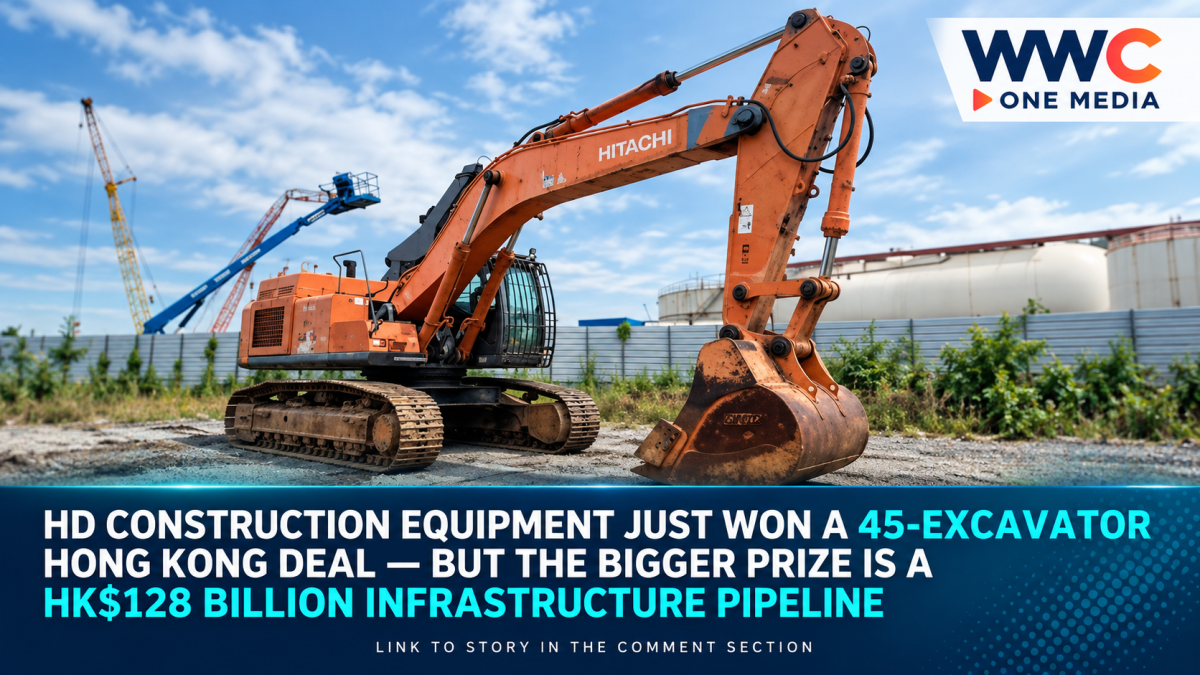
HONG KONG/SEOUL — South Korea’s HD Construction Equipment has landed a 45-excavator order for one of Hong Kong’s major railway projects, giving the newly integrated machinery group a potentially important foothold just as the city ramps up spending on transport, housing and the massive Northern Metropolis development.
The company said Wednesday that it will supply 45 Develon excavators for MTR Corp.’s Tung Chung Line Extension.
The package includes seven 53-ton DX530 excavators and another 38 mid- to large-size machines ranging from 14 to 36 tons.
The financial value of the contract was not disclosed.
But the number of machines tells only part of the story.
HD Construction Equipment says its Hong Kong sales have now reached 75 units in 2026, already its highest annual volume in the market in five years.
And it wants more.
The company is targeting more than 100 units a year in Hong Kong by 2029 as the territory pushes ahead with an enormous infrastructure pipeline.
For HD, 45 excavators could therefore be less important as a one-off sale than as proof that it can rebuild scale in a market where Chinese manufacturers compete aggressively on price.
The machines are heading to one of Hong Kong’s key rail expansions
The excavators will be used on the Tung Chung Line Extension, an MTR project designed to expand rail access across the rapidly developing Tung Chung area of Lantau.
The overall extension comprises two main sections.
The Tung Chung East section involves construction of a new station on reclaimed land and roughly 1.2 kilometers of new and realigned railway track between Sunny Bay and the existing Tung Chung station.
The Tung Chung West section adds another roughly 1.3 kilometers of railway, extending westward from the existing Tung Chung terminus to a new underground Tung Chung West station.
Together, that amounts to about 2.5 kilometers of new railway infrastructure and two new stations.
Construction began in May 2023 and MTR is targeting completion in 2029.
That schedule gives HD several years in which its machines—and potentially additional equipment—could remain relevant to the project.
Why the ground itself matters
The Tung Chung East portion of the railway is being built on reclaimed coastal land.
That creates difficult construction conditions because ground stability and reach can become more important than on conventional sites.
HD Construction Equipment says those conditions are increasing demand for specialized equipment such as long-reach excavators, which can operate farther from the machine body while working in difficult terrain.
The company believes that could create further opportunities for much larger 80-ton and 100-ton excavators as construction progresses.
Those future orders are not guaranteed.
But they explain why HD sees the current 45-machine contract as potentially more than a single delivery.
Getting machines onto a major construction site can give a supplier a reference project, operating data and relationships with contractors—all of which can matter when later tenders arrive.
HD says it beat cheaper Chinese equipment
Perhaps the most strategically significant part of the announcement is who HD says it competed against.
The company said it secured the order despite competition from lower-priced Chinese construction-equipment manufacturers, citing the fuel efficiency of its machines and the strength of its after-sales service network.
That assessment comes from HD itself and should not be treated as an independently verified evaluation of the tender.
Still, it points to one of the biggest challenges confronting Korean heavy-equipment manufacturers.
Chinese machinery groups have expanded rapidly around the world, frequently competing aggressively on price.
For Korean manufacturers, matching the lowest purchase price is not always realistic.
Instead, companies increasingly have to persuade customers that fuel consumption, reliability, maintenance support, resale value and total ownership costs justify paying more upfront.
The Hong Kong order suggests HD believes that argument worked here.
Hong Kong sales have reached 75 machines this year
The scale of HD’s Hong Kong operation is still modest compared with its major global markets.
But the direction is notable.
Including the new order, HD Construction Equipment says it has sold 75 machines in Hong Kong so far in 2026, its strongest annual result there in five years.
Its target is to push annual sales beyond 100 units by 2029 while increasing the range of equipment sold locally.
That is significant because the company says its previous Hong Kong business had been concentrated primarily on compact and midsize machinery.
The MTR order pushes it further into large construction equipment.
That diversification could matter if Hong Kong’s infrastructure boom generates demand for increasingly specialized machines.
And Hong Kong is preparing to spend heavily
That is where the wider story becomes much larger than 45 excavators.
Hong Kong’s government estimates capital-works expenditure of approximately HK$128 billion for the 2026–27 financial year.
It expects spending to remain at roughly comparable levels through the medium-term forecast period as large infrastructure projects accelerate.
That is even higher than earlier government projections.
Hong Kong’s 2025–26 budget had forecast that average annual capital-works spending would rise from a previously estimated HK$90 billion to about HK$120 billion over the following five years.
The 2026–27 budget subsequently lifted the near-term figure to about HK$128 billion.
That distinction matters because the construction-equipment opportunity HD is chasing is not based on one railway alone.
Hong Kong is entering a period of unusually heavy public works expenditure.
Northern Metropolis could be an even bigger prize
One of the biggest drivers is the Northern Metropolis, the huge development area along Hong Kong’s border with mainland China.
The project is intended to transform large parts of the northern New Territories through new housing, transport infrastructure, commercial districts and technology development.
Hong Kong’s government has repeatedly identified Northern Metropolis projects as a major reason capital-works expenditure is increasing.
The scale is enormous.
In Hong Kong’s new five-year development plan announced September 16, the government said the roughly 30,000-hectare Northern Metropolis is ultimately expected to create about 650,000 jobs while accommodating a significant share of the city’s population.
Not all of that investment will require excavators.
But roads, railways, site formation, utilities and new-town construction all represent potential demand for heavy equipment.
That is why HD’s goal of selling more than 100 machines annually by 2029 is closely tied to what happens far beyond the Tung Chung railway site.
Hong Kong is funding infrastructure despite fiscal pressure
There is another important angle.
Hong Kong is increasing infrastructure expenditure even while tightening other areas of public spending.
Its 2026–27 budget calls for roughly HK$128 billion in capital works expenditure and plans annual government bond issuance of between HK$160 billion and HK$220 billion over the next five years.
The government says bond proceeds will finance infrastructure rather than recurrent operating expenditure.
Hong Kong also plans to transfer HK$150 billion from the Exchange Fund to the Capital Works Reserve Fund over two years, supporting Northern Metropolis and other major projects.
That gives construction suppliers something especially valuable: visibility.
Large infrastructure budgets do not guarantee contracts for any individual manufacturer, but they create a relatively predictable pipeline of projects on which machinery suppliers can compete.
HD Construction Equipment itself is only months old
There is another reason this contract carries strategic weight.
The company called HD Construction Equipment in its current form only began operating on January 1, 2026.
HD Hyundai combined the former HD Hyundai Construction Equipment and HD Hyundai Infracore construction-equipment businesses into one organization.
The group retained its two major machinery brands—Hyundai and Develon—while bringing the businesses together under a common corporate structure.
Develon is the brand attached to the 53-ton DX530 excavators heading to Hong Kong.
The merger was designed partly to create greater purchasing scale, combine research and development resources and improve the group’s ability to compete with global rivals.
That makes major overseas contracts especially useful during HD Construction Equipment’s first year as an integrated company.
They offer an early test of whether the larger combined organization can convert scale into actual market gains.
The Chinese competition will not disappear
Winning one project does not fundamentally change the competitive landscape.
Chinese heavy-equipment makers have become formidable global competitors and continue expanding outside China.
Cost is one of their strengths.
HD’s challenge will therefore be proving repeatedly that customers should consider lifetime economics—not only the initial equipment price.
Fuel efficiency matters when an excavator operates for thousands of hours.
Parts availability matters when a machine breaks down in the middle of a major construction schedule.
Service response matters when project delays can cost considerably more than the machine itself.
HD says those factors helped it secure the Hong Kong deal.
The real test is whether it can reproduce that outcome across future projects.
There could be much more machinery to sell
The immediate numbers are straightforward:
45 excavators in the latest order.
75 machines sold in Hong Kong so far this year.
More than 100 annual sales targeted by 2029.
But the more important number may be Hong Kong’s infrastructure budget.
With capital-works spending around HK$128 billion this financial year and Northern Metropolis construction expected to drive investment for years, the territory is becoming a much larger hunting ground for global machinery suppliers.
HD Construction Equipment has now put Develon machines onto one of Hong Kong’s signature railway developments.
Its next challenge is turning that foothold into recurring orders before competitors do the same.
The 45 excavators may be the headline—but for HD, the real prize is the construction boom coming after them.



Leave a Reply