
BUSAN, South Korea — South Korea’s biggest convenience-store networks are no longer fighting only over the best street corners at home. Increasingly, the next battleground is thousands of kilometres away.
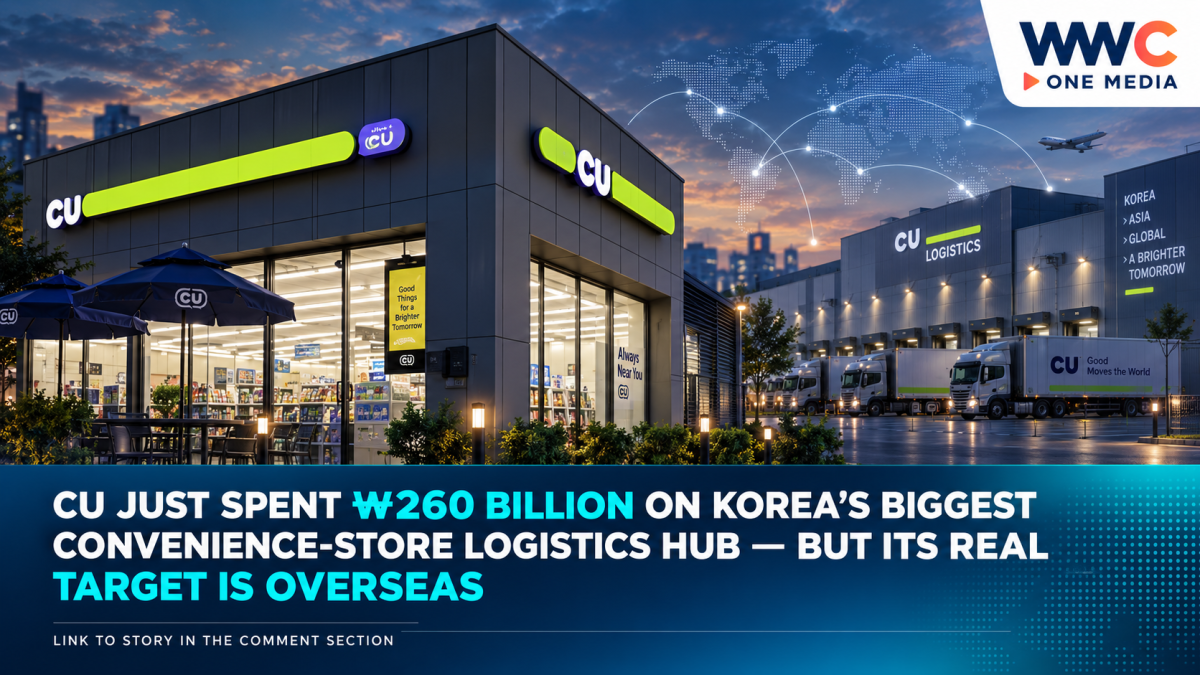
BGF Retail, operator of the CU convenience-store chain, has completed a massive ₩260 billion (about US$190 million) logistics center in Busan, creating what the company says is the largest facility of its kind in South Korea’s convenience-store industry.
The new complex is designed to do two jobs at once.
It will speed deliveries to thousands of CU stores across Busan and the wider Yeongnam region, which includes Daegu, Ulsan and the North and South Gyeongsang provinces.
But its location close to Busan New Port gives the project a much larger purpose: BGF wants to turn it into a logistics gateway connecting its Korean supply chain with a rapidly expanding overseas network stretching from Mongolia and Malaysia to Kazakhstan and Hawaii.
That makes the project more than another warehouse.
It is infrastructure for CU’s attempt to turn the Korean convenience-store model into an export business.
The Numbers Are Enormous
The Busan Logistics Center occupies a site of about 47,187 square metres inside the Busan International Industrial Logistics City in Gangseo District.
Its total floor area is approximately 128,073 square metres, spread across one underground and four above-ground floors. Korean reporting has compared the overall floor space with roughly 18 football fields.
BGF Retail signed an investment agreement with the Busan city government in 2021, broke ground in 2024 and completed construction on July 14, 2026, after roughly two years of work. The official completion ceremony was held on September 16.
The cold-storage section is already operating.
The ambient-temperature operation is scheduled to begin by the end of 2026, meaning the giant facility is not yet running at its full intended capacity.
BGF says the center will function simultaneously as a second central distribution center, a regional logistics base for southern Korea and an import-export hub linked to Busan New Port.
The Final Price Tag Is Higher Than Originally Announced
The project also became more expensive on the way to completion.
When BGF Retail broke ground in September 2024, the company said it planned to invest approximately ₩220 billion in the center.
The final investment announced this week is approximately ₩260 billion.
BGF has not publicly attributed the difference to one specific factor, so it would be premature to describe it as a cost overrun without further disclosure.
What is clear is that the completed project represents BGF Retail’s largest logistics-infrastructure investment to date.
Inside the Warehouse, Automation Does Much of the Heavy Work
The scale is only half the story.
BGF has equipped the Busan facility with automated systems intended to handle an increasingly complicated flow of convenience-store products.
Those include shuttle-based automated storage and retrieval systems, automatic labelers and digital picking systems that help workers locate, replenish, sort and prepare products for shipment.
The company says automation should allow the facility to respond more easily to daily and seasonal changes in shipment volume while reducing repetitive and physically demanding work.
The facility has also received preliminary Grade 1 smart-logistics-center certification from South Korea’s Ministry of Land, Infrastructure and Transport.
For a convenience-store chain, those capabilities matter because the logistics challenge is unusually demanding.
A typical outlet does not simply receive pallets of identical merchandise.
Stores need a constant flow of refrigerated foods, drinks, snacks, ready-made meals, household products and promotional items, often in comparatively small quantities and on tight schedules.
A larger automated hub can therefore affect not just transport costs but whether stores have the right product available at the right time.
There Is a 2,700-MWh Solar System on the Roof
BGF has also built renewable-energy capacity into the facility.
Solar panels installed at the site are capable of producing as much as 2,700 megawatt-hours of electricity annually, according to the company.
That fits a wider trend in logistics, where enormous warehouse roofs offer unusually large surfaces for photovoltaic installations.
The company also expects the center to create local employment, while Busan officials say the investment could strengthen the city’s broader shipping, port and logistics industries.
But BGF’s most strategically important argument for choosing Busan may be geographic rather than environmental.
The port is the bridge between CU’s domestic business and its ambitions overseas.
CU Already Has More Than 850 Stores Outside Korea
Those overseas ambitions are no longer theoretical.
CU entered Mongolia in 2018, becoming the first South Korean convenience-store operator to enter that market.
By June 2026, it had opened its 600th Mongolian store. BGF said in July that there were already more than 600 stores operating there.
The company has since expanded its master-franchise model into Malaysia, Kazakhstan and Hawaii.
By July, reporting based on BGF data put CU’s international network at more than 850 stores, including more than 600 in Mongolia, roughly 180 in Malaysia, more than 60 in Kazakhstan and several in Hawaii.
Just a few months earlier, in April, the chain had 803 international locations.
That was already the largest overseas footprint achieved by a Korean convenience-store brand.
The speed of expansion helps explain why BGF now wants a logistics center positioned beside one of Asia’s major container ports.
As the overseas network grows, BGF increasingly needs to move Korean products and merchandise abroad efficiently rather than treat each foreign market as an isolated operation.
Mongolia Shows Why CU Thinks the Model Can Travel
Mongolia has become the clearest demonstration of the strategy.
CU reached 600 outlets there roughly eight years after entering the country, making it the first Korean retailer to operate that many stores in a single overseas market.
The company has done more than export the CU sign.
It has introduced Korean logistics and IT systems while adapting stores to local consumer habits.
Its 600th Mongolian location, for example, was built as a roadside store roughly 600 kilometres west of Ulaanbaatar and includes showers, EV charging, solar generation and locally sourced food for tourists and long-distance drivers.
BGF has also created dedicated K-beauty areas in some Mongolian stores and has promoted Korean foods ranging from coffee and instant noodles to cream-filled bread.
The result is a model that mixes Korean products with locally adapted convenience retail.
That experience is now informing CU’s wider overseas strategy.
K-Food Is Doing Much of the Heavy Lifting Abroad
The Korean cultural wave also gives CU something most global convenience-store companies do not necessarily have: a ready-made export identity.
According to BGF figures reported by Seoul Economic Daily, Korean products account for around 60 percent of sales at CU stores in Malaysia and 65 percent in Kazakhstan.
In Malaysia, tteokbokki has been among CU’s strongest-selling products.
At CU’s Hawaiian operation, Korean prepared foods such as gimbap, skewers and bakery products have also featured among top sellers.
The chain increasingly presents itself abroad not simply as a place to buy a drink or snack but as a compact K-lifestyle platform offering Korean food, beauty items and retail experiences.
That makes the Busan center important in another way.
If more of those overseas stores depend on Korean-origin products, BGF needs an efficient export pipeline capable of supporting them.
CU Is Already Huge at Home
None of this means the domestic business is shrinking.
CU has more than 18,000 franchised stores in South Korea, according to Yonhap, making its Korean operation vastly larger than its current international footprint.
BGF Retail reported consolidated revenue of about ₩9.06 trillion in 2025.
The Busan hub is therefore still very much a Korean logistics project.
Its immediate job is to improve distribution throughout southern Korea and reorganize deliveries across the Yeongnam area.
What has changed is that BGF is now designing its Korean infrastructure with international expansion in mind.
At the groundbreaking stage in 2024, the company was already describing Busan as a future export base for Mongolia, Malaysia and Kazakhstan.
Hawaii has since joined that network.
Busan New Port Is What Gives the Project Its Global Angle
For overseas growth, the building’s location may ultimately be more valuable than its size.
BGF plans to link the logistics center with Busan New Port, allowing goods moving through the distribution network to connect more directly with maritime import and export routes.
That could shorten the logistical distance between Korean suppliers and foreign CU franchises.
A product moving from a Korean manufacturer to a CU store in Mongolia, Malaysia or another international market requires far more infrastructure than simply opening a shop overseas.
It needs procurement.
Warehousing.
Inventory management.
Export handling.
International transportation.
Local distribution.
And an information system capable of keeping those pieces synchronized.
The Busan center is designed to become one of the places where those domestic and international networks meet.
CU’s Bigger Challenge Is Turning Overseas Stores Into a Scalable Network
Opening 850-plus overseas stores is one achievement.
Building a supply chain that can support thousands would be a different one.
BGF’s international expansion largely uses master-franchise agreements, under which local partners invest in and operate stores while BGF provides the CU brand, operating systems and retail expertise.
That model reduces the need for BGF to own every foreign store itself.
But rapid franchising creates another problem: the larger and more geographically scattered the network becomes, the more sophisticated the supply chain behind it must become as well.
That is why a ₩260 billion warehouse in Busan potentially tells a bigger story than its enormous floor area suggests.
It is physical infrastructure built for what BGF hopes CU will become.
The Real Test Comes After the Warehouse Opens
BGF Chairman Hong Seok-jo said the new center would strengthen CU’s logistics capability, stabilize product supplies and improve franchise competitiveness.
Those benefits can now be tested.
The refrigerated section is already running.
The ambient center is expected to follow before the end of the year.
Then the question shifts from construction to utilization.
Can automation materially improve delivery efficiency across southern Korea?
Can the Busan New Port connection simplify CU’s overseas supply chain?
And as CU moves beyond its current 850-plus international outlets, can one enormous logistics hub help transform a collection of foreign franchises into something closer to a truly regional retail network?
The headline number is ₩260 billion.
But the bigger bet is what BGF hopes eventually passes through the doors.
Leave a Reply