
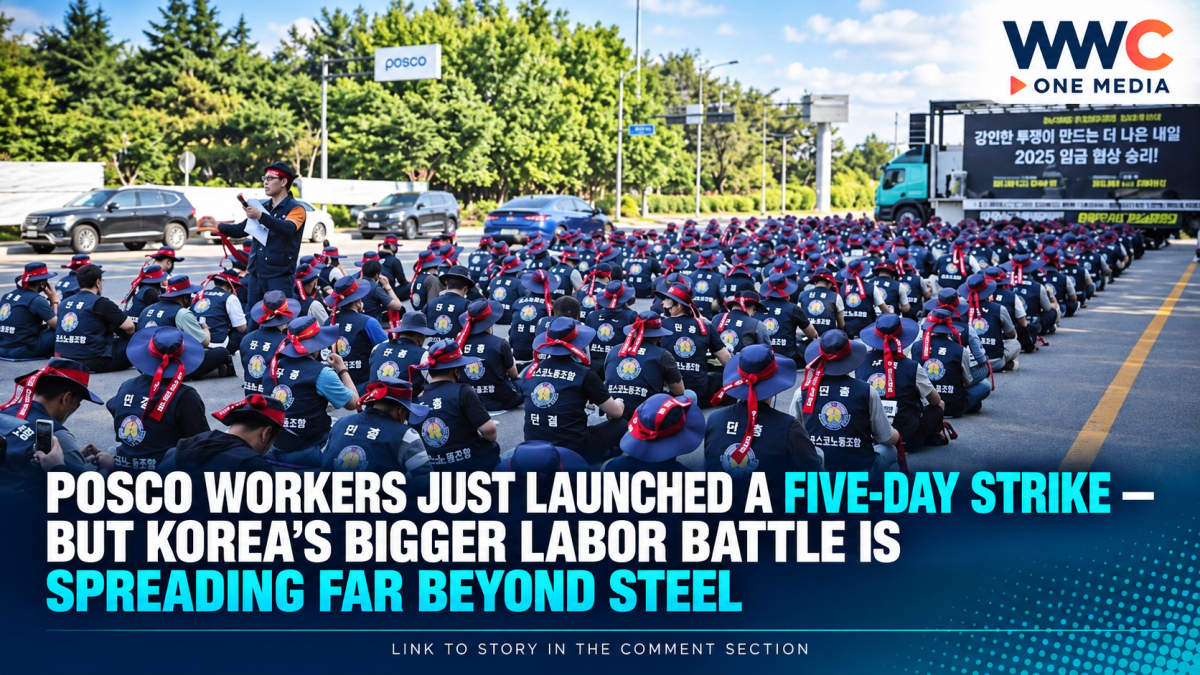
SEOUL — South Korea’s industrial heartland is entering an increasingly tense wage season, with workers at steelmaker POSCO and shipbuilding giant HD Hyundai Heavy Industries escalating partial strikes just as the two companies confront dramatically different business conditions.
POSCO workers began a 120-hour partial strike on Wednesday, September 16, only days after staging the first production walkout in the steelmaker’s 58-year history.
At HD Hyundai Heavy Industries, roughly 8,000 union members were instructed to expand their partial stoppage to seven working hours Wednesday, bringing the action close to a full workday as wage and collective-bargaining negotiations remain unresolved.
The disputes are unfolding for different reasons.
POSCO is trying to contain costs while its core steel business suffers from weak domestic demand and global oversupply.
HD Hyundai Heavy, by contrast, is working through an enormous shipbuilding backlog during one of the industry’s strongest order cycles in years.
Yet workers at both companies are demanding a larger share of compensation—and neither side has yet found a formula acceptable to labor and management.
That makes Korea’s latest strike wave about more than wages.
It is becoming a test of how companies divide gains during a boom—and how much workers should absorb when an industry is struggling.
POSCO’s first strike in 58 years was only the beginning
POSCO’s labor union began its second partial strike at 7 a.m. on September 16, targeting operations at the company’s Pohang and Gwangyang steelworks.
The planned action is scheduled to last 120 hours, or five days, ending Monday.
It follows a 48-hour walkout that began September 9—the first strike affecting POSCO production facilities since the company was established in 1968.
The latest action involves hot-rolling operations at the No. 2 mill in Pohang and No. 4 mill in Gwangyang.
POSCO says it has deployed replacement personnel and that production remains operating normally for now.
Yonhap reported Wednesday that activity around the Pohang steelworks appeared largely normal, with trucks and employees continuing to move through the complex.
The union, however, has said participation could expand and argues that prolonged action could eventually make production disruptions unavoidable.
That difference is important.
There is a strike. There is not yet evidence of a major production shutdown.
What POSCO workers want
The union is seeking a package that goes far beyond a simple salary increase.
Its demands include:
- a 7.1% increase in base salary;
- a performance bonus equal to 600% of monthly base pay;
- 50 POSCO shares per employee; and
- a holiday bonus equivalent to 200% of monthly wages.
The union has also raised concerns about staffing shortages and aging facilities, arguing that those conditions could create safety problems.
Management’s offer is considerably smaller.
POSCO has proposed a 2% base-pay increase, a performance bonus of about 3.5 million won, and 500,000 won in local gift certificates, according to the Korea Herald.
That leaves the two sides far apart.
An eighth round of wage negotiations held Tuesday at POSCO headquarters failed to produce a breakthrough.
The union nevertheless said it could halt the five-day strike early if management produces an acceptable revised proposal.
Why POSCO says it cannot simply pay more
The dispute comes at a difficult moment for the steel industry.
POSCO’s standalone operating profit for the first half of 2026 was approximately 487 billion won, down sharply from the previous year, while its operating margin was only about 2.7%. POSCO’s own financial data show first-half revenue of roughly 18.35 trillion won.
The Korea Herald calculated that operating profit fell 43.3% year on year as weak domestic demand and persistent global steel oversupply weighed on earnings.
Chinese steel capacity remains one of the biggest structural issues confronting producers throughout Asia.
When Chinese domestic demand is weak, excess production can flow into export markets, adding pricing pressure for steelmakers elsewhere.
South Korea’s construction slowdown has compounded the problem at home.
That gives management a straightforward argument: this is not the moment for a large permanent increase in labor costs.
Workers see the situation differently.
They argue that compensation, staffing and safety cannot continually be subordinated to market conditions—particularly at a company that remains one of South Korea’s largest and most strategically important industrial groups.
POSCO Holdings is healthier than the steel business alone
There is another important distinction.
POSCO and POSCO Holdings are not financially identical.
The steelmaking company itself is dealing with weak profitability.
But its parent group has businesses spanning lithium, battery materials, LNG, infrastructure and trading.
POSCO Holdings reported second-quarter consolidated revenue of 19.26 trillion won, operating profit of 819 billion won and net profit of 761 billion won.
The group said results improved from the previous quarter as battery-material and infrastructure businesses strengthened, including record quarterly operating profit at POSCO International.
That broader group performance does not erase the pressure on steelmaking.
But it helps explain why compensation has become such a contentious issue.
Workers can look at the entire corporate group and see recovering profits.
Management can look specifically at the steel operation and see shrinking margins.
Both are describing real parts of the same company.
HD Hyundai Heavy has the opposite problem: too much work to risk delays
At HD Hyundai Heavy Industries, labor unrest is occurring against an almost opposite economic backdrop.
Shipbuilding is enjoying a powerful upcycle.
Korean yards have benefited from demand for LNG carriers, containerships, tankers and increasingly sophisticated low-carbon vessels.
HD Hyundai Heavy secured about US$12.69 billion in commercial ship orders between January and July, already surpassing its full-year target of US$11.47 billion, according to the Korea Herald.
Its commercial-shipbuilding backlog stood at approximately US$42.67 billion at the end of July.
That backlog is good news financially.
But it also means the company has years of ships that customers expect to receive on schedule.
A prolonged labor dispute therefore creates a different kind of risk.
POSCO worries about maintaining profitability.
HD Hyundai Heavy worries about maintaining production and meeting delivery commitments.
Shipyard workers expand their strike to seven hours
HD Hyundai Heavy’s union began its first company-wide strike of this year on September 11, initially stopping work for four hours.
The union repeated four-hour walkouts on September 14 and 15.
Beginning September 16, it escalated the action to seven-hour daily partial strikes, with additional stoppages planned through Friday if negotiations fail to produce progress.
About 8,000 union members were instructed to participate in Wednesday’s expanded action, according to the Korea Herald.
The company and union have continued negotiating even while workers strike.
But despite talks extending late into the evening, there had been no breakthrough by Wednesday afternoon.
What HD Hyundai Heavy workers want
The union is demanding a 149,600-won increase in monthly base pay, a 100-percentage-point increase in bonuses, and a profit-sharing arrangement tied to at least 30% of operating profit, according to the Korea Herald.
Management has offered a smaller increase.
Its proposal includes an approximately 110,000-won increase in monthly base salary, incentives worth 200% of base pay plus 10 million won, and around 500,000 won in gift certificates.
Other welfare measures have also been included in management proposals.
The disagreement is therefore not simply about whether employees receive higher compensation.
It is about how much of the shipbuilding boom should flow directly to workers.
That question becomes more difficult to resolve when employees can point to record or near-record order books.
A booming order book strengthens labor’s argument
Shipbuilders often operate with a delay between winning an order and recognizing the resulting profits.
A ship ordered today may not be delivered for two or three years.
So an enormous backlog does not mean every dollar of that backlog is immediately available as profit.
Management must also account for steel costs, labor, equipment, financing, supplier expenses and the risk of cost increases between contract signing and delivery.
Workers nevertheless see strong orders as evidence that the industry is no longer fighting for survival.
After a long downturn that pushed Korean shipbuilders through years of restructuring, losses and workforce reductions, unions increasingly argue that employees should participate more directly in the recovery.
That dynamic is helping fuel labor disputes not just at HD Hyundai Heavy but across Korea’s shipbuilding sector.
Hanwha Ocean workers are also applying pressure
HD Hyundai Heavy is not the only major shipbuilder facing labor tensions.
Seoul Economic Daily reported that Hanwha Ocean workers have also rejected management’s wage proposal and used a combination of full and partial industrial action.
Its union has raised the possibility of further joint strike activity after the Chuseok holiday.
That broadening unrest matters because South Korea is one of the world’s dominant shipbuilding nations.
Its major yards compete globally in high-value vessels, including LNG carriers, ammonia carriers and sophisticated naval and offshore projects.
Customers typically sign contracts years in advance with specified delivery windows.
If industrial action eventually delays production across several yards simultaneously, the consequences could extend beyond Korea.
Even Korea’s cable industry is joining the labor fight
The unrest is spreading farther still.
LS Cable & System, South Korea’s largest cable maker, is confronting what could become the first strike since its union was established 37 years ago in 1989.
Workers scheduled warning-level industrial action at plants in Donghae and Gumi on September 16 as they push for greater compensation amid booming demand for power infrastructure.
The timing is striking.
AI data-center construction is driving enormous global demand for electricity transmission equipment, transformers, cables and bus ducts.
LS Cable’s first-half revenue reached approximately 4.52 trillion won, while operating profit rose about 44% to 238.4 billion won, according to Seoul Economic Daily.
Workers argue that compensation has not risen enough to reflect that performance.
Management counters that cable manufacturing still produces relatively thin margins and that the company must finance billions of dollars in new factories and overseas expansion.
Again, the same dispute appears in a different form:
Who should receive the benefits of an industry boom—and how quickly?
Korea’s manufacturing wage season is becoming a wider test
Taken separately, POSCO, HD Hyundai Heavy and LS Cable are very different businesses.
Steel faces oversupply.
Shipbuilding faces overflowing order books.
Power infrastructure is benefiting from the global AI investment boom.
Yet their labor disputes share several characteristics.
Workers are pressing for larger permanent salary increases.
They want stronger performance-related compensation.
And unions increasingly argue that years of restructuring, inflation and demanding workloads justify a larger share of corporate earnings.
Companies are pushing back for different reasons.
POSCO points toward deteriorating steel-market economics.
HD Hyundai Heavy must balance compensation against the cost and execution risk attached to its giant backlog.
LS Cable argues that major capital investments and relatively low operating margins limit how aggressively it can raise pay.
Production has not yet been seriously disrupted
Despite the dramatic headlines, there is an important distinction between labor action and industrial paralysis.
POSCO said Wednesday that replacement personnel were keeping the affected production lines operating and that no production disruptions had occurred at that point.
HD Hyundai Heavy likewise had not reported production disruptions significant enough to require public disclosure as of the Korea Herald’s report.
That could change if strikes become longer, involve more workers or expand into additional production areas.
But claims that Korea’s steel mills or shipyards have already been broadly shut down would overstate the evidence.
For now, the strikes are pressure tactics occurring alongside continuing negotiations.
The next few days matter
At POSCO, the 120-hour strike is scheduled to continue through Monday unless labor and management reach an agreement sooner.
At HD Hyundai Heavy, seven-hour partial walkouts are scheduled through Friday while intensive bargaining continues.
And at LS Cable, warning action could become a larger strike if wage negotiations remain deadlocked.
That places several of South Korea’s most important industrial companies in simultaneous labor negotiations immediately before the Chuseok holiday period.
The short-term question is whether those disputes produce revised compensation offers.
The longer-term issue is more consequential.
South Korea spent years restructuring heavy industries, improving shipyard efficiency and adapting its steelmakers to fierce Chinese competition.
Now workers are asking what happens when companies emerge stronger—or, in POSCO’s case, when one business struggles while other parts of the corporate group recover.
One strike is about a downturn. The other is about a boom.
That is what makes the current labor unrest unusual.
POSCO employees are striking while their core industry struggles.
HD Hyundai Heavy employees are striking while their company sits on a multibillion-dollar order backlog.
LS Cable workers are threatening unprecedented industrial action during an AI-driven power-infrastructure boom.
Different industries.
Different balance sheets.
Different business cycles.
But increasingly similar demands.
And if negotiations at these companies continue to stall, South Korea’s next industrial challenge may not be winning enough orders or competing with China.
It may be convincing the workers needed to fill those orders—and keep those factories running—that they are receiving a fair enough share of the outcome.


Leave a Reply