
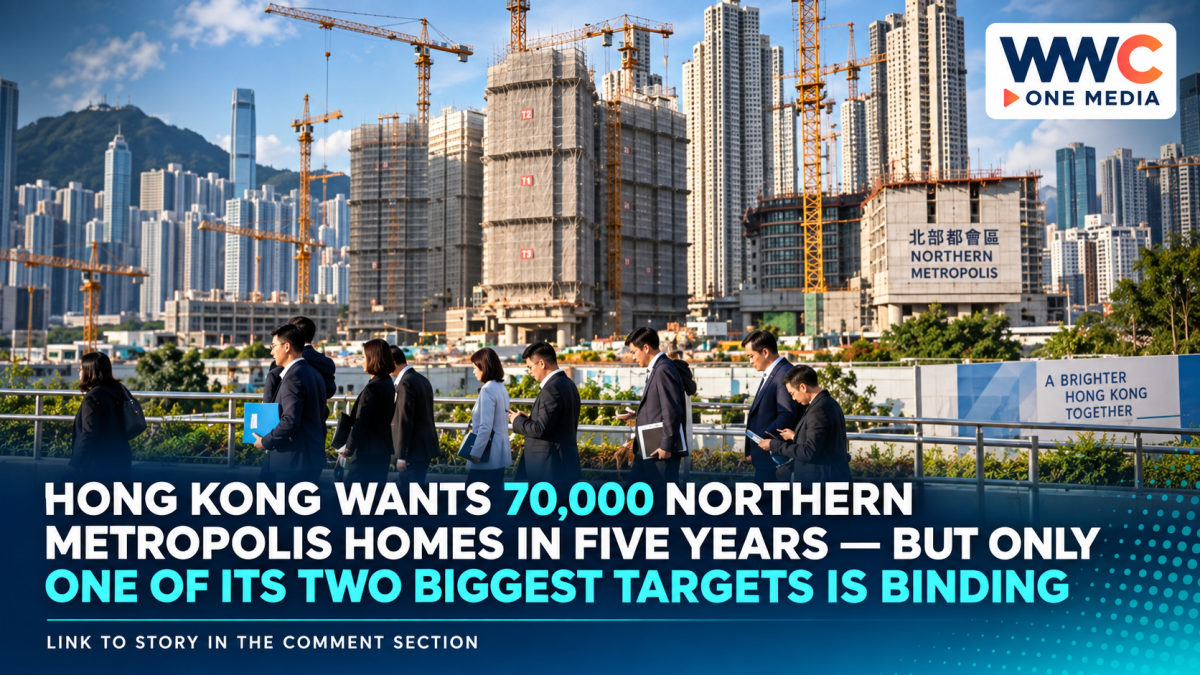
HONG KONG — Hong Kong has put a number on one of its biggest development promises: 70,000 homes in the Northern Metropolis over the next five years, alongside a massive increase in construction-ready land as the city attempts to transform its northern border with Shenzhen into a second economic growth engine.
Chief Executive John Lee unveiled Hong Kong’s first-ever Five-Year Plan for Economic and Social Development on Wednesday, September 16, covering 2026 to 2030 and spanning housing, jobs, technology, finance, healthcare, education and regional integration.
At the heart of the blueprint is the 30,000-hectare Northern Metropolis, where the government wants to accelerate construction of homes while building technology parks, universities, commercial areas and cross-border infrastructure.
But buried inside the headline housing figure is an important distinction.
Hong Kong has made the delivery of 900 hectares of “spade-ready” land a binding target for the five-year period from 2026-27 to 2030-31. The target of completing 70,000 domestic units, meanwhile, is classified as an anticipatory target rather than a binding one.
That means the government has effectively committed itself more firmly to preparing the land than to guaranteeing that every one of the 70,000 homes will be completed within the five-year window.
And that could become one of the most important tests of the entire Northern Metropolis project.
From 11,000 Homes to 70,000
The scale-up envisioned by the government is substantial.
According to the official Five-Year Plan, only about 11,000 domestic units were completed in the Northern Metropolis during the five-year period from 2021-22 to 2025-26.
For 2026-27 through 2030-31, authorities are targeting 70,000 completed units — roughly a 640 percent cumulative increase from the previous five-year period.
Land preparation is supposed to increase even more dramatically.
The government says about 120 hectares of spade-ready sites were available during the previous five-year period. That figure is targeted to jump to 900 hectares over the coming five years, an increase the plan calculates at 750 percent.
“Spade-ready” essentially means land has been prepared to the point where development can proceed rather than remaining stuck at an earlier planning or site-formation stage.
That matters because Hong Kong’s housing problem has never been solely about announcing how many apartments it wants.
The harder question has often been how quickly suitable land, roads, utilities, transport and community facilities can actually be delivered.
The Plan Is Bigger Than Housing
Those 70,000 homes are only one part of what Hong Kong wants to build in the north.
The Five-Year Plan says authorities intend to make enough land available for more than 70,000 housing units and around one million square metres of economic floor space over the coming five years.
The Northern Metropolis is also being positioned as a centre for:
innovation and technology, universities and research, advanced industries, cross-border commerce and new residential communities. The government specifically identifies the Northern Metropolis University Town, San Tin Technopole and the Hong Kong-Shenzhen Innovation and Technology Park in the Loop as major components of the strategy.
Hong Kong also wants to strengthen technology links with mainland China in areas including artificial intelligence, robotics, microelectronics, healthcare technology, new energy, advanced manufacturing and new materials.
The underlying idea is to change Hong Kong’s traditional development pattern.
For decades, much of its financial and commercial power has been concentrated around Hong Kong Island and Kowloon.
The government now describes its strategy as a “South-North Dual Engine” — finance in the traditional urban south and innovation and technology increasingly concentrated in the north near Shenzhen.
Eventually, the Northern Metropolis Could House 2.5 Million People
The long-term vision is vastly larger than the first five-year target.
Hong Kong first formally unveiled its Northern Metropolis strategy in 2021. At full development, authorities have said the area is intended to accommodate about 2.5 million people while creating roughly 650,000 jobs.
The project also includes plans for three university campus sites, reinforcing the government’s aim of connecting higher education with research, technology companies and industry.
That means the development is effectively being designed as far more than another cluster of housing estates.
Hong Kong wants it to function as a new urban and economic centre in its own right.
And that is precisely why simply hitting the apartment target will not be enough.
Hong Kong Wants Bigger Homes Too
The Five-Year Plan also addresses a problem familiar to many Hong Kong households: living space.
Rather than focusing solely on the number of apartments constructed, the government says it will progressively improve the mix of public housing flats and increase the proportion of larger subsidised-sale homes.
For new private residential developments in the Northern Metropolis, authorities also plan to raise unit-size requirements, with the stated aim of increasing average living space per person.
That marks a notable shift in emphasis.
The policy is not simply to fit as many apartments as possible onto new land, but to use the Northern Metropolis to create conditions for somewhat more spacious housing than is common in Hong Kong’s dense urban districts.
Financial Secretary Paul Chan said in July that the new communities were also being planned around a “15-minute living circle”, where many everyday needs should be reachable within roughly a 15-minute walk or bicycle ride. He said public open-space provision in the Northern Metropolis was planned at 3.5 square metres per person, around 30 percent above the existing city-wide standard.
A 70,000-Home Target Gives the Project Something It Previously Lacked
The housing number is significant for another reason: it provides a measurable benchmark.
Jason Leung, assistant research director at the Our Hong Kong Foundation, told RTHK in July that earlier discussion of the Northern Metropolis had often lacked concrete performance indicators.
He said the 70,000-unit target gave residents and businesses a clearer picture of what the development should look like by around 2030.
But Leung also highlighted the other side of the equation.
Housing needs to arrive with schools, hospitals and other community facilities, he said, particularly as the first residents have already begun moving into development areas such as Kwu Tung North and Fanling North.
Without those services, a housing target can be achieved on paper while producing communities that are considerably less attractive to people asked to relocate there.
Transport May Be One of the Hardest Pieces
The Northern Metropolis sits directly beside Shenzhen, making cross-border connectivity one of its biggest potential advantages.
Hong Kong is pushing ahead with projects including the Northern Link, connections to the new Huanggang Port and the Hong Kong-Shenzhen Western Rail Link. The Five-Year Plan also calls for studying a southern extension of the Western Rail Link toward Hong Kong International Airport.
But some of the most important transport infrastructure extends well beyond 2030.
Under previously announced government schedules, the Northern Link Main Line is targeted for completion in 2034, while the Northern Metropolis Highway’s San Tin section has been targeted for 2036.
That illustrates one of the project’s fundamental timing challenges.
Thousands of people and businesses could begin moving into northern development areas before every major transport link envisioned for the finished metropolis is operating.
Recent SCMP reporting has also highlighted practical concerns around cross-border journeys and infrastructure coordination, including lengthy travel between technology centres in Shenzhen and existing Hong Kong research locations.
The Government Is Also Trying to Get Businesses to Move North
Homes alone cannot create a second economic centre.
Businesses must be willing to locate there.
That is why the government is experimenting with new development models intended to bring private capital and industries into the Northern Metropolis earlier.
The Five-Year Plan calls for public-private partnerships, new industry-park companies, more flexible land use and a “Pay for What You Build” pilot scheme intended to lower initial development costs and encourage investment.
Authorities are also working on dedicated Northern Metropolis legislation aimed at streamlining development procedures. Earlier this year, Development Secretary Bernadette Linn said the government wanted the legislative process completed before the end of 2026.
The commercial side may prove just as important as the housing side.
Ahead of the Five-Year Plan announcement, analysts and observers cited by the South China Morning Post said a key challenge would be convincing businesses to make long-term commitments to a project whose full development could take many years.
Why Hong Kong Is Issuing a Five-Year Plan Now
The document itself is a major policy change.
Hong Kong has long issued annual Policy Addresses, but the 2026-2030 blueprint is the city’s first locally formulated five-year economic and social development plan.
It follows China’s national 15th Five-Year Plan and is explicitly designed to align Hong Kong more closely with national development strategies and the Guangdong-Hong Kong-Macao Greater Bay Area.
Lee said before the launch that Hong Kong’s Five-Year Plan should not be interpreted as a switch to a planned economy. He described it instead as a strategic blueprint establishing priorities and targets that annual policies would then implement.
That distinction is reflected in the plan itself.
Its indicators are divided into “binding” targets, which the government says must be met, and “anticipatory” targets, representing objectives authorities intend to pursue.
For the Northern Metropolis, the difference is particularly revealing:
900 hectares of spade-ready land: binding.
70,000 completed homes: anticipatory.
The Real Test Begins With Delivery
On paper, the numbers are enormous.
Hong Kong wants seven times as much spade-ready land as it produced in the previous five-year period, tens of thousands of new apartments, a million square metres of economic space, new university campuses and an innovation corridor tied increasingly closely to Shenzhen.
Over the much longer term, the Northern Metropolis is supposed to become home to millions of people and hundreds of thousands of jobs.
The Five-Year Plan therefore gives Hong Kong something the megaproject previously lacked: a clearer scoreboard.
By 2030, residents will be able to count the homes completed.
Businesses will be able to see how much industrial and commercial space actually materialised.
And the government’s own binding target will make it possible to measure whether 900 hectares of development-ready land really arrived.
The headline may be 70,000 new homes.
But the larger story is whether Hong Kong can turn an enormous tract of the northern New Territories into a functioning second urban and economic centre — with jobs, transport, schools, hospitals and businesses arriving quickly enough to match the housing.




Leave a Reply